

“I hold that while man exists it is his duty to improve not only his own condition but to assist in ameliorating mankind.” Abraham Lincoln on Man’s Responsibility.
From the series Great Ideas of Western Man – Herbert Bayer. Wikioo.
Do you think we owe it to others to be better than we are? Have we a responsibility to improve ourselves, and thus, improve the world? Or do we just live for ourselves? These are knotty questions……
 Anna Ancher – Sunlight in the Blue Room. 1891. Wikimedia Commons.
“Service to others is the rent you pay for your room here on earth. “
Mohammad Ali
- Do We Have A Responsibility To Others?
What, if any, is our responsibility to others in the world, and to the world itself? Responsibility is a big word, encompassing many aspects of our life here on earth. Perhaps we have a responsibility to be authentic, true to ourselves? This is not easy…..
“Responsibility to yourself means refusing to let others do your thinking, talking, and naming for you; it means learning to respect and use your own brains and instincts; hence, grappling with hard work.”
Adrienne Rich
Some would say we owe the world something; the fact we have had the chance of life is so wonderful that we need to show our gratitude through becoming better and better people.
“You only get one life. It’s actually your duty to live it as fully as possible.”
Jojo Moyes, Me Before You
 I Give My Little Stars to Children – Maria Primachenko. Wikioo.
“Everybody, every human being has the obligation to contribute somehow to this world.”
Edith Carter
This is a moral obligation; it is sometimes, but certainly not always, linked to religion, depending on your beliefs and ways of thinking.
“All religions try to benefit people, with the same basic message of the need for love and compassion, for justice and honesty, for contentment.”
Dalai Lama
“We don’t need any sort of religious orientation to lead a life that is ethical, compassionate & kind.”
Sharon Salzberg
There is an ‘ought’ implicit here, and, as a therapist I do not usually deal in ‘oughts’ or ‘shoulds.’ It would appear to me, however, that the real value of our existence in the world is dependent on us being there for others.
“The worth of a human being lies in the ability to extend oneself, to go outside oneself, to exist in and for other people.”
Milan Kundera
“The purpose of human life is to serve, and to show compassion and the will to help others.”
Albert Schweitzer
- If These Statements Are True, How On Earth Can We Improve Ourselves? Are There Any Rules?
Change and growth are important if we are to have fulfilling lives, to be a part of meaningful and satisfying relationships, and become our best selves. We can improve ourselves through gaining self-awareness, practising self-care, focussing on being kind, compassionate and empathic to others’ needs as well as our own, through learning about ourselves and the world and surrounding ourselves with people who are empathic to us.
Max Craig Kusovtsky on Twitter (@psychicsherpa) made a point to me about one of my quotations; he commented that it “reminded him of Karen Horney speaking to the moral obligation of evolving from neurosis to human growth. Should we be aware that as we’re alive we OUGHT to improve ourselves?” His Tweet prompted me to write this post, so thank you Max!
Karen Horney’s view, in her book Neurosis And Human Growth; The Struggle Toward Self-Realisation (1959) was that the development of our ‘real self,’ of self-realisation, is crucial for us all, in order for us to be fulfilled and to be able to benefit ourselves AND the world.
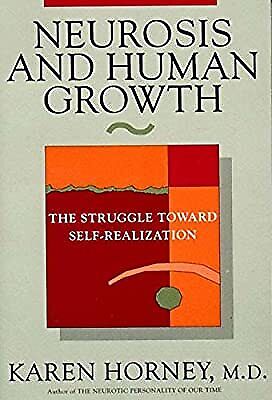
“If you want to be proud of yourself, then do things in which you can take pride.”
Karen Horney
Whatever we do for others, no matter how small, is meaningful and important. Aiming to carry out some random acts of kindness every day, enables us to feel good, as well as helping other people.
However, there is no blueprint for how to improve ourselves. We have choices….
“Integrity has no need of rules.”
Albert Camus
What did Camus mean by this statement? My interpretation is that he is saying that if we possess real integrity, we will not need external laws and regulations, we will know how to be in the world from knowledge and awareness inside ourselves.
Camus is referring to the fact that we all need to take responsibility on a personal level for how we act in the world, rather than having to obey external standards and rules.
“Loving kindness is greater than laws; and the charities of life are more than all ceremonies.”
The Talmud.
The humanist approach regards every person as undergoing a process of becoming and self-improvement; it is a progressive attitude to life and personal development which believes that….
“….we owe it to ourselves and others to make it the best life possible for ourselves and all with whom we share this fragile planet. A belief that when people are free to think for themselves, using reason and knowledge as their tools, they are best able to solve this world’s problems.”
The Humanist Society of Western New York.
The philosopher Immanuel Kant felt that we have a duty not to treat others as a means to an end; that is, we should avoid using other people for our own needs. He argued that we should always treat humanity as ‘….an end in itself.’
This approach demands that we be self-aware; Kant saw humans as rational autonomous agents, and believed that not working to improve oneself would be to abuse this autonomy.
He felt that, having the unique gift of consciousness, we have an obligation to continually improve ourselves, to work at becoming better people and to help others in the process. Without this, our lives would be full of immorality, dysfunction and unhappiness and we would create suffering for ourselves and others.
Kant also argued that by acting dutifully, respectfully and morally to others, such attitudes will spread and ripple out to those around us; in this way we will be making good use of our time on earth, using and developing our consciousness as fully as we can.
The cognitive psychologist and psycholinguist Steven Pinker would no doubt agree with Kant’s view; he regards our appreciation of the gift of consciousness as giving real meaning to life:
“Nothing invests life with more meaning than the realisation that every moment of sentience is a precious gift”
Steven Pinker, The Blank Slate: The Modern Denial of Human Nature
 Frederick George Cotman – One of the Family. 1880. Wikimedia Commons.
“The meaning of life is to perpetuate life,
to increase knowledge, wisdom, and beauty,
and to maximize the flourishing and minimize the suffering of sentient beings.”Steven Pinker.
- Inspiring Others..
“Life is not accountable to us. We are accountable to life.”
Denis Waitley

Inspiration – Marc Chagall. Wikioo.
“You get one life. Live it in a way that it inspires someone.”
Robert Kiyosaki
Why should we be inspiring to others? Surely we have a choice to dodge this, to feel that it is someone else’s responsibility, to cop out, to pass the buck?

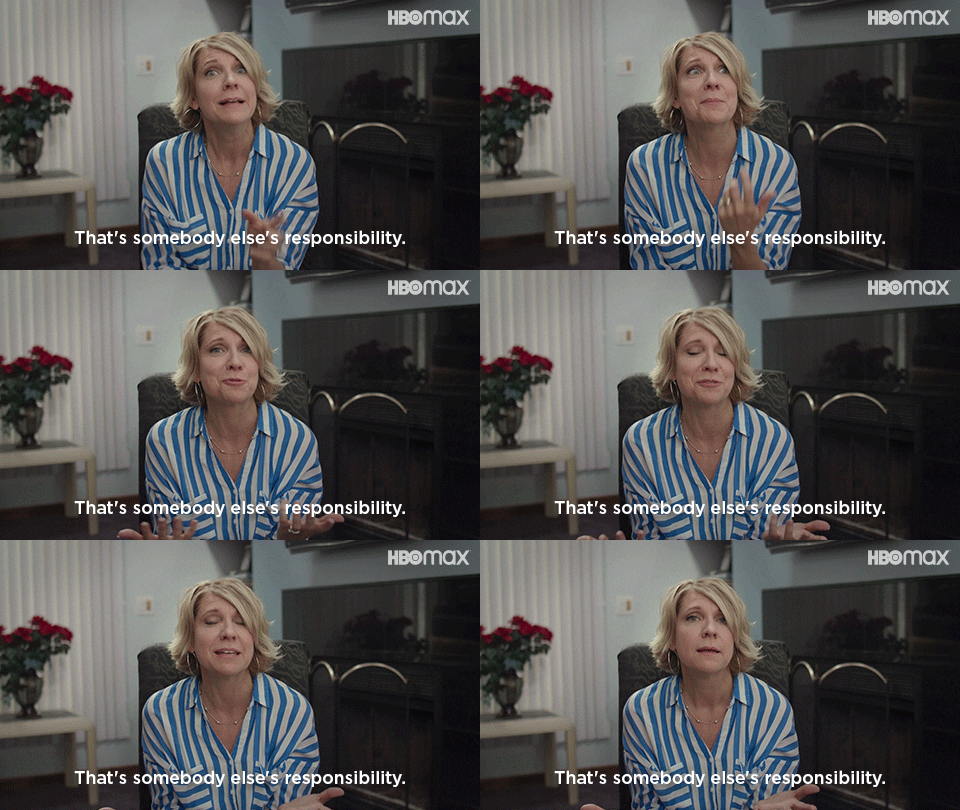
“People are more inclined to pass the buck than they are to take responsibility. The fact is, though, passing the buck doesn’t build your character or give you the opportunity to learn from your mistakes.”
Marshall Goldsmith
Being an inspiration to other people is important in terms of fulfilling our obligations in life and improving ourselves at the same time. Inspiring others, through our actions and our words, modelling productive and thoughtful behaviour, are ways of spreading our influence for the benefit and learning of other people around us, whether at home or at work.
“Be the most ethical, the most responsible, the most authentic you can be with every breath you take, because you are cutting a path into tomorrow that others will follow.”
Ken Wilber

A Helping Hand. Image depicts a child coming to the aid of another in need. Once we have climbed it is essential for the sake of humanity that we help others do the same. It is knowing that we all could use, and have used, a helping hand. Paessagio. Wikimedia Commons. 2016.
In 1923, Eglantyne Webb, founder of The Save The Children Fund, drew up ‘The Declaration Of The Rights Of The Child.’ One of her main points in this declaration was:
“The child must be brought up in the consciousness that its talents must be devoted to the service of its fellow men.”
She was emphasising the importance of raising children to be aware of their obligation to others, using their skills to help people.
- Developing The Freedom To Be Oneself…
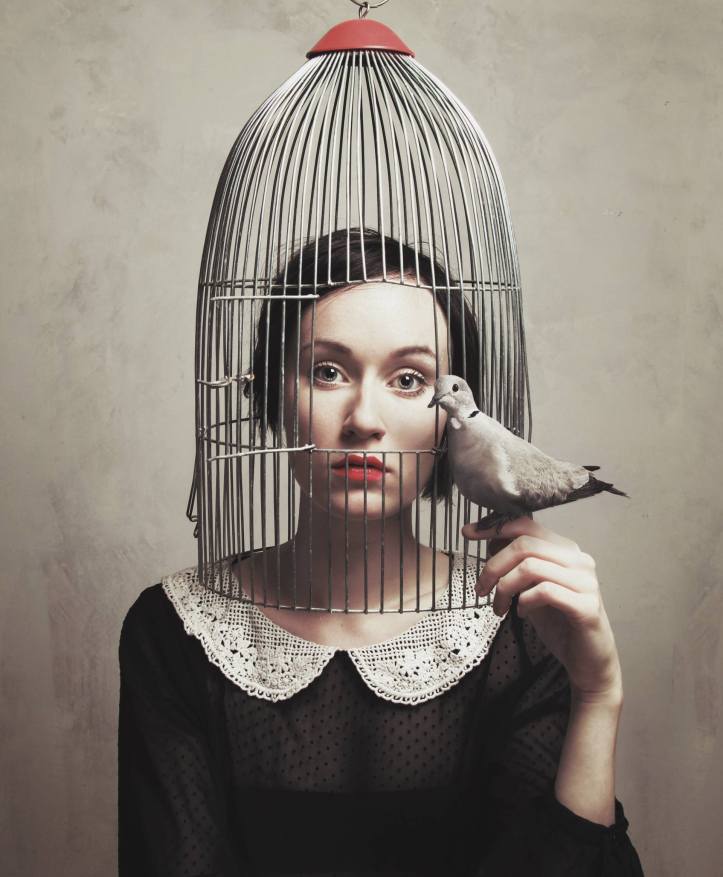 Flora Borsi. Subective Freedom 1. Flickr.
“Most people do not really want freedom, because freedom involves responsibility, and most people are frightened of responsibility.”
Sigmund Freud
There is a barely hidden imperative in Freud’s statement about freedom and responsibility here, which can serve as an answer to my question above about passing the buck…
Freud is saying that we cannot have freedom without taking responsibility in life.
This is the freedom to be oneself, as I have mentioned, and it starts with us, risking being in the driving seat of our own lives, rather than waiting for others to lead or guide us. We can be an active force, rather than passively waiting for something to happen. This is the freedom to choose our own path, whilst becoming aware of and facing the fact that all our choices have consequences.
 Looking Within. Kelly Birkenrith. 2019. Gandalf’s Gallery. Flickr.
“I can do nothing for you but work on myself…you can do nothing for me but work on yourself!”
Ram Dass, Be Here Now
“Grace has been defined as the outward expression of the inward harmony of the soul.”
William Hazlitt
- The Obligation To Improve Ourselves For Others In Relationships.
 The Joy of Life – Paul Delvaux. Wikioo.
“Life will bring you pain all by itself. Your responsibility is to create joy.”
Milton Erickson
“When we love, we always strive to become better than we are. When we strive to become better than we are, everything around us becomes better too.”
Paulo Coelho
We do have a duty to continue to improve ourselves in a relationship, both for ourselves and our partner. If we remain static and unaware of the effects we are having on the other, refusing to change and sticking to old patterns of behaviour, then the relationship is likely to become stale and full of resentment and pain. Willingness to change for the other person is very much a sign of love and respect.
‘We repeat what we don’t repair.’
Christine Langley-Obaugh
Relationships need work; inevitably, being in a relationship revivifies past unworked through issues. Understanding the links between past and present and how past experiences affect the present in terms of behaviour, feelings and ways of relating to others can be a very important part of the process of change.
Patterns of behaviour that may be adversely affecting our lives and relationships can be unconsciously repeated unless they are identified and brought into awareness. These patterns will be recognised and explored in psychotherapy.
To end this post, I will leave you with some thought-provoking quotations and images about the importance of taking responsibility to bring light to your own world and that of others.
 Rosy Light – Friedrich Julius Oskar Blümner. Wikioo.
“We must… We must bring our own light to the darkness”
Charles Bukowski

Couple with Light – Alphonse Maria Mucha. Wikioo
“Life will bring you pain all by itself. Your responsibility is to create joy.”
Milton Erickson
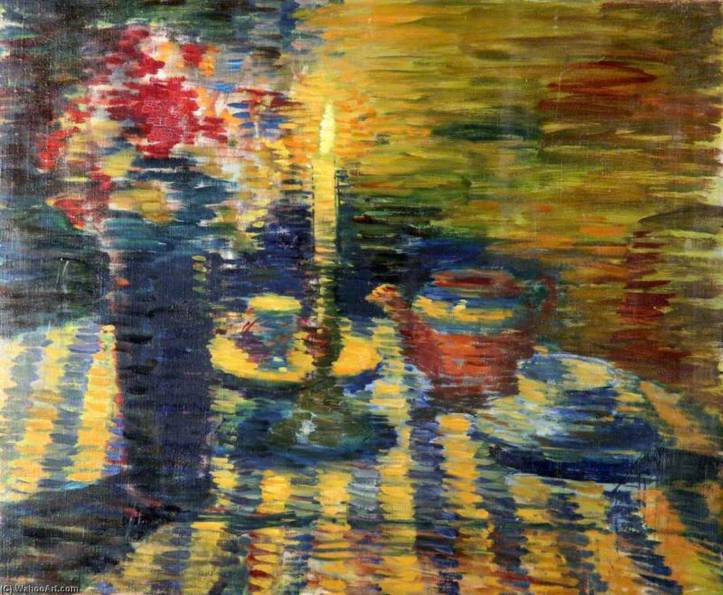
Still Life with Candle – (Evan Walters)
“As far as we can discern, the sole purpose of human existence is to kindle a light in the darkness of mere being.”
Carl Jung
************
I gratefully acknowledge the help of my philosopher grandson, Ben, in formulating aspects of this post.
© Linda Berman.
 waysofthinking.co.uk