
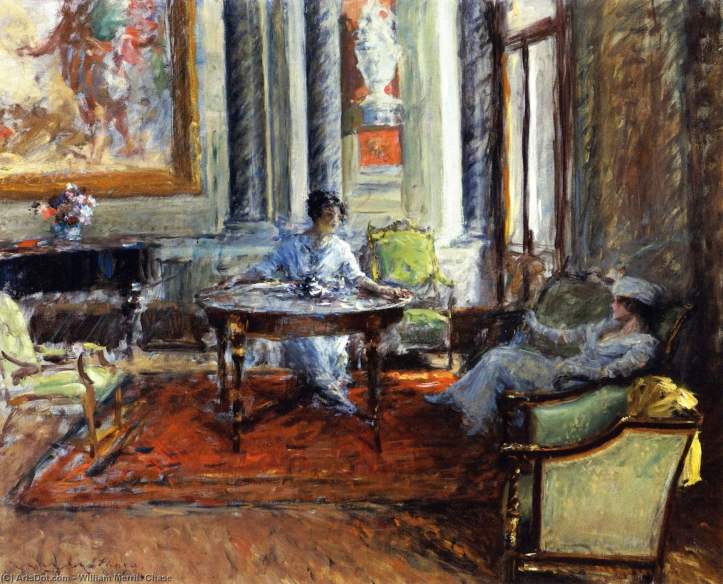
 Friendly Advice – William Merritt Chase. 1913. Wikioo.
“I always advise people never to give advice.”
P.G. Wodehouse
- Not Allowing Others To Learn From Their Mistakes.
Learning from one’s own mistakes, in an atmosphere that is accepting, therapeutic and facilitative, is the best way of working towards real change and insight.
A popular view of therapy is that it involves advice, or it is concerned with ways of managing stress, teaching, recommending books, thinking positively, reassurance, and so on. This is (or should be) a total myth, misleading and wholly inaccurate. Such advice is widely available in families, friendships and so forth; it has no place in psychotherapy.
Psychotherapy involves considerable sensitivity and empathy on the part of the therapist and the ability to ‘stand back objectively,’ and ‘be there,’ with and for the patient, waiting in an empathic silence until something emerges.
“Never miss a good chance to shut up.”
Will Rogers
If therapy begins to spill over into the solution-offering or advice-giving kind of interaction, it becomes unhelpful, and potentially damaging.
“… it is natural to want to demonstrate our competence, to show our patients that we have something to offer. This inclination can get in the way of maintaining enough reserve to let people make their own discoveries and come up with their own solutions to the problems in their lives.”
Nancy McWilliams, Psychoanalytic Psychotherapy: A Practitioner’s Guide
‘Rescuing’ a distressed patient is something to be resisted, for this is not respecting the patient’s autonomy, independence and ability to learn to comfort themselves or find their own way. It verges on infantilising the other.
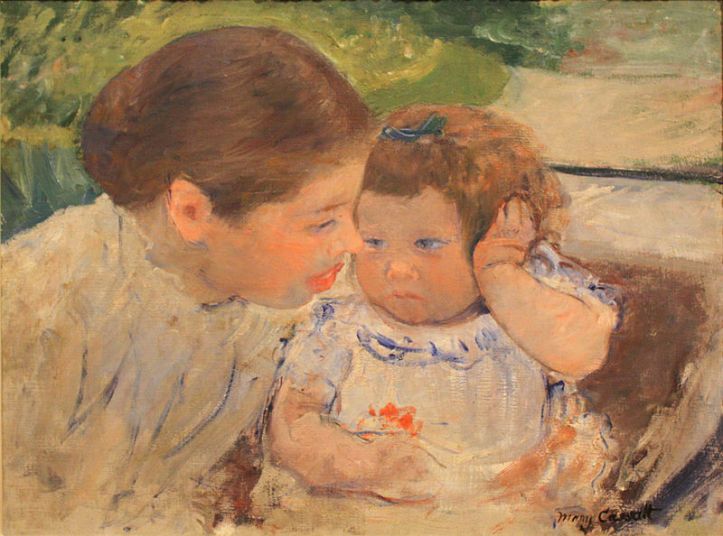 Mary Cassatt – Susan Comforting the Baby No. 1 (c. 1881). Wikimedia Commons.
Allowing a patient to come across their own path will mean that they will experience the joy and freedom of discovery, rather than being a meekly infantile receiver of someone else’s suggestions.
 Path Through the Mountains – William Trost Richards. 1858. Wikioo.
“To find a mountain path all by oneself gives a greater feeling of strength than to take a path that is shown.”
Karen Horney
Such discovery enhances confidence and, as Horney says, gives strength. Constantly needing to reassure, comfort or over-validate the patient is not encouraging them towards autonomy and independence, which is what all therapy needs ultimately to be about. In addition, asking several questions of the patient can appear interrogational and attacking, not exploratory or conversational, as a therapist’s approach needs to be.
Offering exercises and tasks set by the therapist can also be a way of colluding with the patient’s need to avoid real issues. Therapy is not about reassurance; one might wonder, at times, whether a therapist who over-comforts is doing this to reassure themselves…
Of course, we always need to bear in mind transference and counter-transference issues, and to explore whether our parental behaviour is our own issue or a reaction to the patient seeing us as a figure from their past.
It is also important to remember that a non-judgemental, accepting and empathic stance on the therapist’s part is, in itself, a precious kind of comfort; it is not an approach that many patients have ever experienced before. Being listened to and really heard is also a valuable way of helping others and the skills involved in this should not be under-estimated in terms of their immense therapeutic value.
- Not being able to stay with pain…
 Quiet Garden – Jean Warin. Wikioo.
“When someone is going through a storm, your silent presence is more powerful than a million, empty words.”
Thema Davis
A therapist who can be there for the patient, staying in the now, without pressurising or intruding at inappropriate times, who is willing to wait with the patient for feelings and memories to surface in their own time, will be a strong, facilitating presence. The therapist can, indeed, create a ‘quiet garden’ for the patient, rather than a noisy verbal intrusion, especially when people are distressed.
Our ‘silent presence ‘ is crucial to our work as therapists. It is a great relief for the patient when we can stay with their pain, quietly accompanying them on their very difficult and sometimes painful journey into the self.
Rather than attempting to ‘pull out’ the person from dark emotional places, perhaps the therapist can be emotionally there with them, even for a few seconds, no matter how dark and scary it feels.
As therapists, we need to maintain awareness of the nature of our own presence. Do we have an aura of warmth, compassion, containment and empathy when we enter or leave a room, and is this maintained during the process of therapy?
- Not being aware of interactional nature of issues in couple therapy
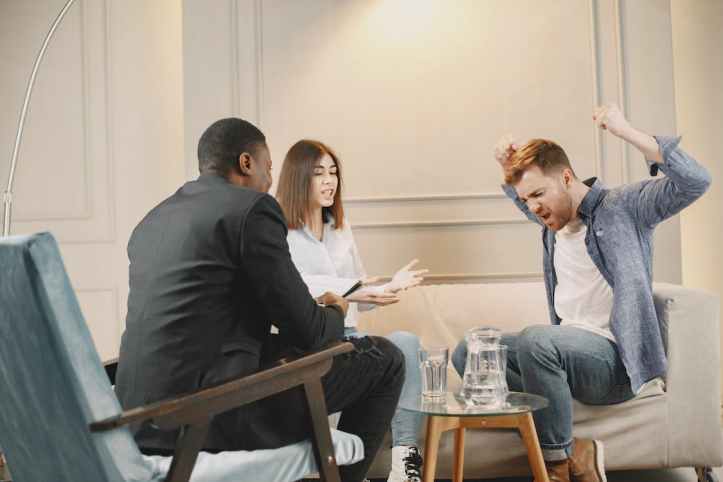
‘The test of a first-rate intelligence is the ability to hold two opposed ideas in mind at the same time and still retain the ability to function.’
F. Scott Fitzgerald
In everyday life, when there is marital strife, separation or divorce, other people have a tendency to opt for one side or another, choosing to ignore the fact that the world, relationships, and life, are just not that simple.
Couples therapy, however, involves the therapist constantly keeping two opposite, contradictory views in mind at the same time. This is a difficult task; however, if we are able to do this, the rewards are manifold, in life and in therapy. Such thinking is surely situated at the heart of therapy.
In actuality, marital breakdown is about two people; it is an interaction. Even though it might appear as if one partner is ‘at fault,’ that partner is always unconsciously expressing something for the other.
“We marry our unfinished business.”
Lori Gottlieb
Unconsciously, we select a partner whom we hope might complete us, who might be able to help us find parts of ourselves long hidden in the depths of our unconscious mind. With an analytical eye, it is usual to find considerable similarity of experience in both partners’ pasts, even though it all might look quite different on the surface.
“Love is the longing for the half of ourselves we have lost.”
Milan Kundera
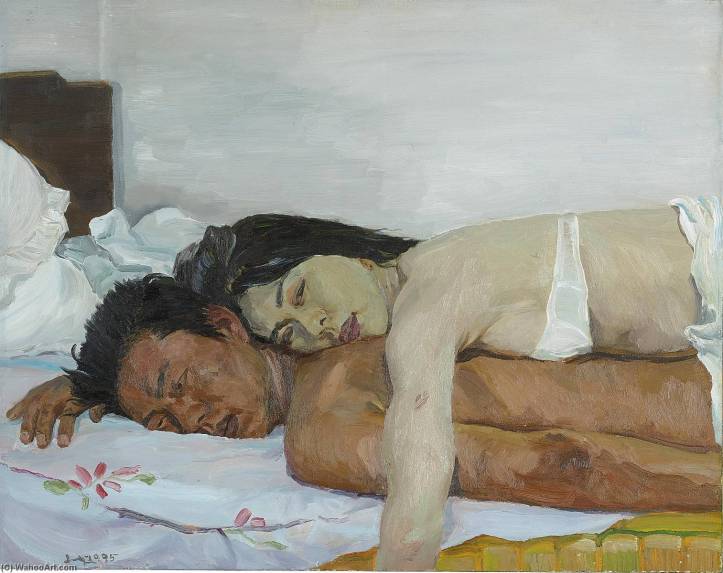 Love – Liu Xiaodong. 1995. Wikioo.
“We do not choose others at random. We meet those who already exist in our unconscious.”
Sigmund Freud
The above quotation helps us focus on the role of our unconscious mind in partner choice; it is, truly astonishing how, at a deep level, we know what we need to help and heal ourselves. We unconsciously choose loving partners who can complement and complete us. What does this mean?
We choose our partner on many levels. Whilst we may at a conscious level look for people who attract us and have similar interests and outlook on life as ourselves, the actual choice is also partially unconscious.
Our partner selection process will inevitably be heavily influenced by our past relationships with parents or caregivers. We all have unmet needs from childhood, powerful bonds that link us to past figures in our life and that keep us fixed in old patterns and ways of relating to others.
We are attracted to another because we unconsciously share some of the same unresolved issues and are stuck at a similar point in terms of emotional development. In Chapter 6 (pp122ff) of my book Beyond The Smile: The Therapeutic Use of The Photograph (Routledge), I explain the process further:
“Such unmet needs from early life will be awakened in marriage, in an unconscious attempt to use the opportunity to work through the problems associated with them. The hope is that each partner has chosen the other in order to recreate the shared past problems and thus work through them- for one cannot work through a problem without going into it again. But, in this way, marriage can also mean that the partners become desperately trapped in the problems once more.”
Linda Berman.
The couple represent two parts of a whole; they created the entity of the marriage and they both have a part in its demise. Apportioning blame to one partner or another represents a way of thinking that is limited and incomplete. It is the product of a one-sided mindset, a way of thinking that cannot recognise the validity of two different viewpoints. The result is half-truths and biased versions of reality, which are certainly not the stuff of therapy.
Therapists who feel drawn to one side or another will need to take a long, hard look at their own inner world, working at understanding their biases and their pre-conceived ideas. Interaction is the keyword, consciously and unconsciously.
‘My experience with couples in conflict over divergent subjective experiences inspired what I call the “You’re Both Right Intervention”: The therapist points out that while both people seem to assume that there can be only one correct way to see a situation, in fact, both can be simultaneously correct. When making this postmodern point, I mention a situation, familiar to all, of two people reacting very differently to the identical movie.’
(Nielsen)
Partial ways of thinking have their roots within our own minds, acknowledging only one side of ourselves and denying the existence of the ‘bad’ side. Jung called this our ‘shadow’ side, a part of us all:
‘Everyone carries a shadow and the less it is embodied in the individual’s conscious life, the blacker and denser it is.’
Jung’s shadow refers to the darker parts of the personality of which we tend to be unaware. As therapists, we need to be cognisant of the fact that, if one or both of the partners in couple therapy remains in denial about the existence of their own shadow, they will tend to project that darkness onto the other. This is exactly what happens in troubled relationships.
Such paranoid ways of thinking involve unconscious projection onto the other of unwanted or unacceptable fears. This involves the mechanism of splitting, of black and white thinking, where the world is divided into people who are wholly good, and utterly bad.
Condemnation of another as dishonest, grasping or lazy might, for a short time at least, leave the person feeling smugly virtuous. However, the negative feelings inside, unresolved and ignored, will return, ready to be projected out onto some other unwitting victim.
Then they are unable to see the self in the other, cannot recognise that the other partner has, for example, vulnerable child-like feelings inside. Often, when seeing couples, I have found that, if they can be helped to see the child within the other, they begin to take back some projections and recognise more of the whole person in each other.
Thus, instead of regarding the other as all bad and the self as good or faultless, we might help the couple pause a moment to look at how easy it is to denounce another, rather than to admit that all is not perfect inside oneself.
The Spanish proverb ‘An optimist is a person who has a depressed friend’ illustrates my point perfectly. It is easier to deny one’s own pessimism if one can focus on another’s depression or misery.
Helping a couple become aware of, and then slowly take back, their projections onto the other, is a large part of the work of couple therapy, from a psychoanalytical point of view.
- Applying technique across the board: going by the book
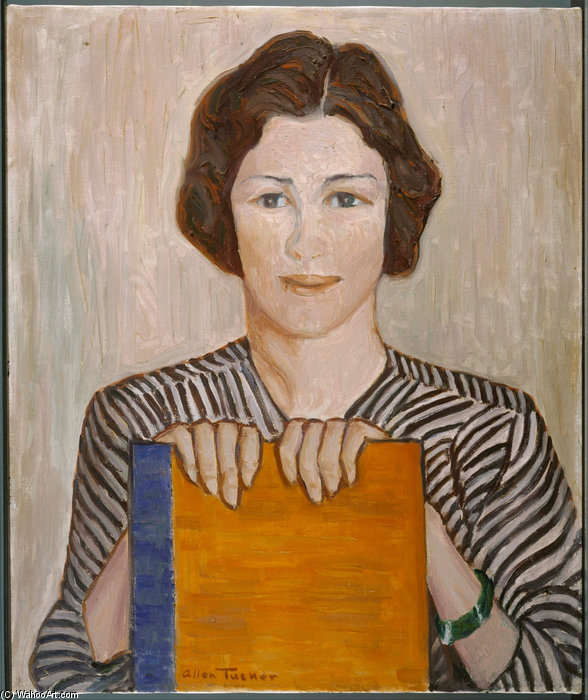
The Orange Book – (Allen Tucker)
“Because researchers have a legitimate need to compare one form of psychotherapy treatment with another… they must offer a ‘standardised’ therapy – that is, a uniform therapy for all the subjects in the project that can in the future be replicated by other therapists…. And yet that very act of standardisation renders the therapy less real and less effective.”
Yalom, The Gift Of Therapy, pp33.
Yalom underlines the importance of ‘creating a new therapy for each patient,’ of adapting to the person, with the therapist being flexible and acutely aware of the other’s uniqueness. Applying a manualised therapeutic approach to all patients will result in an insensitive and inadequate kind of therapy.
We cannot categorise our patients or file them neatly in boxes, for they are individual people, a fact that needs to be respected by the therapist at all times.
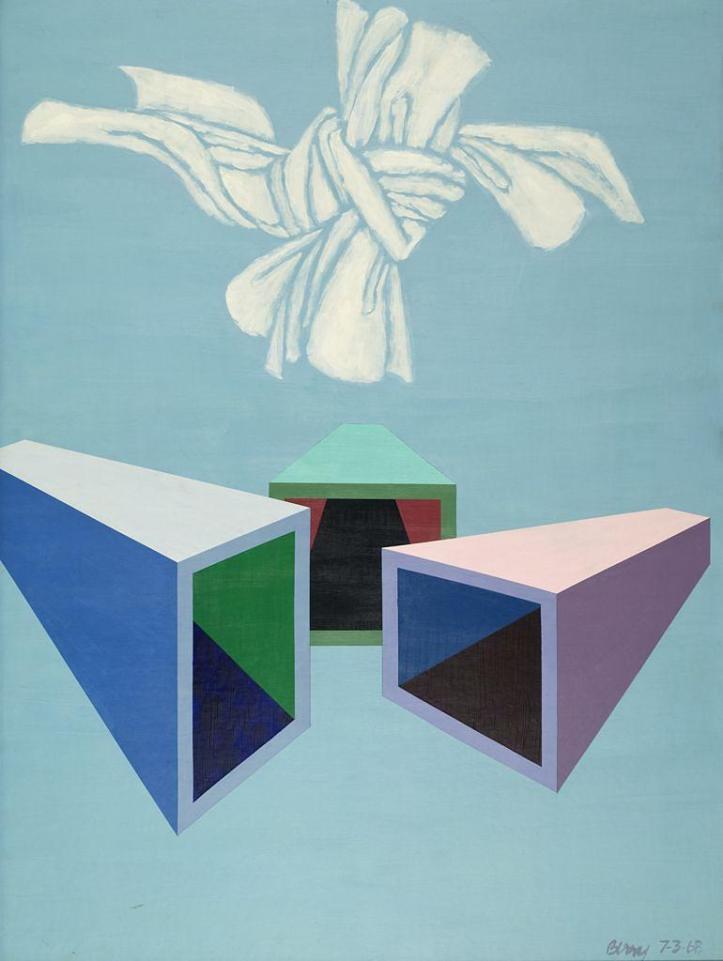 Three Converging Boxes – Glenn Berry. 1968. Wikioo.
“The world is complicated, if we put people in boxes it kind of makes it all simpler and we can classify.”
Nick Haines( Runa Magnusdottir and Nick Haines. The Story of Boxes, The Good, The Bad And The Ugly.)
Rather than classifying and labelling our patients, a more real and spontaneous approach is needed. Whilst a thorough grounding in theory and technique are, of course, crucial to the therapist being effective, there needs to be an awareness that the application of such technique must be honed and modified according to the needs of the individual patient. Formulaic application of any theoretical material will render the therapy cold, mechanical and uniformly dull.
We are all individual and complex and we need therapists who can respond to our unique selves, offering a kind of therapy that is not in the ‘one size fits all,’ off the peg mode.
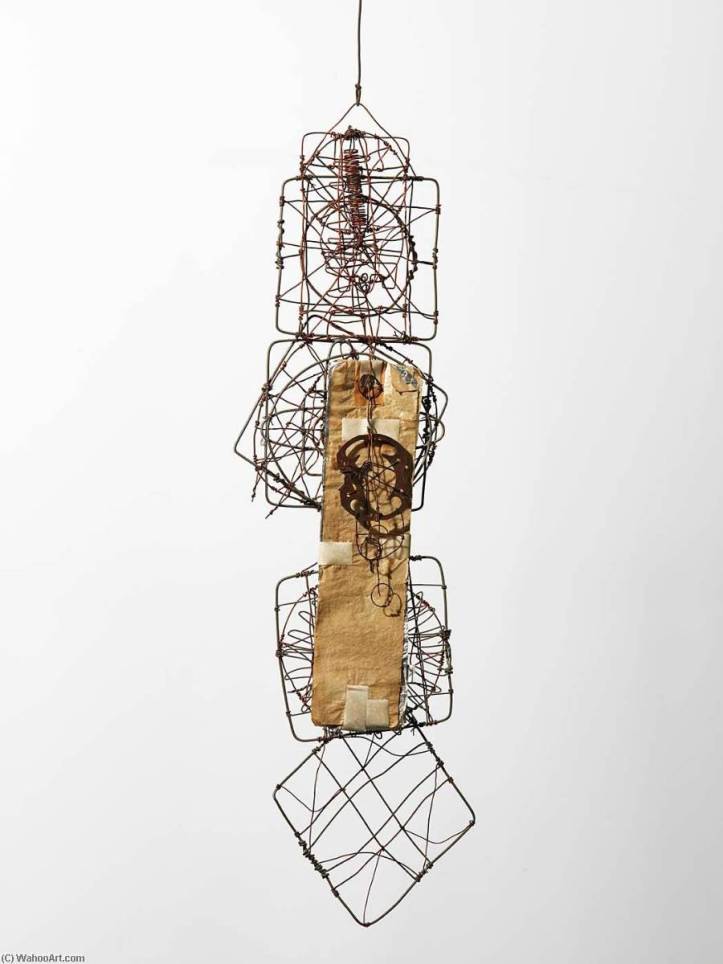 Untitled (Individual element from The Healing Machine) – Emery Blagdon. 1986. Wikioo.
…the therapist must strive to create a unique therapy for each patient.
(Yalom, ibid, p34)
- Managing your errors
“Knowledge rests not upon truth alone, but upon error also.”
Carl Jung
Linked to the concept of the ‘happy accident’ is the view that all mistakes are lessons. In his book ‘On Learning from the Patient’, (1985, Tavistock Publications) Casement shows that psychotherapists can make discoveries through their patients’ awareness that a mistake has been made. The patient will often refer to therapist mistakes directly or indirectly. (p180)
“The greatest mistake you can make in life is to be continually fearing you will make one.”
Elbert Hubbard.
Professor Jonathan Shedler, the renowned American psychotherapist, has wisely said:
“I don’t think I had a session in my life where I didn’t make a mistake.”
I can definitely identify with this statement! It is so helpful to know that, even the great and the good are humanly fallible….
Repeated errors may mean we need to reflect, engage in some introspection, and then decide how we will get help to move forward, either through supervision, or therapy, or both. In this way, mistakes can promote new beginnings.
We will learn that such mistakes can motivate us to review, reassess, and be more flexible and open-minded in relation to new ideas and new ways of thinking. With a fresh attitude, we may discover new approaches to the work of therapy, and find capabilities and skills that we had not previously considered.
We learn that it is important not to be stuck in repetitive, outmoded patterns of thinking, being and doing; change can lead to creativity and innovation.
 Julius von Klever – Blooming Poppies [1905] Wikimedia Commons.
“Learn to get in touch with the silence within yourself, and know that everything in life has purpose. There are no mistakes, no coincidences, all events are blessings given to us to learn from.”
Elisabeth Kubler-Ross
© Linda Berman.
***If you have found my posts helpful, then why not become a follower of waysofthinking.co.uk? You’ll receive notification of the next post straight to your email inbox. I’d really appreciate your support in this – just press the follow prompt. Thank you to everyone of you who is following me.
 waysofthinking.co.uk