

Christian Krohg. In the Tub. 1889. Gandalf’s Gallery, Flickr.
“There is so much more we need to learn and understand. Therefore to be open to learning, understanding, and questioning our socially constructed gender box is, in my view, the absolute first step.”
Runa Magnusdottir, The Story of Boxes, The Good, The Bad and The Ugly: The Secret to Human Liberation, Peace and Happiness
What are ascribed gender roles? This term refers to the stereotyping of people, fitting them into boxes and categories based only on their perceived gender.
The ‘socially constructed gender box’ is an interesting way of describing how we assign roles to certain genders that have not been chosen by those involved and that certainly may not suit their personality or wishes.
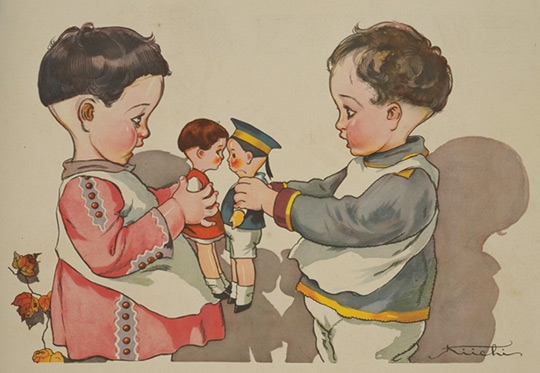
Best Friends. Kiichi Okamoto. Wikimedia Commons.
But are gender roles dead? Looking around us, we might say that things are changing, but such externally imposed roles are still alive and kicking.
Even today, when gender and gender roles tend to be approached with less of a fixed view, with more acceptance and openness, many people are stuck in the habit of assigning to others outdated and fixed gender roles. They have been socialised into such roles from early in their lives and it is hard to let them go.
For example, deep inside, hidden from view, women through the ages have harboured and repressed all kinds of strong thoughts and feelings about attitudes that have kept them trapped. They have felt totally unable to reveal their true selves.
Many lost touch with their real feelings beneath the pressure of domesticity and under the weight of societal and familial disapproval if they dared even consider moving out of their assigned, stereotypical, gender-roles.
Women have had to be gentle, soft and ‘feminine,’ domesticated and nurturing, counterbalancing the male ‘toughness’ and the cultural permission, perhaps encouragement, for men to be sweary and loudly aggressive. This is not only hard on women; men too have been socialised to hide their emotions, mostly the gentler feelings, and, of course, never to show their tears, or even have them.
- Myths about gender identity
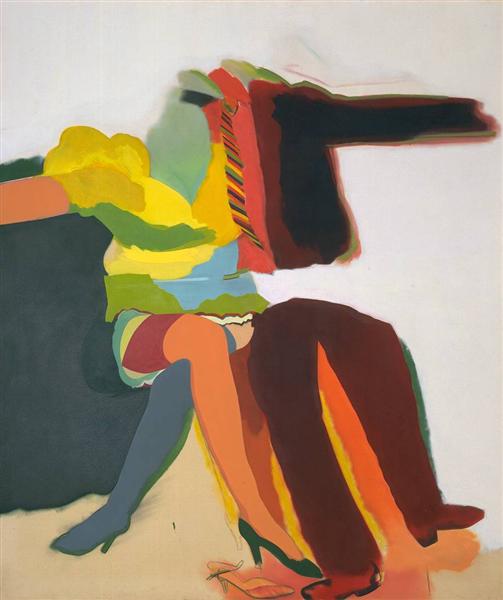
Man woman. Allen Jones.1963. Wikioo
Myths abound in connection to gender, especially in relation to having a binary approach, which tends to deny the reality of multiple gender identities and to think that there are only two genders- male and female.
Some people can be discriminatory against anyone who challenges this in relation to their way of identifying themselves. They cannot-or will not-be aware of gender fluidity and choice, believing that sex and gender have to be the same for all of us.
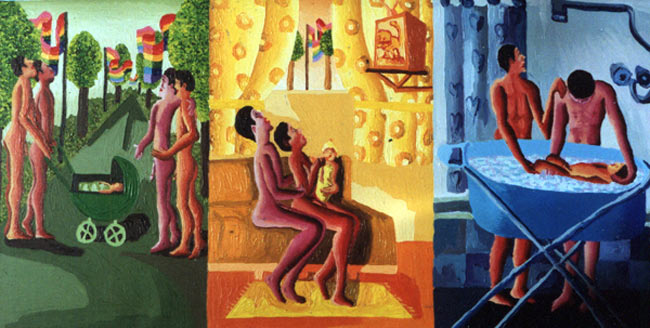
Gay Family. Raphael Perez. (b 1965) Wikimedia Commons.
This means that the sexual characteristics we are born with must determine our gender, which is forever fixed and cannot be changed.
In fact our gender is on a spectrum, which reveals not just two possibilities, male or female, but many others, including not having an identified gender at all.
Decorative Painting. Raphael Perez. c 1965. Wikimedia Commons
Many people are transsexual; they have changed, or are in the process of, changing their sex; there has been such controversy over this and many trans people feel unheard and unfairly treated. Being nonbinary or trans is not an illness; although many people who are rejected and abused have mental health problems because of this mistreatment.
It is important not to label people, for all labels can be reductionist, restrictive, discriminatory, limiting, and a distortion of who people are.

“Labels are for filing. Labels are for clothing. Labels are not for people.”
Martina Navratilova
Labels tend to isolate and exaggerate one perceived attribute of a person, which may or may not be applicable to them in reality, and to then identify that person by that one attribute only, and nothing else.
In reality, that is nonsense; we are all made up of different aspects, with many sides to our personalities.
By reducing people to one simple aspect, like gender, for example, we actually miss seeing the multifarious meanings in humanity and in the world, the shades of grey.
“Definitions belong to the definers, not the defined.”
Toni Morrison
Generalising is a way of describing a whole group of people in a manner that lumps everyone together as ‘all the same.’
Attributing certain characteristics to a person or group on the basis of their colour, race, ethnicity, culture, gender, sexuality, age, nationality or socio-economic status, is a prejudiced, discriminatory and dysfunctional way of seeing others.
It rigidly categorises people, puts them into boxes, as if human beings can be slotted into their ‘place’ like inanimate objects.
Expectations that are put on people in relation to gender roles can be harmful psychologically, resulting in some people hiding who they really are, for fear of criticism and rejection. In addition, racism, gender bias, sexism, homophobia, transphobia, are examples of the terrible lack of understanding and hostility many have to endure, in a world that can be full of hatred for difference and diversity.
Such extremism involves a total lack of anything vaguely resembling compassion for another human being, a host of disowned projections regurgitated from some people’s own dark inner world.
- Breaking Gender Norms
Through the years, there have been many brave souls who have dared to show to the world that they are not going to be labelled. One of these is Frida Kahlo, who identified as bisexual and appeared on photographs and paintings in many and varying clothes styles.
 Self-Portrait With Cropped Hair, 1940. Frida Kahlo. Wikioo.
“Your anatomy doesn’t determine your gender identity and neither does the “gender binary.”
Amnesty International
Whilst Kahlo chose different ways of dressing at different times, we must not assume that what she wore on any occasion was definitely expressing her gender identity. This expression of identity is different from what a person feels personally about themselves and we must not make assumptions based on a person’s choice of dress style.
Similarly, it is also important to use the name a person has chosen themselves; again, no assumptions should be made about gender from a name. Being misgendered can be upsetting and frustrating, giving a feeling that the person is not being seen or heard.
Gender identity and expression can both change as we grow; there can be periods in life when people may alter their perception of their gender.
Whatever process people, (and especially young people), experience in relation to their own gender, needs to be heard and validated. Sadly, this is not always what happens and many people feel harmed and hurt by thoughtless comments.
*For a more detailed and very clear explanation of different gender identities and related issues, click on this link: Amnesty International .
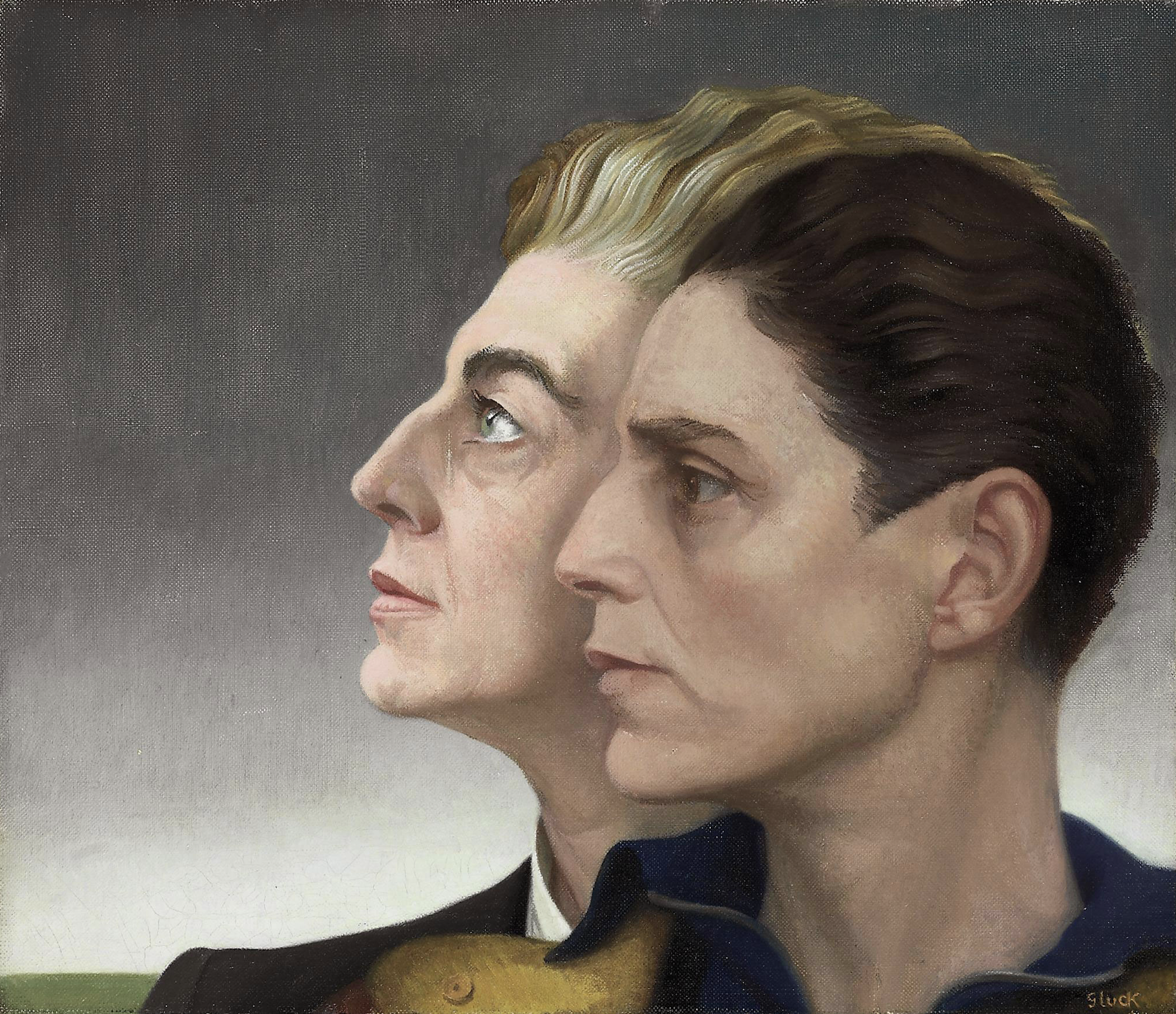
Gluck (Hannah Gluckstein) – Medallion [1936] Gandalf’s Gallery, Flickr.
“Once you label me you negate me.”
Kierkegaard
“Your labels don’t limit me… they limit your experience of me.”
Steve Maraboli
Of course, we do not have to feel constrained to fit in with any labels or identities at all. We can be whoever we want.
“I am a rare species, not a stereotype.”
Ivan Coyote
- Pronouns
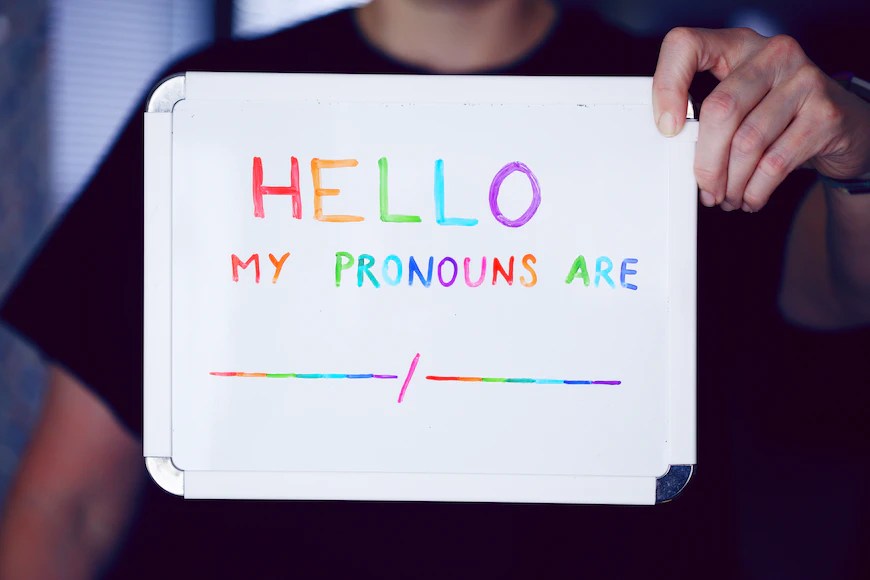
Pronouns are important because they are ways of describing and asserting our identity. At one time, there were only masculine and feminine gender pronouns (he/him/his and she/her/hers.)
Now, people are gaining the confidence to use more specific and personally relevant pronouns, for not everyone identifies their gender within the binary of being either male or female. Using the gender-neutral pronouns they/them/theirs, or the newer ones, xe/xir or ze/zir, gives more freedom to people to use in their descriptions of themselves.
What pronouns do you use?
“The truth is, I’ve been learning a lot about myself lately, and at this point, I don’t feel like any of the labels really fit me.”
Nic Stone
- Some Sticky Issues
It is early days in terms of working out how we might manage gender differences in society. There have been difficulties in many areas, such as in relation to children wanting to change gender, in therapy, in providing shared restrooms, and also in prison populations.
Questions abound, deep, concerning questions on all sides. People complain about any changes, sincerely designed to help some, but offending others. Girls in a mixed school grumbled when they had to follow boys into the all-gender toilet and found splashed seats.
Transexual people felt excluded and discriminated against when they had to use a washroom designed for the sex they been identified as being when they were born, not the sex they felt they in fact were.
People are still grappling with such issues and will continue to do so. At the moment, we are still searching for answers and new ways of seeing.

- What can we do?
Meanwhile, what our options in terms of attitudes towards those who might seem different gender-wise?
We need to accept that none of us are totally one gender; we all have parts of us that overlap with others, and no two people are alike gender-wise, or in any other way. The large spectrum of gender stretches to well over 80 different genders.
For more information on the different genders and for therapeutic help with gender issues follow this link.
Despite the difficulties in society’s attitudes around gender differences, what can we, as individuals, do to try and ease the situation?
The keywords and phrases here are listening, wanting to learn, being open, not judging, accepting difference and valuing another’s experience. In addition, we all need to educate ourselves as much as possible about the different genders, so that we neither discriminate out of ignorance, nor use language that might be offensive to some amongst us.
We need to know that being nonbinary or trans is entirely normal, and that this has been around for many thousands of years.
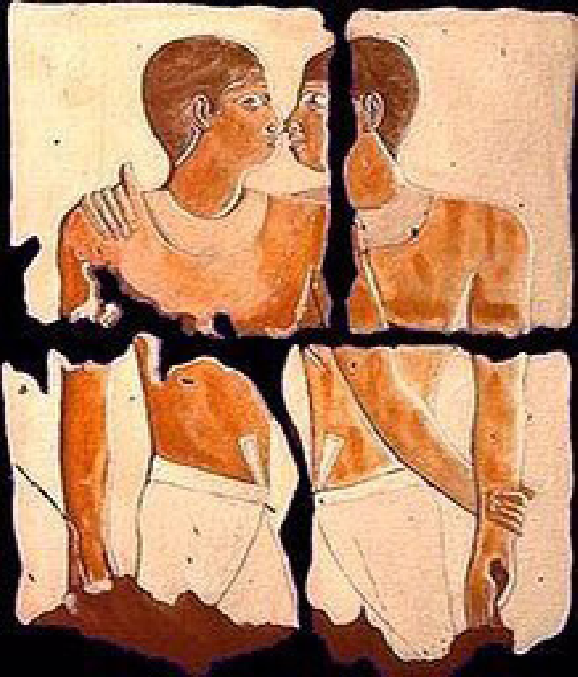
Cave paintings of the San people near Guruve in Zimbabwe of evidence suggesting same sex sexual relations dating back to the time of Bushmen.
“In the cultures of the ancient world, there was no need for designations such as LGBTQ+ because there was no difference noted between what is now defined as “homosexual” and “heterosexual” relationships. There was no “us” and “them” dichotomy to encourage such labels; there was only “us” and whoever one chose to love was one’s own business.”
It is important that we learn to respect people’s pronouns, in order that we can be inclusive and appreciative of diversity.
Supporting people who are nonbinary or trans can involve everyone around helping to create an atmosphere of acceptance and respect, ensuring that, in whatever setting, whether in the family, socially or at work, there is an attitude of standing with, of tolerance, inclusiveness, acceptance and support.
© Linda Berman
If you have valued this post, please become a follower of my blog!
 waysofthinking.co.uk