
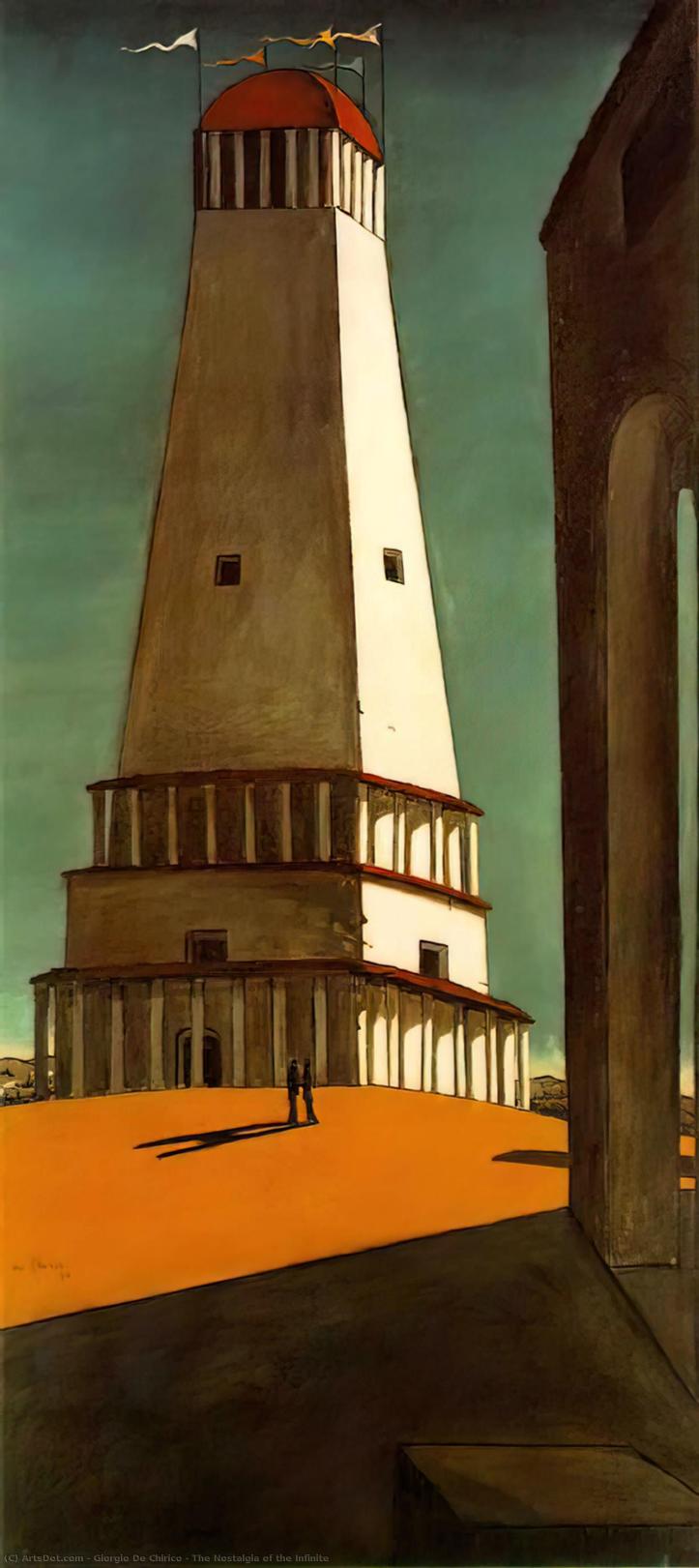
 The Nostalgia of the Infinite – Giorgio De Chirico.1913. Wikioo.
“Nostalgia is the heart’s way of reminding you of something you once loved. It travels in many forms; on a song, in a scent or in photographs… but no matter how it comes to you it will always have the same bitter-sweet taste.”
Ranata Suzuki
What is nostalgia, and how does it affect you? Does it even figure in your life?
Nostalgia is a kind of mourning, with feelings that are ‘bitter-sweet,’ sad and happy at the same time. We may feel grief at the loss of something good, and joy, too, as we remember it. Some people do not experience this very often, if at all, whereas others frequently feel nostalgic.
“The Greek word for “return” is nostos. Algos means “suffering.” So nostalgia is the suffering caused by an unappeased yearning to return.”
Milan Kundera, Ignorance
Wishing we were young again, wanting to go back to something good in the past, kidding ourselves that everything will be the same… all this is nostalgia.
Even if things were to be the same, which they certainly will not, the fact is that we have grown and changed, mentally and physically. This personal development will mean we have different, and more complex needs that could not have been met then.
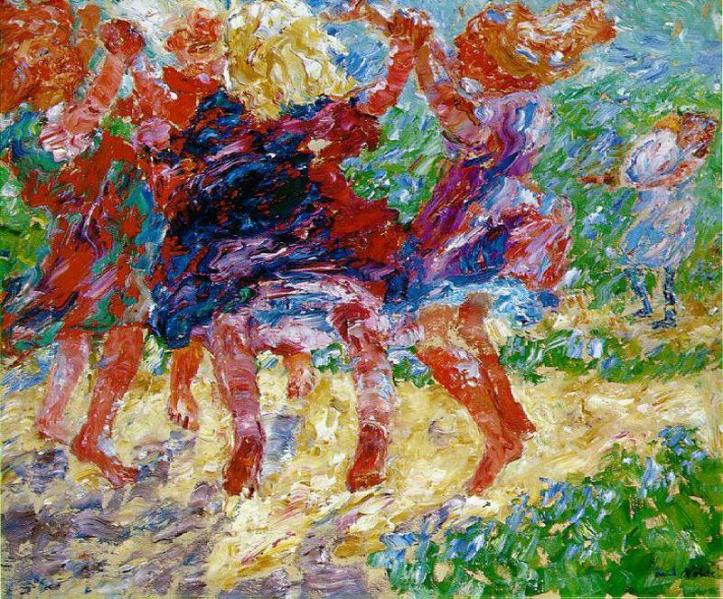 Wildly Dancing Children – Emile Nolde. Wikioo.
“The past is desirable, more often than not, because it can make no demands.”
Patrick White, Voss
We may believe how great it would be to go back to that time, the good old days, when life was easy.
In fact, life has never been easy. Nostalgia is a way of denying that fact, creating days made of sparkly, golden sunshine, pure, unadulterated delight and ‘no demands.’
It may be comforting to put on rose-coloured spectacles and remember such good times, and this is sometimes necessary and pleasurable. It also important not to become engulfed by the past, locked in a state of constant longing and regret for times gone by.
- Getting stuck in the illusion of the past
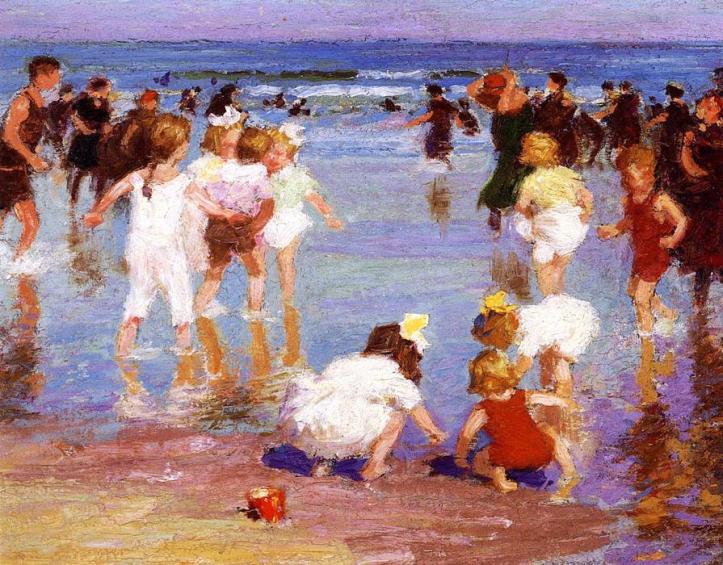 Happy Days – Edward Henry Potthast. 1910. Wikioo.
In every age “the good old days” were a myth. No one ever thought they were good at the time. For every age has consisted of crises that seemed intolerable to the people who lived through them. ”
Brooks Atkinson
Getting stuck in nostalgia for the past can be a way of avoiding real feelings like grief and fear, and escaping from the pressures of today. At times, people may be afraid of letting themselves enjoy today, in case things turn out badly, and it feels safer for them to ‘hide’ in the past.
If we find the present day lacking, it may be that we are unconsciously comparing it to a fantasy-enhanced past. This can stop us from appreciating our current lives, as nothing could live up to the gilded memory of a time long gone, even though we know that no period in anyone’s life can be so perfect.
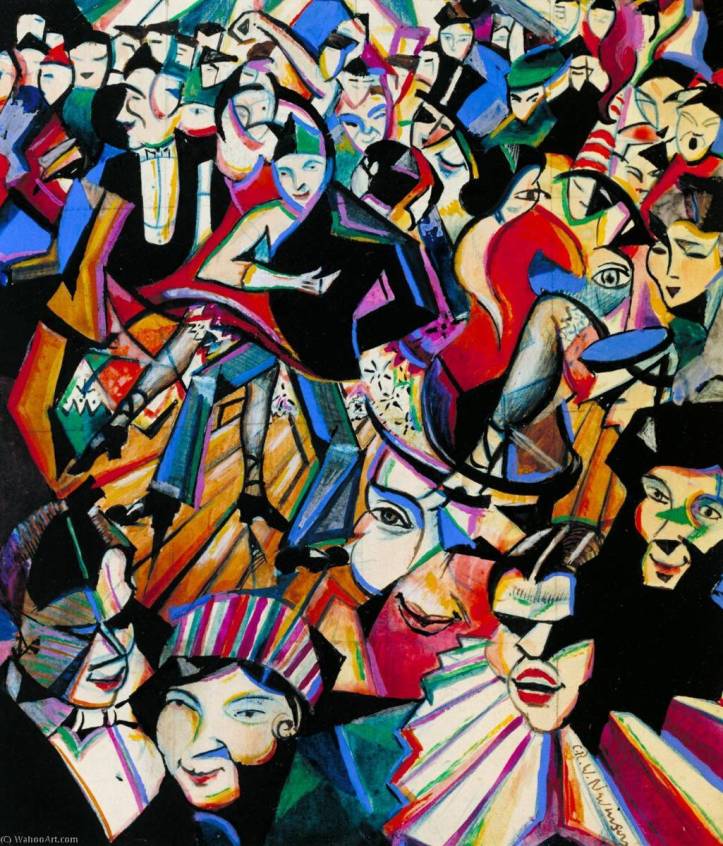
Dance Hall Scene – Christopher Richard Wynne Nevinson. Wikioo
“We seem to be going through a period of nostalgia, and everyone seems to think yesterday was better than today. I don’t think it was, and I would advise you not to wait ten years before admitting today was great. If you’re hung up on nostalgia, pretend today is yesterday and just go out and have one hell of a time.”
Art Buchwald
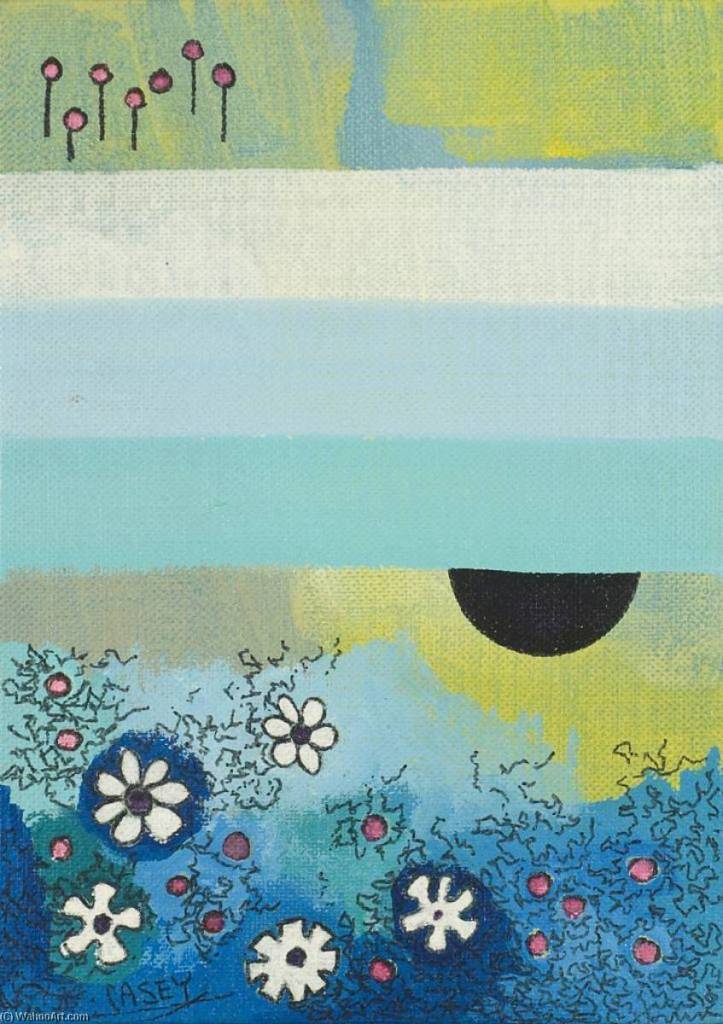 In Springtime Yesterday – Bernie Casey. 1968. Wikioo
“Nothing prevents happiness like the memory of happiness.”
Andre Gide
Focussing on the past also avoids current fears of making the ‘wrong’ choices for ourselves. Additionally, perhaps it is easier to remain in the past, than to face fears of ageing and dying.
If we do not make life choices, we may end up feeling lost and ‘at sea,’ in a world where we feel we do not fit in. Holding onto the old, rejecting the new, are ways of living in the past and avoiding the present moment.
Finding new paths involves coping with uncertainty and venturing into the unknown, but without taking such risks at some points in our life, we would remain static.
Perhaps it also reflects the fact that we have not moved on, we are stuck in the past, afraid of change. Adapting to changing times can be exciting as well as uncertain; allowing ourselves to grow and develop, without indulging in too much nostalgia for the past, will mean we become more able to value every moment.
“The basic for any approach to self-transformation is an ever-increasing awareness of reality and the shedding of illusions.”
Erich Fromm, The Art of Being
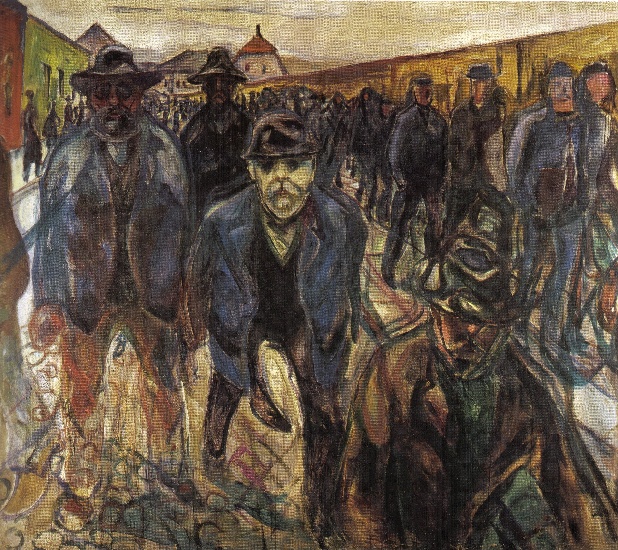
Workers returning home – Edvard Munch. 1913. Wikioo
“We long to have again the vanished past, in spite of all its pain.”
Sophocles, Oedipus at Colonus
In accepting that something is over, that it belongs in the past, whether it is a person or a place, we allow ourselves to feel stronger, more independent. Letting go can involve loss, uncertainty and stepping into the unknown. If we are able to take the risk, we may glimpse new possibilities, new freedoms.
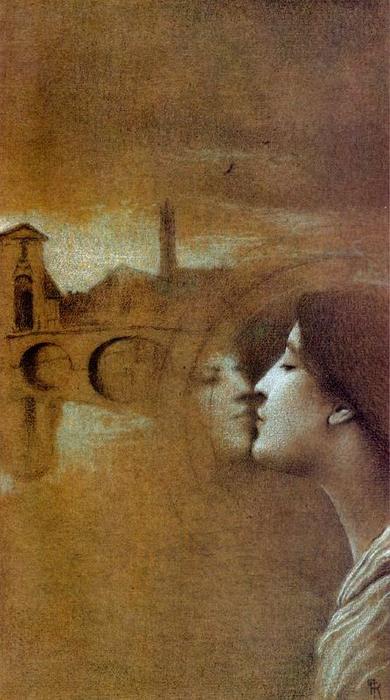
With Gregoire Le Roy. My Heart cries for the Past – (Fernand Edmond Jean Marie Khnopff. Wikioo
“Letting go means to come to the realization that some people are a part of your history, but not a part of your destiny.”
Steve Maraboli
- Nostalgia for food and drink
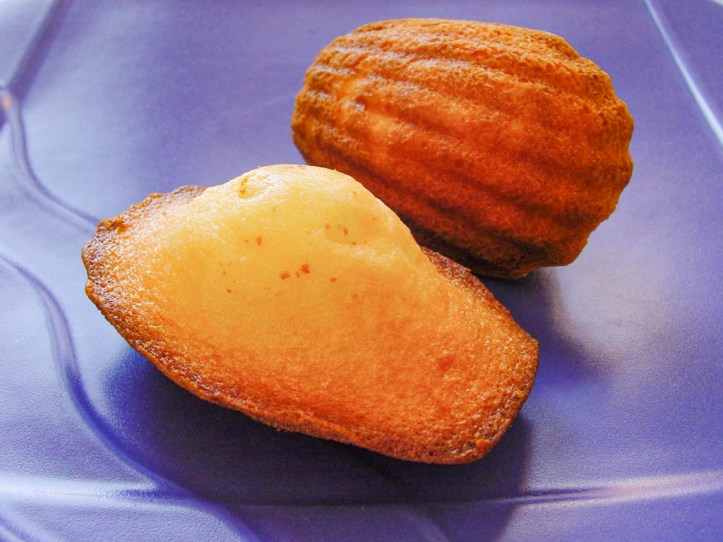 Madeleines de Commercy. Bernard Leprêtre. 2007. Wikimedia Commons.
“No sooner had the warm liquid mixed with the crumbs touched my palate than a shudder ran through me and I stopped, intent upon the extraordinary thing that was happening to me. An exquisite pleasure had invaded my senses, something isolated, detached, with no suggestion of its origin…… Whence did it come? What did it mean? How could I seize and apprehend it? …… And suddenly the memory revealed itself. The taste was that of the little piece of madeleine which on Sunday mornings at Combray… when I went to say good morning to her in her bedroom, my aunt Léonie used to give me, dipping it first in her own cup of tea or tisane. “
Marcel Proust, In Search of Lost Time
Food can be a way of remembering people and events in our lives. Such memories can bring us together, as we reminisce about shared experiences from the past.
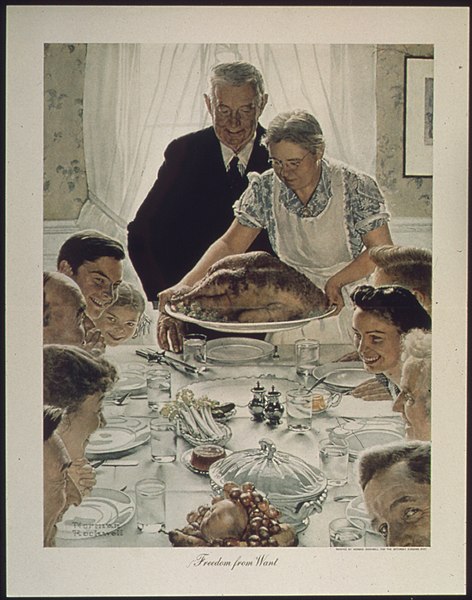
“Freedom From Want.” Norman Rockwell, between 1941-45.
“The smells of Christmas are the smells of childhood”
Richard Paul Evans
Food, whether at Christmas or not, evokes nostalgic memories for many of us.
Culinary traditions and recipes are handed down through families in a way that keeps past relationships alive in the present, continuing old traditions and instantly reminding us of those who may now be gone, through our senses of taste and smell.
“Most of us have fond memories of food from our childhood. Whether it was our mom’s homemade lasagna or a memorable chocolate birthday cake, food has a way of transporting us back to the past.”
Homaro Cantu
Advertisers rely to some extent on our nostalgia about food; the sense of familial and community togetherness in such advertisements is appealing and, for some, reminiscent of good days gone by.
Have you noticed how people often smile when they are served dessert? The sight and anticipation of a sugar-filled pudding releases endorphins, flooding us with anticipated pleasure, based on many past experiences of sweet delights.

Of course, not everyone has happy memories of food; some people may find food reminds them of unpleasant experiences, and it can be linked to trauma, punishment, power and control, guilt and shame. Sometimes people develop a dislike of or anxiety about foods that may be connected to unpleasant experiences in the past; such foods certainly do not feel nostalgic.
- Smells and scents
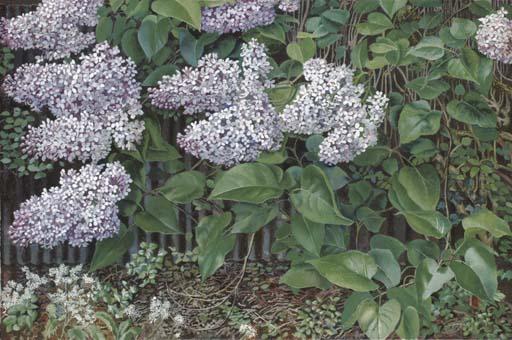 Lilac – Stanley Spencer. Wikioo
“If I was to be limited to the memories of smell
I would elaborate for you the brightness of
Sagebrush in the rain
Sun-soaked brows of laughing children
Suburb lawns infused with lilac…”Cheryl Seely Savage, Carve a Place for Me
How evocative are some odours! Like taste, smells can take us time-travelling back in an instant. They can immediately transport us into good times or bad… that pervasive stew and overcooked cabbage smell at school, the wonderful fragrance of a garden rose, the salty balm of the sea, the sweet scent of a baby’s head, the reek of mothballs on an old fur coat….what smells are evocative for you?
Smells can affect our feelings, too. In fact, the French word ‘sentir’ can mean ‘to smell,’ ‘to feel’ and ‘to taste.’ Some odours can make us feel nauseous and those olfactory memories can stay with us for years. I still cannot bear the smell of Brut men’s aftershave, which was worn in the 1970’s when I was pregnant… it used to make me nauseous then and even the memory of it brings back those sickly feelings today!
- Memory and nostalgia
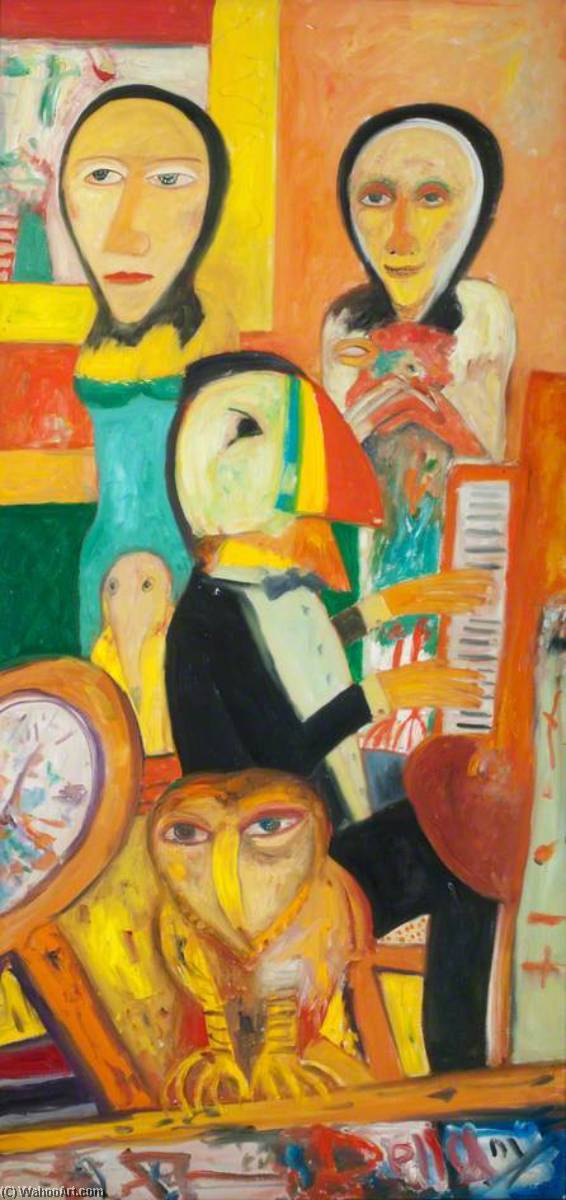
Idyllic Childhood Memories (triptych, right panel) – John Bellany. Wikioo.
“You know what nostalgia is, don’t you? It’s basically a matter of recalling the fun without reliving the pain.”
Bette Davis
Inevitably, nostalgia is about selective memory. This means that we will unconsciously choose what to remember; other memories, perhaps the difficult ones, will be repressed. Lingering in the depths of our unconscious are a host of ‘forgotten’ memories. Sometimes, such memories remain hidden there, perhaps because they feel too painful to bring to consciousness.
If we are feeling too disturbed and upset by such memories, or have distressing symptoms, we may decide to have psychotherapy, in order to understand what is bothering us. In an empathic and safe atmosphere, we can be helped to uncover and work through traumatic memories.
Such memories need to be consciously put in their place, once they have been explored and when we feel ready to let go. Of course, this is not a complete process; we can never wipe trauma from our brain.
“Conscious forgetting means wilfully dropping the practice of obsessing, intentionally outdistancing and losing sight of it, not looking back, thereby living in a new landscape, creating new life and new experiences to think about instead of old ones.”
Clarissa Pinkola Estes
Once we have faced, and worked through, our difficult memories as far as is possible for us in therapy, then we have a choice. We can choose to remember them often, or we can relegate our memories to the ‘back-burner’ of our minds, so they do not dominate our everyday lives.
We can never simply ‘forget.’ That would not be therapeutic at all. But we can learn to carry the painful memories better, so that they do not control our lives.
Thus, we simultaneously remember…. and forget. Both are important.
(However, once we have worked on them, such memories often tend to come less frequently to the forefront of our minds in any case.)
This kind of ‘forgetting’ is about being able to reduce the power the memory may have to stop us living productively. It is about having the courage to go on, not in denial, but fully knowing what has happened, whilst nevertheless carrying our lives forward and focussing on happily nostalgic past experiences….
- Nostalgia and the Seasons
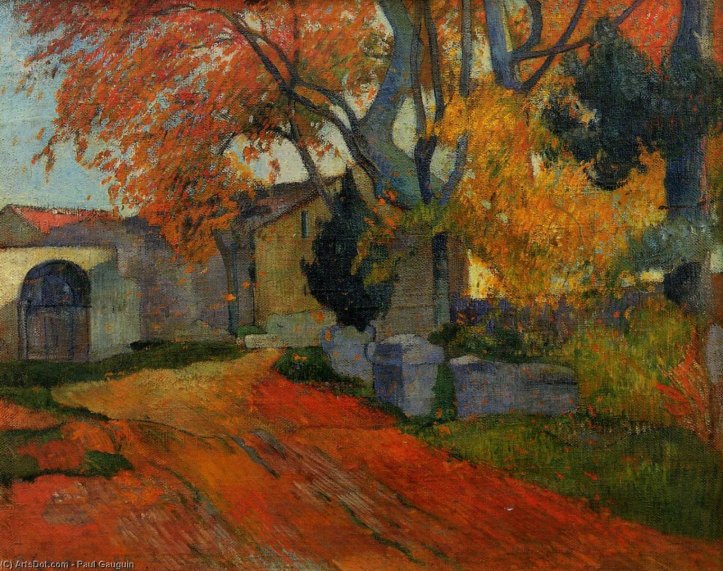 Lane at Alchamps, Arles (also known as Les Alychamps, Falling Leaves) 1888. Paul Gauguin. Wikioo
“There is something incredibly nostalgic and significant about the annual cascade of autumn leaves.”
Joe L. Wheeler
Many people feel nostalgic about the seasons; each season possesses its own beauty, and it own memories. Autumn leaves, summer sunshine, winter snow, spring flowers, all of these can stir up nostalgic feelings in us, according to our life experiences and ways of seeing the world.
On the other hand, there are those who feel differently about the seasons and all that is most commonly associated with them, like the poet TS Eliot:
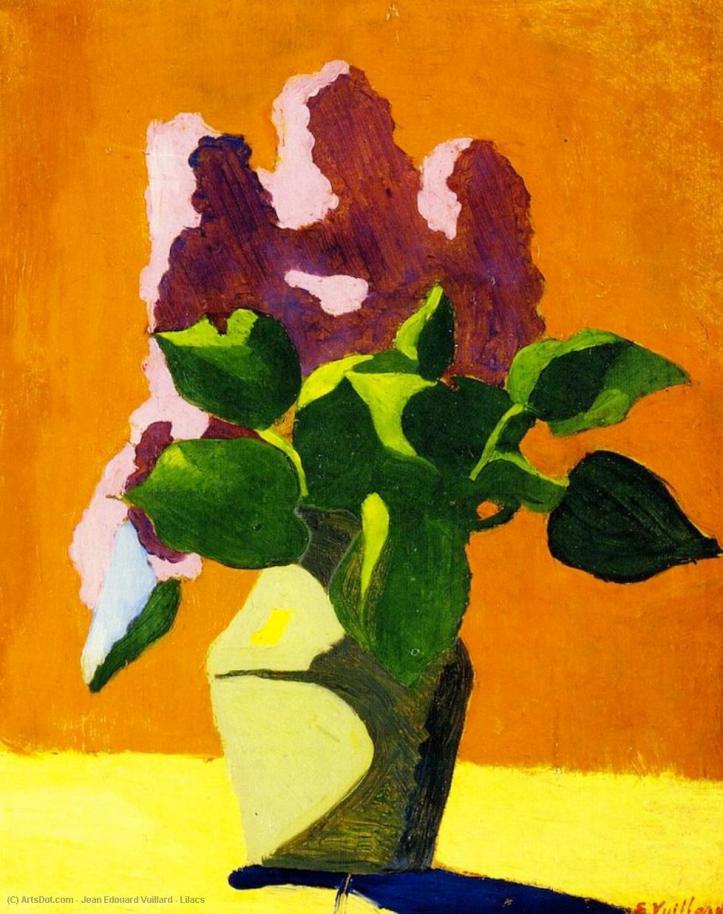
Lilacs – Jean Edouard Vuillard. 1890 Wikioo.
“April is the cruelest month, breeding
lilacs out of the dead land, mixing
memory and desire, stirring
dull roots with spring rain.”T.S. Eliot, The Waste Land
Lilacs in April are not seen as beautiful, as in the Stanley Spencer image above, but they serve to stir up difficult, disturbing memories and feelings.
It is interesting to note that Eliot mentions ‘mixing both memory and desire,’ as if he, too, is experiencing some kind of nostalgic memory, something from the past that stirs desire.
Spring’s awakening of both memory and desire is seen as cruel, and Eliot was feeling this particularly acutely when he wrote this poem, as he had separated after a very unhappy marriage.
- Places and traces
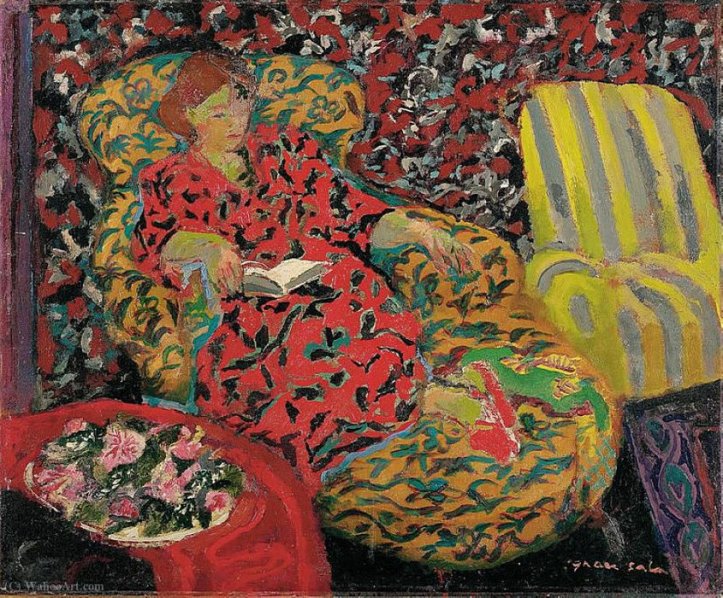 Woman on Sofa, (1950) – (Emilio Grau Sala)
“People leave traces of themselves where they feel most comfortable, most worthwhile.”
Haruki Murakami, Dance Dance Dance
The quotation points to the fact that we all leave traces of ourselves in places that we like, places that make us feel good about ourselves. Sometimes, we might leave an item at someone’s house, or in a restaurant. Unconsciously, this can be because we might want to return there.
Traces are also important after someone has died; then, those personal traces they have left behind become especially meaningful. It is as if a part of them is still with us.
We leave traces of ourselves in our writings, music and art, through marks and indentations on our favourite chair, through our hair in a brush, perfume on our clothes….We leave behind our love in cards and gifts, tangible signs that we have had a life; there may be forgotten coins dropped down the back of the sofa, our voice recorded on a mobile phone, fingerprints on a window and coffee stains on a book, handwriting, bookmarks, a favourite pen, our clock still ticking on the mantelpiece……
We inevitably leave such ‘trace-evidence’ behind us, whether we are leaving a place to go somewhere else, or, even more poignantly, when we die. The traces we leave can serve as a kind of memory, or real evidence that we have been there, that we have existed.
They can be distressing reminders, or they can bring comfort, or both. It is as if something of the lost person remains with us. Additionally, it can feel as if traces of the living have gone with the dead person.
“I became quietly seized with that nostalgia that overcomes you when you have reached the middle of your life and your father has recently died and it dawns on you that when he went he took some of you with him.”
Bill Bryson, The Lost Continent: Travels in Small-Town America
We inevitably leave invisible traces, too, everywhere we have been in terms of our DNA…… and, of course, there are photographs….. sometimes generations of them.
“A photograph is not only an image (as a painting is an image), an interpretation of the real; it is also a trace, something directly stencilled off the real, like a footprint or a death mask.”
Susan Sontag
“To live means to leave traces.”
Walter Benjamin
Places can be very nostalgic for people, especially if we have been happy and content there. We can ‘escape’ to that place in our minds, perhaps during times of stress or difficulty. We may enjoy thinking about what happened there, the good times, the happy memories leaving us feeling better.
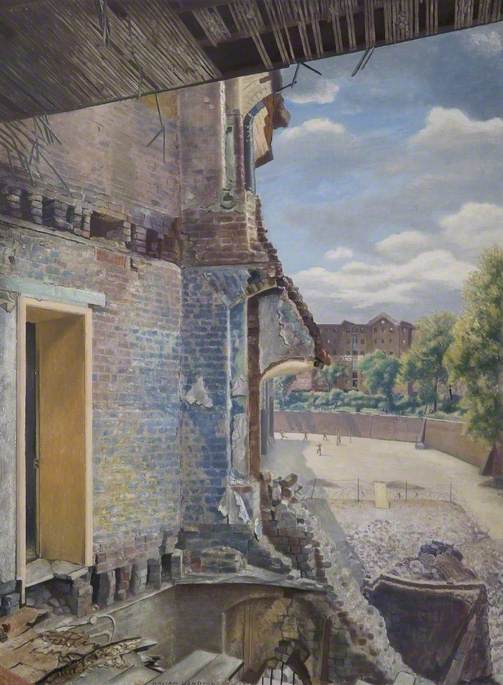
Bombsite – William Herbert Hampton. 1942. Wikioo
“You can’t return to a place that no longer exists, luv.”
Samantha Sotto, Before Ever After
On the other hand, such places may now have disappeared and may also remind us of past happiness that we have now lost. Perhaps we will experience some grief that they have gone. The place exists only in our memory and comes to represent our loss. This will need some working through, maybe in psychotherapy.
“This is not the life you pictured but here you are. You can still make something beautiful. Grieve. Breathe. Begin again.”
Thema Bryant-Davis
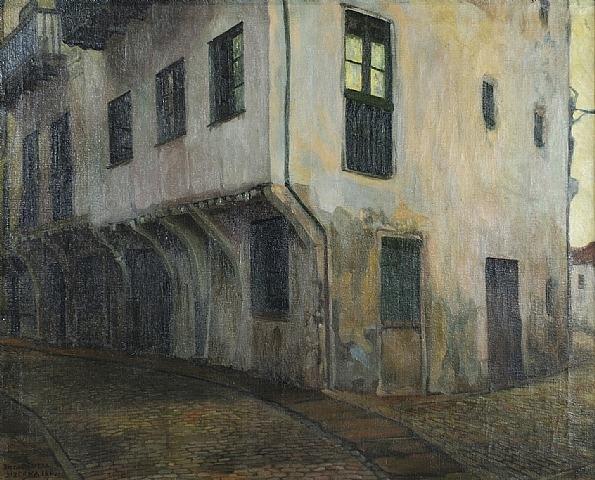
The House of Vizcaya – Diego Rivera. Wikioo.
“Nostalgia makes hallowed ground from mundane places.”
Caroline George, The Summer We Forgot
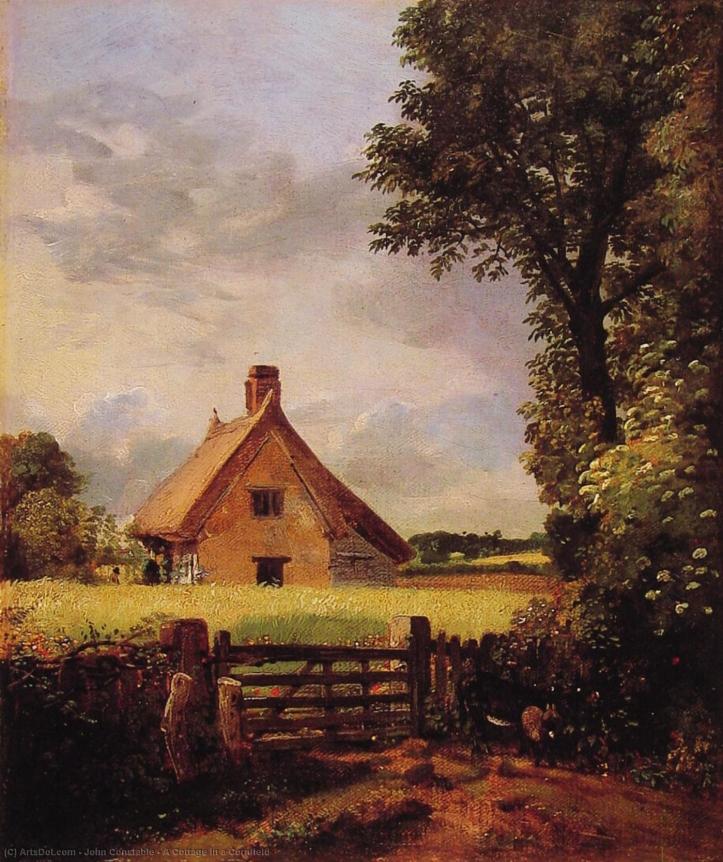 A Cottage in a Cornfield –John Constable. Wikioo.
“Time changes the places that knew us, and if we go back after years, still even then it is not the same spot; the gate swings differently, new thatch has been put on the old gables, the road has been widened, and the sward the driven sheep lingered on has gone.”
Richard Jefferies
- Music and Books
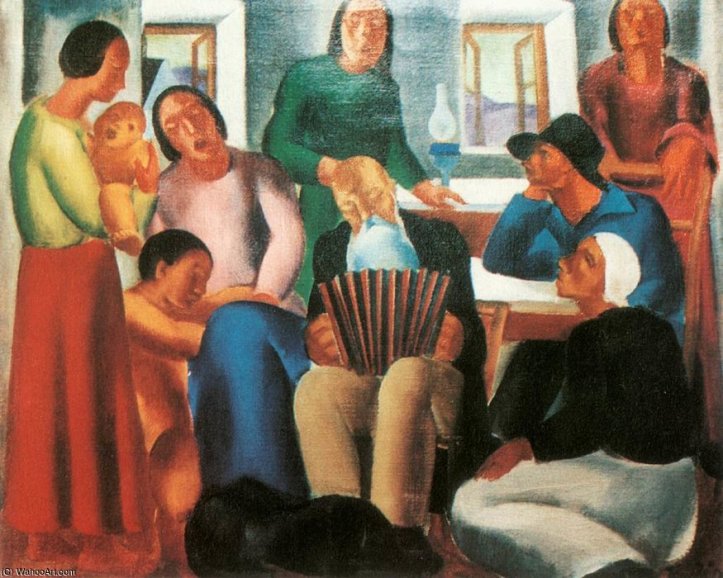 Singing Family – David Jandi. Wikioo.
“Music anchors us to a time and place, rooted with feelings, and is invisible liquid nostalgia that flows through our ears directly into our hearts (where our memories are stored).
Jarod Kintz
Playing or hearing music can quickly transport us to another place and time; it has a magical quality that can fill us with feelings of nostalgia, with memories, sometimes good ones, sometimes sad ones.
“Music can be a way for me to think back a lot of the time, almost like an opening into all the nostalgia I never express.”
Amber Mark
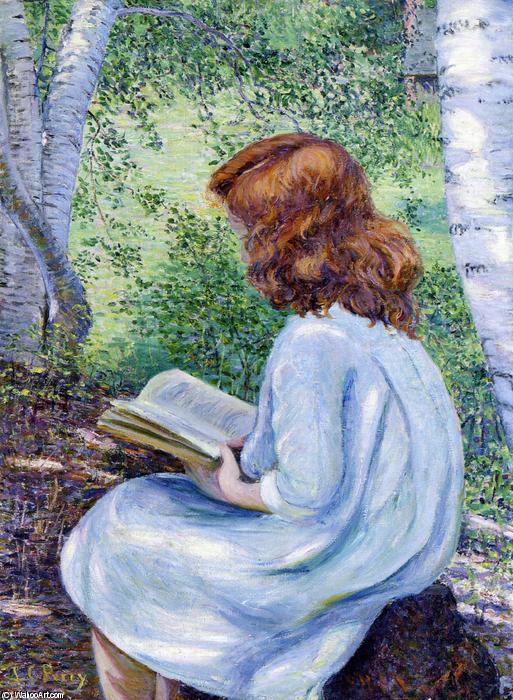
Lilla Cabot-Perry. Child with red hair, reading. Wikioo
“To return to the books of my childhood is to yield to the strain of nostalgia that is curious about the self I once was.”
Chimamanda Ngozi Adichie
Looking through our old books can be a highly nostalgic experience; remembering who and where we were when we read them can bring back a stream of feelings.
Can you remember the feelings of involvement and excitement you felt while reading a particularly good book as a child?
We may feel nostalgia and some sweet regret at the loss of those feelings, of our childhood imagination, our innocence and the comforting, fantastical enchantment of books.
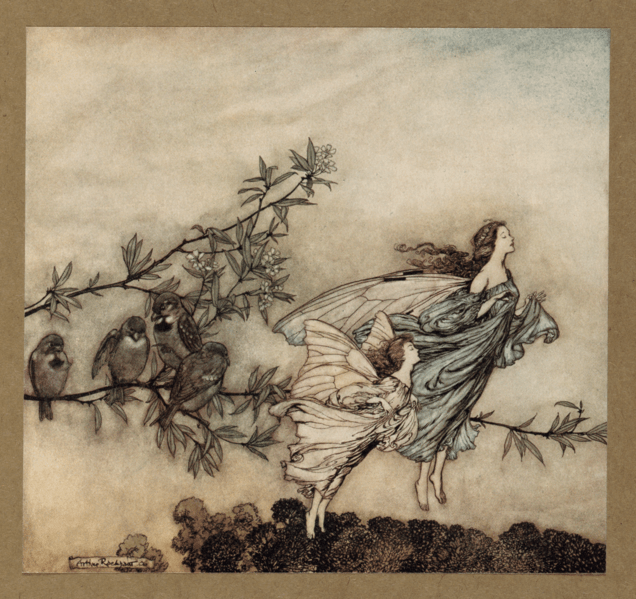
Arthur Rackham, Peter Pan – The fairies have their tiffs. 1906. Wikimedia Commons.
©Linda Berman
This blog is totally non profit-making. As a retired psychotherapist with 30 years experience, I write both for my own self-expression and to help others.
If you have liked this post, I would much appreciate you showing support by becoming a follower of waysofthinking.co.uk
 waysofthinking.co.uk