
- A world full of noise…
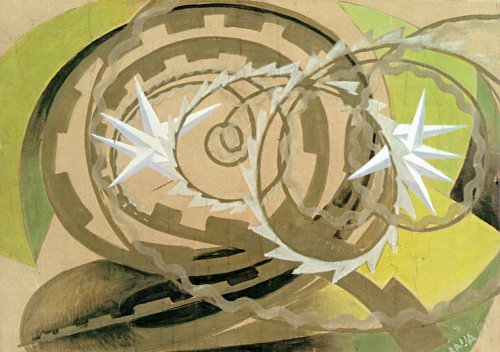
Shape and Noise of Motorcyclist – 1913. Giacomo Balla
“Noise is the most impertinent of all forms of interruption. It is not only an interruption, but also a disruption of thought.”
Arthur Schopenhauer
How can we find peace amongst all the noise of the world?
This is a 21st century world in which we are besieged by stress, surveillance, constant interruption and hyper-activity. With the current focus on information and the gathering of hard facts, multitasking is becoming the norm in a cacophonous, beleaguered world. This is far from peaceful…
In his book The Organised Mind: Thinking Straight in the Age of Information Overload, Daniel Levitin underlines how this current trend towards ‘cognitive overload’ results in a depletion of mental resources. He states that ‘multi-tasking is the enemy of a focussed attentional system,’ and he advocates concentrating on the most important issues and not letting oneself be distracted.
- Peace begins with the self
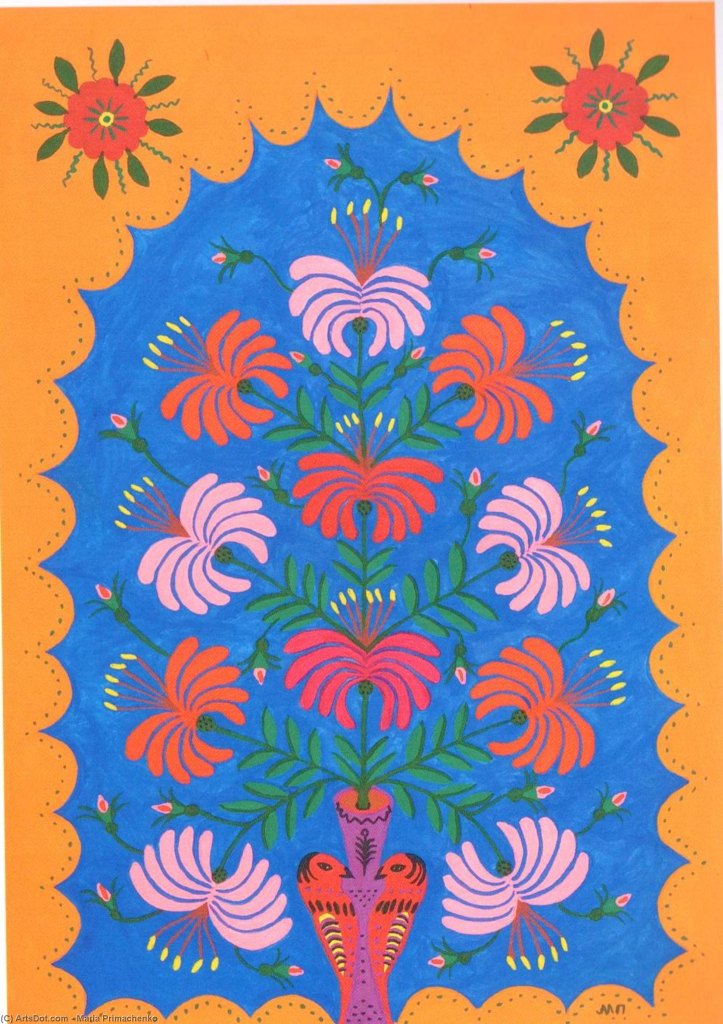 My Flowers To Those Who Love Peace – Maria Primachenko.1983. Wikioo
“What is first seen as a loss is now seen as a gain. For he finds solitude, not in far off, quiet places; he creates it out of himself, spreads it around him, wherever he may be, because he loves it and slowly he ripens in this tranquility.”
Janwillem van de Wetering
The above quotation reminds us that peace and tranquillity can be created inside of us, no matter how noisy and pressurising is the outside world. Being silent and in solitude may produce for us a soothing backdrop of calm and peace, and this can have a temporary de-stressing effect.
However, whilst allowing ourselves to spend such quiet time will create an atmosphere of serenity, this merely provides us with an encouraging exterior, a setting; it can, indeed, complement and help the process of discovering our real selves. What is most important within such surroundings, if we wish to find inner peace, is to engage in self-examination, to let oneself ‘slowly ripen’ and mature.
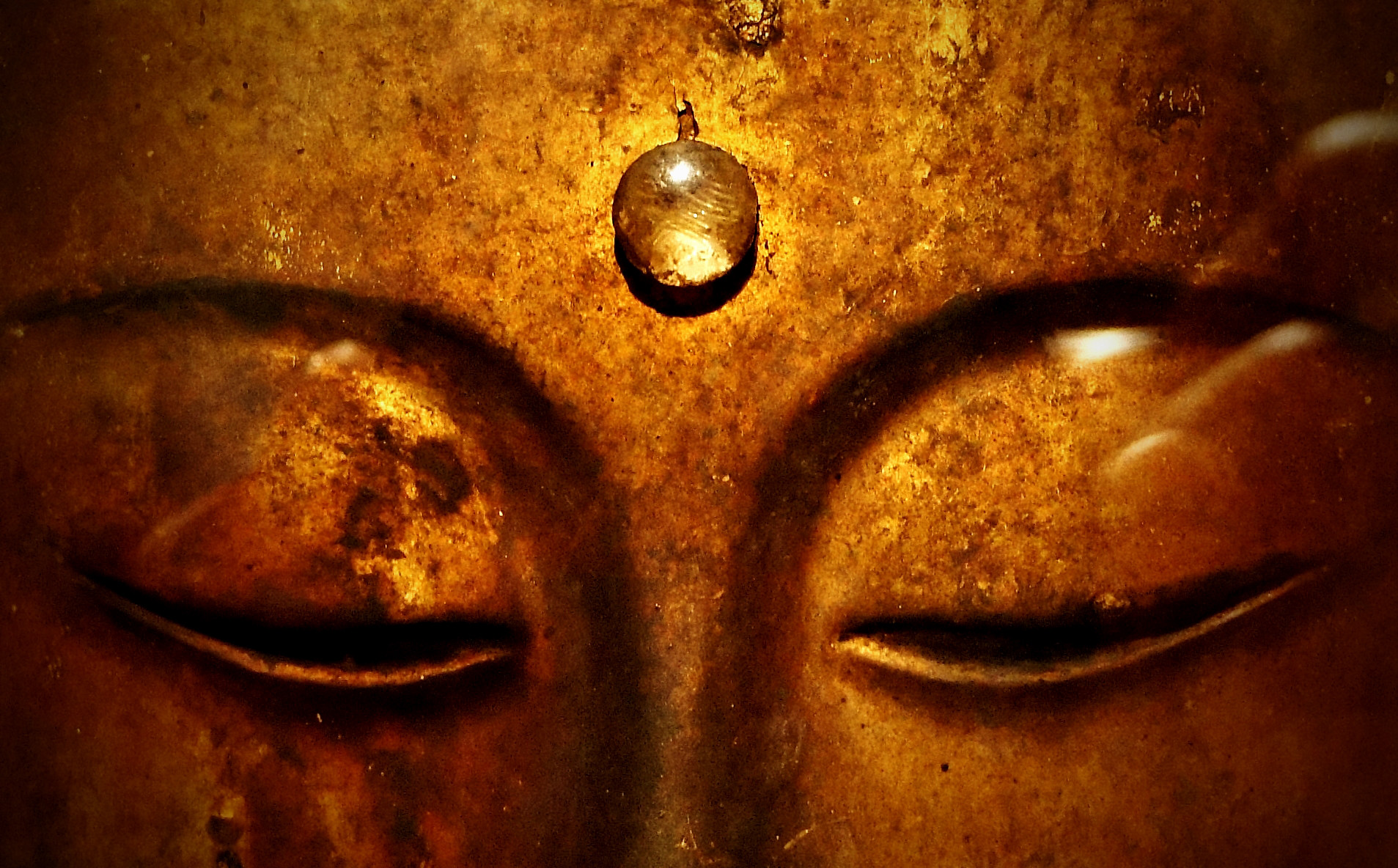 sea turtle. Enlightenment. (taken 2012.)At the Seattle Asian Art Museum, in Volunteer Park on Capitol Hill.
“To enjoy good health, to bring true happiness to one’s family, to bring peace to all, one must first discipline and control one’s own mind. If a man can control his mind he can find the way to Enlightenment, and all wisdom and virtue will naturally come to him.”
Buddha
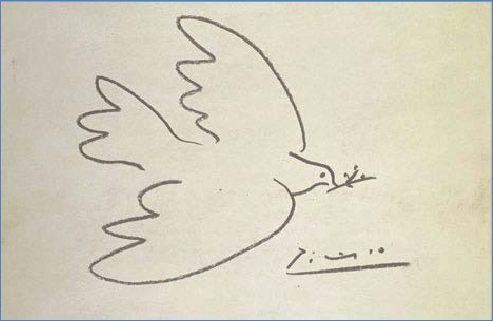
“Nothing can bring you peace but yourself.”
Ralph Waldo Emerson
Achieving peace inside oneself can be a long and difficult process; such calmness of mind might be gained through such experiences as psychotherapy, counselling, religious practice, meditation, mindfulness, or yoga.
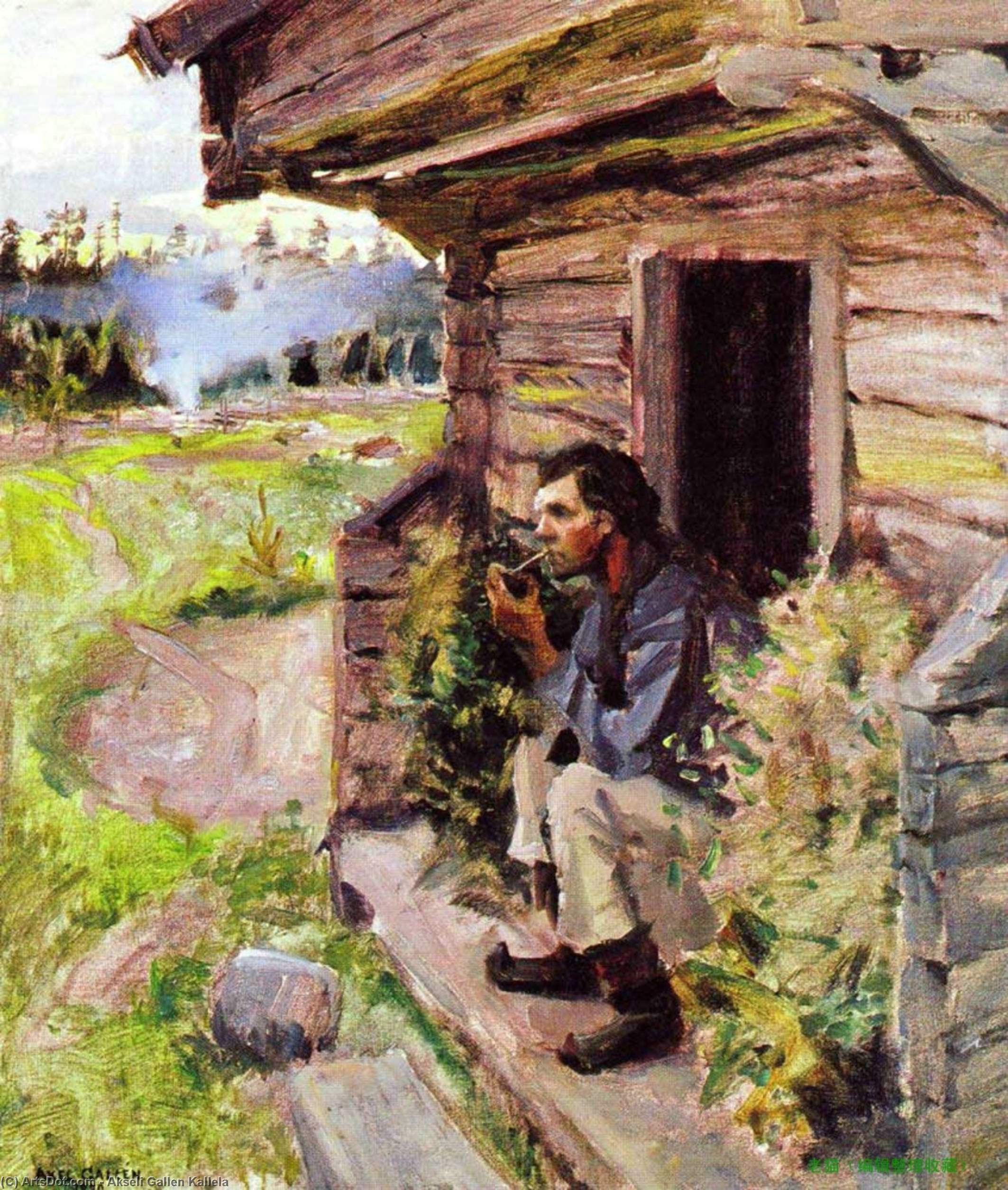 Evening Peace – Akseli Gallen Kallela. 1890. Wikioo.
“The human body, at peace with itself, is more precious than the rarest gem.”
However one works at attaining peace, it is important that we all do make some attempt to do so, for the sake of our health and well-being. Otherwise we may find it difficult to cope with life, struggling to sleep, to relax, or to work.
- Looking within

“Peace comes from within. Do not seek it without.”
Siddhārtha Gautama
Trying to find peace outside of ourselves will not be effective. Many people do this, thinking that a luxurious bubble bath, a massage, lit scented candles, a quiet garden, sitting on top of a mountain, or completing a set of tasks and exercises, will be their permanent solution. They do not realise that the answer is concealed somewhere deep within themselves.

“There must be quite a few things that a hot bath won’t cure, but I don’t know many of them.”
Sylvia Plath
Much as a hot bath may make us feel relaxed and pampered, such external experiences, whilst pleasurable in the moment, simply soothe and placate us. A hot bath is most unlikely to ‘cure’ us of anything in any depth.
In addition, a person can travel the world, but they will take their inner problems and repeated behaviour patterns with them, wherever they go, if they have not made the inward journey towards self-knowledge and change.
Without the inner journey into ourselves and our internal world, we will be totally missing the point and certainly going in the wrong direction.
“Our most important choice in life, according to Epictetus, is whether to concern ourselves with things external to us or things internal. Most people choose the former because they think harms and benefits come from outside themselves.”
William Irvine
“Life is not so much defined by the external situation as it is by the internal one.”
Jacob Needle-man
Even at times when life is very tough on the outside, if we have achieved a calm and peaceful sanctuary within our selves, we will more likely survive the distress and torment of our outer world.
“If there is peace within, no outward turmoil can affect the soul; but outward peace can never quiet an inward tempest.”
Walter Kirchbauer
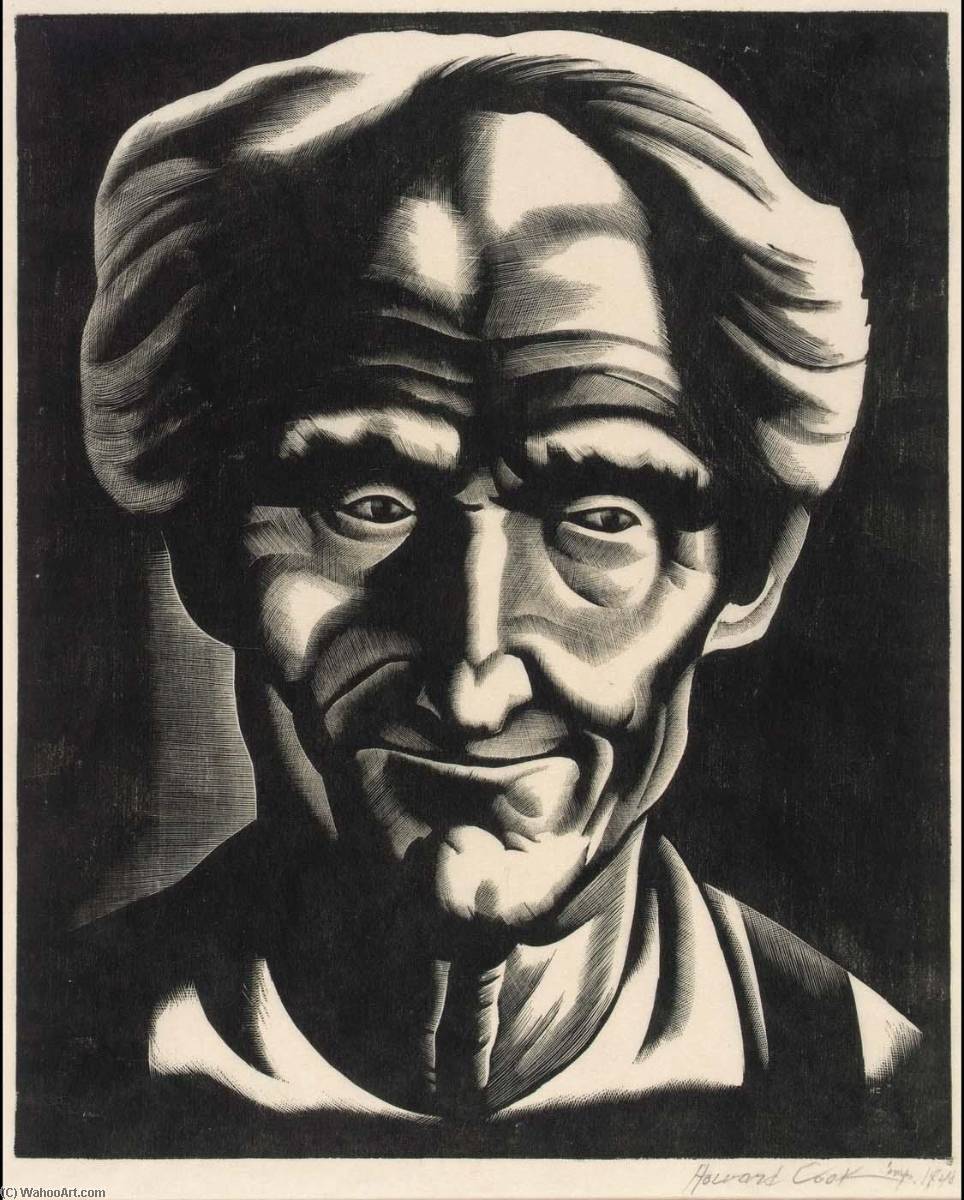 Happy Uncle. 1935. Howard Cook. Wood engraving on paper. Wikioo
“A happy heart can walk in triumphant indifference through a sea of external trouble; while internal anguish cannot find happiness in the most favorable surroundings.”
Hannah Whitall Smith
It takes courage to face ourselves and to embark on a journey into the deeper reaches of our inner self, but the rewards will be numerous and enduring. A sense of peace can be found through delving into the realms of our unconscious and working through painful issues.
“It is in the most undesirable of external circumstances that we discover internal qualities like courage, faith, compassion, inspiration, acceptance, and love.”
Christine Hassler
- Choice of response

“How much more harmful are the consequences of anger…than the circumstances that aroused them in us.”
Marcus Aurelius
If we are strongly triggered, for example, by another’s anger, then we really do need to discover what it is in our psyche that is causing us to get instantly hooked into reacting without thinking, or ‘shooting from the hip’. We have a responsibility to do that, for ourselves and our others.
“It’s time to care; it’s time to take responsibility; it’s time to lead; it’s time for a change; it’s time to be true to our greatest self; it’s time to stop blaming others.”
Steve Maraboli
 Politics. Robert Robinson, 1916. Wikimedia Commons
“If you hate a person, you hate something in him that is part yourself. What isn’t part ourselves doesn’t disturb us.”
Hermann Hesse
Without conscious awareness, we may sometimes contribute to the pain of a situation and make it even worse for ourselves. Being able to think before we speak allows us a choice, a time to decide on the best kind of response that will not aggravate existing issues.
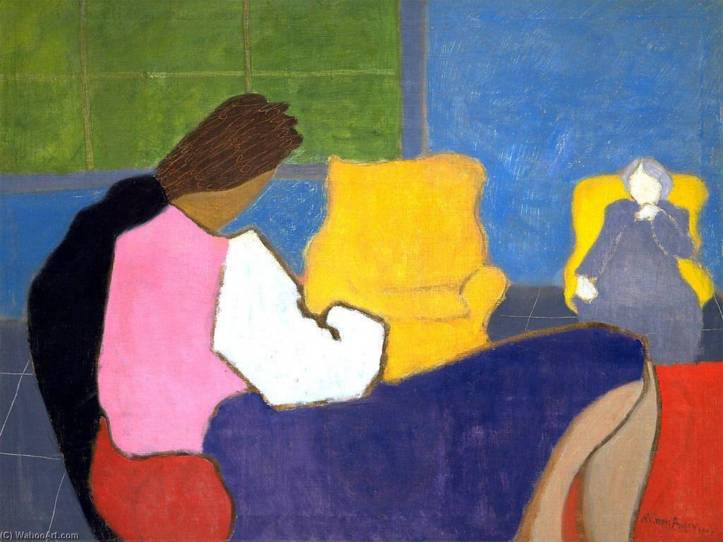 Sally and Sara – Milton Avery. Wikioo
“Every day try to convert your reactions to responses. Reactions are always instinctive, whereas responses are always well thought of, just and right to save a situation from going out of hand, to avoid cracks in relationship, to avoid taking decisions in anger, anxiety, stress or hurry.”
Abhishek Ratna
This quotation above neatly sums up the difference between two styles of communicating in relation to another person. One of them is likely to result in more peace than the other.
The key, as mentioned above, is to understand the importance of thinking before speaking. Of course, there are times when spontaneity is necessary and delightful, but we must also be able to detect when we need to have a more measured response and think carefully about possible consequences.
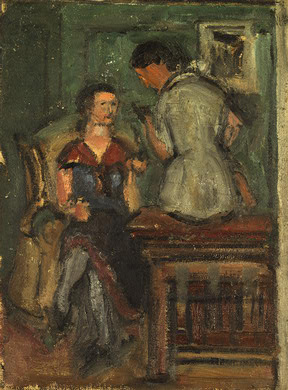
Women Talking – Mark Rothko. 1929. Wikioo
“Always ask yourself: “What will happen if I say nothing?”
Kamand Kojouri
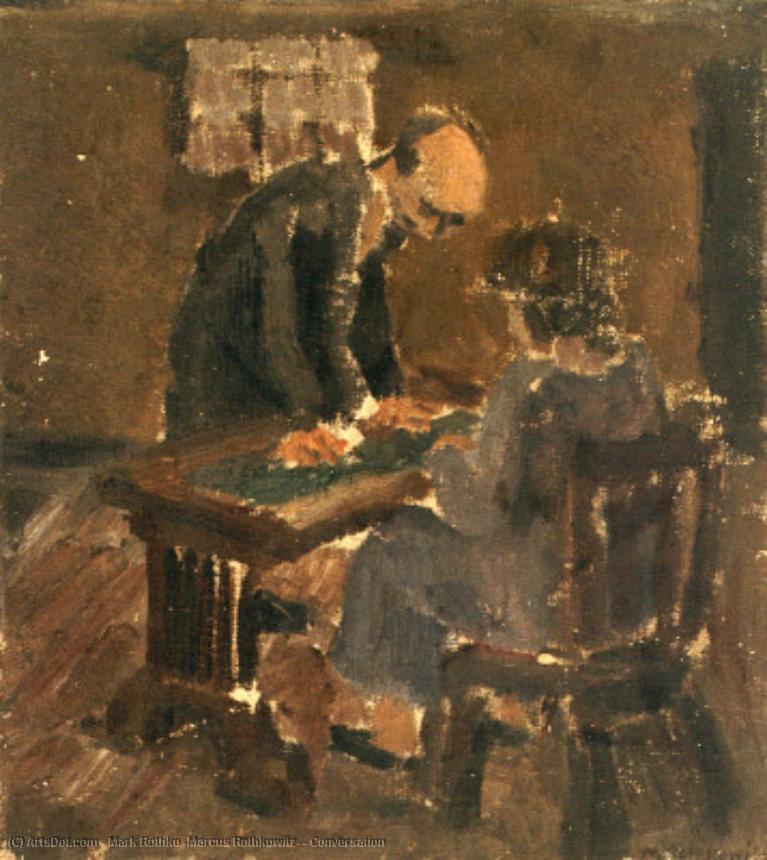 Conversation – Mark Rothko. 1932. Wikioo
“Between stimulus and response there is a space. In that space is our power to choose our response. In our response lies our growth and our freedom.”
Attributed to Viktor E. Frankl
It is important not to rise to another person’s ‘bait,’ not to let their rage become ours, not to allow it take us over to the extent that we constantly have it in the forefront of our minds.
If this is permitted to happen, it can result in a state of perpetual anger and mental disruption. It is the opposite of attaining a peaceful outlook on the world and will deplete our own store of personal power. Blaming another for our anger will mean that we have no agency to alter anything, for we cannot change another person… we can only change ourselves, from within.
Sometimes, walking away from a person or a situation may be the best response.
- ‘An invincible summer’: discovering our peaceful place inside
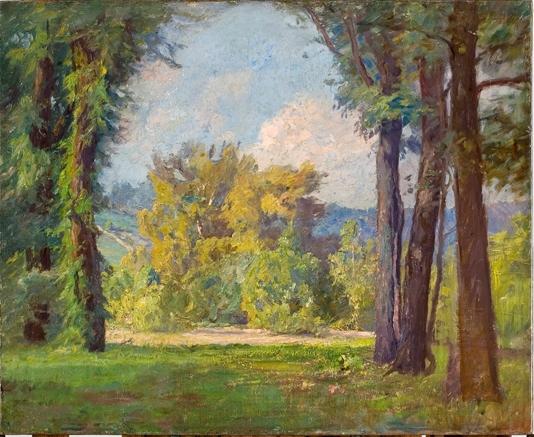
Radiant Day in Late Summer (Mid-Summer) – Theodore Clement Steele. (1847-1926) Wikioo
“In the midst of winter, I finally learned that there was in me an invincible summer. And that makes me happy. For it says that no matter how hard the world pushes against me, within me, there’s something stronger – something better, pushing right back.”
Albert Camus
In this wonderfully inspiring quotation, Camus is saying that, no matter how hard the external situation is, he is sure there is always a healthy and peaceful sanctuary inside himself. He knows himself, and is aware that he has the indomitable strength and resilience to ‘push right back,’ and that brings him peace and hope.
Winter symbolises the cold and the miserable parts of life, and summer represents the opposite, the more peaceful times in our lives. Camus realised that he could survive the dark times because he felt internally grounded in a bright place, the ‘invincible summer’ he had not previously realised existed within. This may be true for many of us, and it is important to discover the peace of our inner light.
The benefits of a quiet conviction within our inner world that we can survive and overcome life’s difficulties cannot be underestimated.
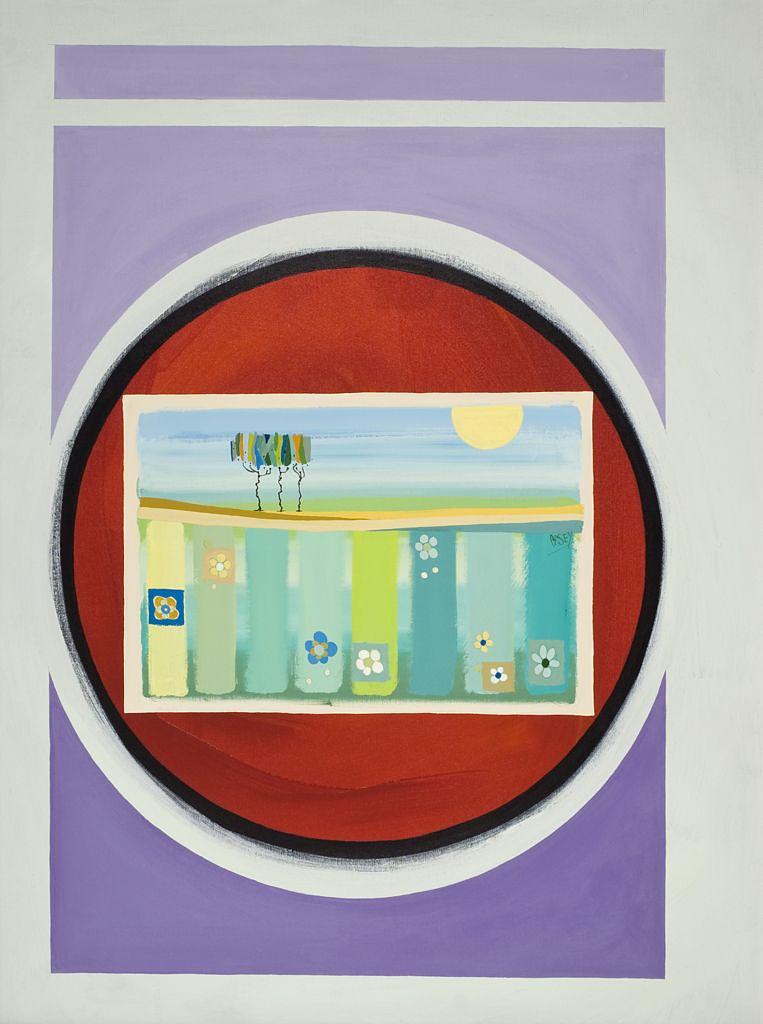
Inner Landscape – Bernie Casey. 1970. Wikioo
“Do not let the behavior of others destroy your inner peace.”
Dalai Lama
Life is full of stormy weather, stormy relationships and stormy people. If we constantly take on board others’ disturbance, we will inevitably feel disturbed ourselves. Other people can only affect us if we allow them to do so.
Blaming the outside world, or someone else, for provocation or for ‘causing’ our reactions is a denial of the reality of our own choice, our own agency.
If we are able to face ourselves, to understand ourselves and the roots of our own negative behaviour patterns, then we may learn to understand and cope with the most difficult of external pressures, whether from difficult events or difficult people.
“Without inner peace, outer peace is impossible. We all wish for world peace, but world peace will never be acheived unless we first establish peace within our own minds. We can send so-called ‘peacekeeping forces’ into areas of conflict, but peace cannot be oppossed from the outside with guns. Only by creating peace within our own mind and helping others to do the same can we hope to achieve peace in this world.”
Geshe Kelsang Gyatso
The human psyche was seen by many ancient philosophers as a reflection, a microcosm of the Universe, the macrocosm in which we live. Therefore, ideally, a peaceful outer world is reflected in our inner worlds. Everything is connected.
“Man is a microcosm, or a little world, because he is an extract from all the stars and planets of the whole firmament, from the earth and the elements; and so he is their quintessence.”
Paracelsus
When the outside world and our inner world are largely in alignment, we will feel more peace than if there is a jarring discord between these two worlds, experiencing hatred and enmity towards others.
 Edward Robert Hughes . 1912. Night with her Train of Stars. Wikimedia Commons
“We shall find peace. We shall hear angels, we shall see the sky sparkling with diamonds.”
Anton Pavlovich Chekhov
© Linda Berman
Next week, in part 2, I will explore the concept of toxic energy that can be inside some people, and how we might protect ourselves from this.
© Linda Berman
 waysofthinking.co.uk