
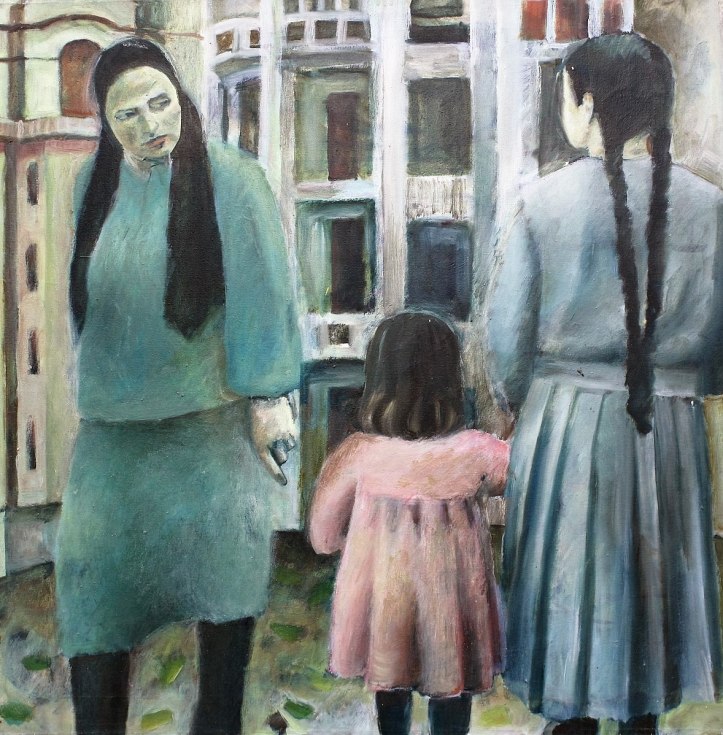
 Nomi Tannhauser. 2016. Gaze. Wikimedia Commons
The gaze describes how we look at other people, our ‘ways of seeing.’ (John Berger.) It is an intense kind of looking, where the eyes are fixed attentively on someone or something. Our gaze will, inevitably, affect the object of our attention.
This effect will take several forms, as there are many different kinds of gazes and expressions of visual interest, some good, some neutral, some not so good. If the gaze is loving and caring, and if the recipient has similar feelings, this gaze will likely provoke something similar in terms of affection. If it is piercing, aggressive and invasive, the other will feel uncomfortable, angry and intruded upon.
- In the beginning ...
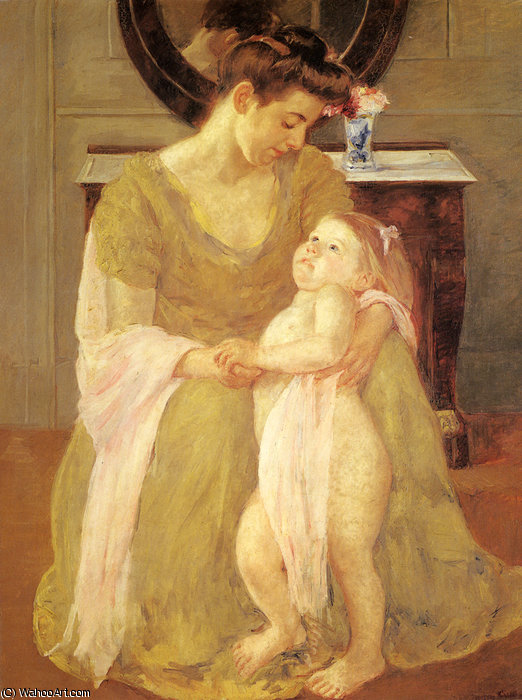
Mother and Child – Mary Stevenson Cassatt.1908. Wikioo.
‘The mother gazes at the baby in her arms, and the baby gazes at his mother’s face and finds himself therein… provided that the mother is really looking at the unique, small, helpless being and not projecting her own expectations, fears, and plans for the child. In that case, the child would find not himself in his mother’s face, but rather the mother’s own projections. This child would remain without a mirror, and for the rest of his life would be seeking this mirror in vain.’
D.W. Winnicott
Winnicott is describing the first gazes that we usually encounter, those of the parent or the main carer. It is crucial, he says, that, when this person looks at their child, they see the child for who they are, and not for what they, the parent, expects them to be.
The child needs to see themselves reflected in the adult’s eyes, so that they can gain a strong sense of self, a sense of who they are.
Ways of thinking about ourselves develop from these early experiences with our first caregivers, whatever their gender. The responsiveness of the other person to the child, the way in which the child’s image is mirrored and reflected in the parent’s eyes, crucially influence the child’s self image.

A significant other who is not empathic, who cannot attune to the child’s needs, will not be able to help that child develop a sense of self that is cohesive and sustaining. The way the parent thinks about and gazes at their child will form and affect the manner in which the child thinks about themselves.
 Harsha K. Ojas’ First Shoot.2013. Flickr.
“As a therapist, she knew a baby’s first sense of self comes through its parents’ gaze. We are born being watched – our parents’ expressions, what we see reflected in the mirror of their eyes, determines how we see ourselves.”
Alex Michaelides
- The animal gaze
Animals are often seen, and depicted in art, as marginalised and far from central. Historically, they have not been shown as having their own agency, but as a sideline in art or photography. Their gaze is usually towards a human or elsewhere; it has rarely been a face-forward gaze out of the image, as a human’s often is.
 Charles J. Chaplin-Girl in a Pink Dress Reading, with a Dog. c19th. Wikimedia Commons.
Perhaps now, this lack of centrality is changing and animals are being seen as more than decorative accessories to the human figures.
I have painted several different kinds of owls, and my aim has been to accord the animals centrality, agency, and the right to be the focus of my work.
The animal gaze is no ordinary gaze; it is that of another being, asserting their own agency. It challenges assumptions of human primacy. It is there in my series of paintings of wild birds, mugshot-style, challenging marginalisation, facing us. Here is one example…

Marvin. © Linda Berman.
Painting the animal portrait, without objectification, accords the animal importance, gives them focus and reveres their individuality and consciousness. Their gaze becomes that of a sentient being with rights, unlike the generalised ‘cute’ or ‘loyal to humans’ images that are often found in art.
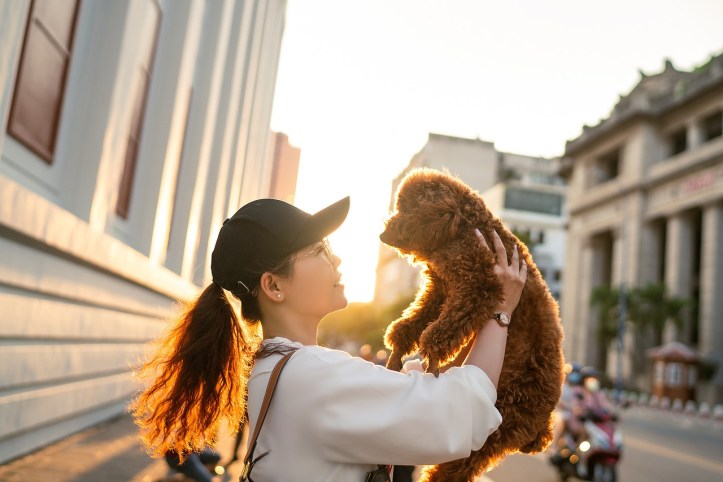
“Research published in the journal Science in 2015 reported that simply gazing into each other’s eyes causes a tremendous spike in oxytocin levels in both dogs and dog guardians.
Of the duos that had spent the greatest amount of time looking into each other’s eyes, both male and female dogs experienced a 130 percent rise in oxytocin levels, and both male and female owners a 300 percent increase.”
The Wet Nose Blog.
Animals bring us pleasure and comfort; the same hormone that is detected in parent and baby when they gaze into each other’s eyes can be also detected in dogs and humans doing the same.
- The male gaze
 The Proposition, or Man offering money to a young woman (1631). Judith Leyster. Wikimedia Commons.
The male gaze is traditionally depicted focussing on a passive, powerless or uninterested female. It is often a look that objectifies women, projecting the male’s sexualised ways of seeing onto the observed woman.
This can be seen especially in old sexist photographs and advertisements, where scantily-clad women adorn the bonnet of fast cars, or pose subserviently for the male gaze, the men often being depicted as dominant and more knowledgeable.
 His Girl Friday (1940 poster)Wikimedia Commons.
- The female gaze
 Alexej von Jawlensky – Spanish Dancer [1909] Gandalf’s Gallery. Flickr.
If the male gaze has tended to objectify, how is the female gaze depicted ? This has more likely been inward-looking, passive, receptive. However, over the years, it has become more purposeful, empowered, and has increased agency.
Compare and contrast the paintings above and below!
“The first feminist gesture is to say: “OK, they’re looking at me. But I’m looking at them.” The act of deciding to look, of deciding that the world is not defined by how people see me, but how I see them.”
Agnes Varda
- Gazing into the abyss…

The Red Gaze. Arnold Schoenberg. 1911. Wikimedia Commons.
“Whoever fights monsters should see to it that in the process he does not become a monster. And if you gaze long enough into an abyss, the abyss will gaze back into you.”
Friedrich Nietzsche
Nietzsche’s wise quote highlights a very important point; he is saying that if we are having an altercation with those who are regarded as evil, if we gaze too long into their wicked eyes, then we need to take care that we, too, do not become evil and monstrous.
An example of this would be if we react to being mistreated by gaining revenge in a way that sees us behaving as bad as, or even worse than, the original perpetrator.
 Gallen-Kallela Joukahainen’s Revenge. 1897. Wikimedia Commons
- On not being gazed at…
 Edvard Munch – Self-Portrait with a Bottle of Wine. 1906. Wikimedia Commons.
Our need to be seen and reflected by others is hard-wired into our psyche; being overlooked for whatever reason can feel like an awful punishment. Feeling disregarded and ignored will have a highly deleterious effect on us.
We are social beings, and the pain of being unnoticed can be acute. It takes a good deal of strength and resilience to manage such experiences. When no-one makes eye-contact with you, there will be a feeling of isolation and rejection…
“What’s worse than being hated is being ignored, because it’s like you don’t exist at all and your presence is nothing.”
Anurag Prakash Ray
- Really being seen and seeing the other…
 Edvard Munch – Eye in Eye. 1899-1900. Wikimedia Commons
“…to gaze into the face of another is to gaze into the depth and entirety of his life.”
John O’Donohue
Being really seen makes us feel real and affirms our identity and our humanity. Gazing into another person’s eyes, looking beyond the surface of another human being, helps us to gain knowledge of that person on a deeper level. Returning their gaze, in a respectful and caring manner, will create a connection, a real meeting…
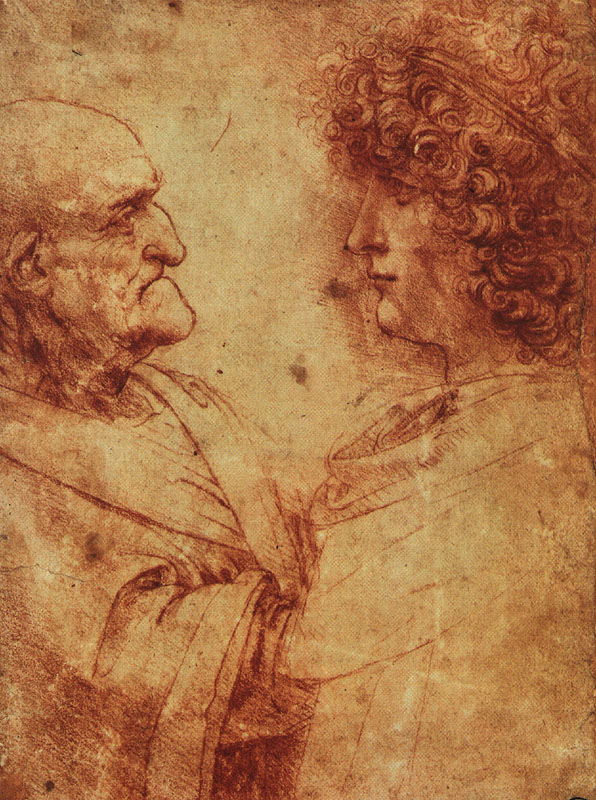
Leonardo da Vinci. Two heads. End c15th, beginning c16th. Wikimedia Commons
“To look at something that can gaze back at you, or that has a reserve and depth, can heal your eyes and deepen your sense of vision.”
John O’Donohue.
© Linda Berman