
Quote 1
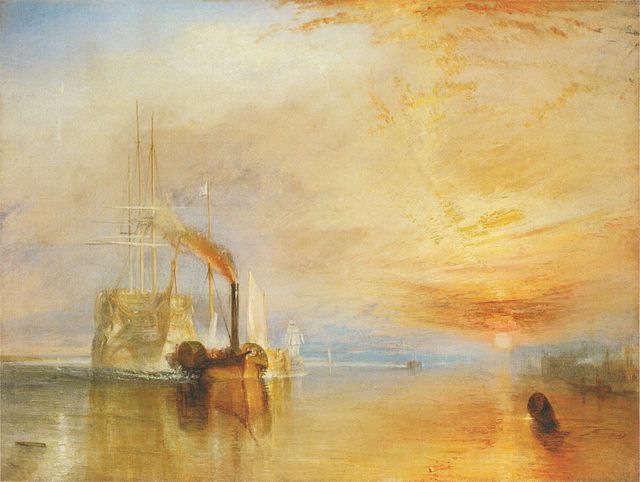
J.M.W. Turner – The Fighting Temeraire (1839)Wikimedia Commons
‘Our thesis is that symbols and myths are an expression of man’s unique self-consciousness, his capacity to transcend the immediate concrete situation and see his life in terms of ‘the possible,’ and that this capacity is one aspect of his experiencing himself as a being having a world.’
Rollo May
Myths are traditional, long-established stories that explain and clarify a culture’s ideas, worldview and ways of thinking. Thus they reflect human beliefs and values, aiming to convey meaning and to help people understand some of the deeper issues in life. Their messages are often universal and timeless, so that we can comprehend our world through their age-old wisdom.
Symbols are deeply embedded in myths; they involve the use of images that signify more complex meanings. An object that seems apparently concrete and simple can represent ideas that are bigger and more abstract, such as a red rose symbolising love, or an owl representing wisdom and learning.
Myths and symbols help us to understand the ways in which people experience the world. They reflect human life, its struggles and its challenges. We can all recognise aspects of our own experiences in many of the myths; these special stories can, and do, help us through some of life’s most testing times.
The stunning work by Turner, above, could be interpreted as illustrating one of Rollo May’s thoughts on symbols, for it really does reflect the human being’s ‘capacity to transcend the immediate concrete situation and see his life in terms of ‘the possible.’
Here, ‘the possible’ could be seen as the imminent rise of steam-powered ships, a huge technological move forward in the field of navigation.
This ship was prominent in the Battle of Trafalgar, playing a leading part in the British victory. In the painting, the old ship is now at the end of its life and is being led to the shipyard to be taken apart, having served so valiantly. Here it is, on its final day. The painting appears to symbolise the idea of moving on with hope and the passage of time.
Quote 2
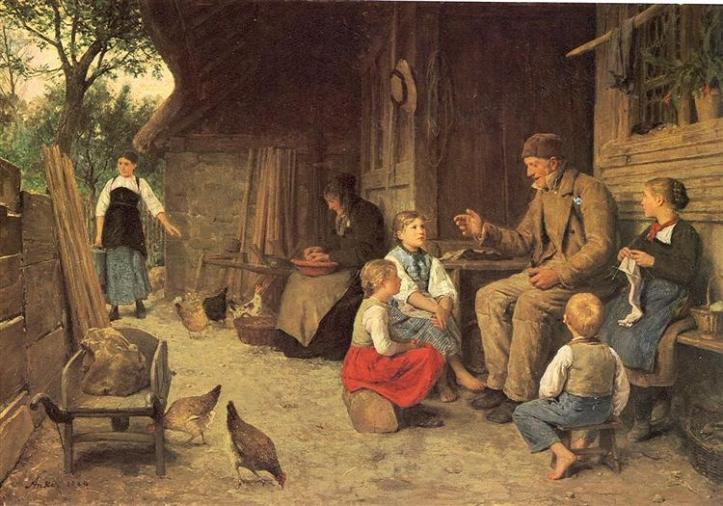 Grandfather Telling a Story. 1884. Albrecht Anker. Wikimedia Commons
“Belonging is not merely about being with others—it is about sharing a common myth, a shared vision that gives life coherence.”
Rollo May
The quotation above is important in terms of highlighting the connection between myths and belonging. It reveals how important are myths in providing a kind of ‘home’ for people, a sense of community and mutual understanding. Sharing common myths can serve as a sort of passport that indicates affiliation and connection.
Myths help to forge our identity and such stories are crucial in everyone’s life, as they help to define who we are. However, it is also important to remember that myths may sometimes have detrimental effects. They are created by human beings, not all of whom are wise. Some myths also become distorted through time, or reflect superstitious ideas that may be bigoted or have long been discarded.
For example, those cultural stories that are based on our own personal value being dependent on how much wealth we may have, how religious we are, or how ‘strong’ we are meant to be for others, can encourage us to feel worthy only if we can achieve these skewed, culturally-based mythical values. People who do not take on board these ideas and reject peer pressure to conform, may feel excluded, rejected or ostracised by their community.
In contrast, in relation to myths that are uplifting and helpful to people, stories like the phoenix rising from the ashes encourage people to be resilient, to embrace new beginnings or to reinvent themselves.
Quote 3
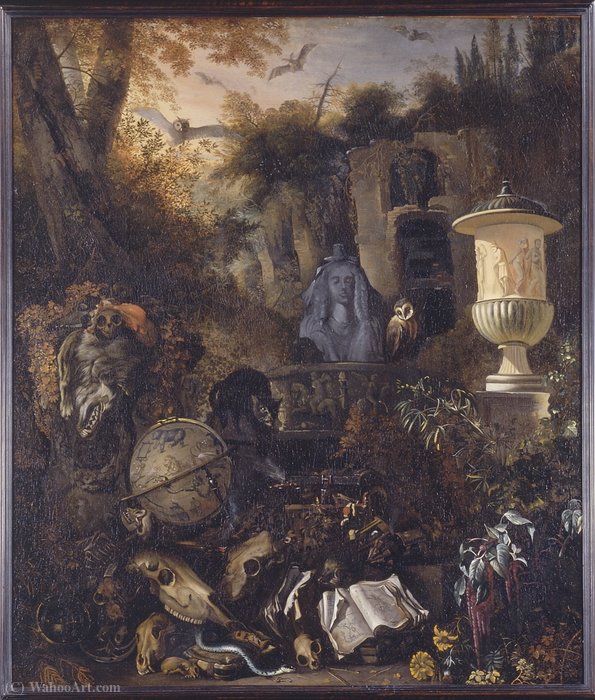
Vanitas symbols in a landscape – 1627. Matthias Withoos (Calzetta Bianca.)
“The collective unconscious contains the whole spiritual heritage of mankind’s evolution born anew in the brain structure of every individual.”
Carl Jung
- Personal and universal myths and symbols
The eminent psychotherapist, Jung, believed in the idea of the Collective Unconscious.
This is the part of the unconscious mind that is not created through personal events in our lives, but is made up of a shared, inherited set of concepts common to all humans. These universal, inborn, themes, ideas and ways of thinking were seen by Jung as explaining why people tend to have similar myth and dream symbols throughout the world.
Analytical psychology, founded by Jung, focusses on the client’s experience of the collective unconscious and its recurring archetypes; these are innate and archaic symbols that include, for example, the persona, the shadow, the anima and animus and the self. These are Jung’s four main archetypes.
Jung believed that the unconscious was made up of a personal part and a collective part. The personal unconscious incorporates our memories of experiences throughout our lives, some of which may be repressed. However, these may still affect our lives today, without our conscious awareness of their existence. They may surface, however, in dreams, where we will discover both personal and universal symbols.

Tatiana Larina’s dream by Volkov (1891)Wikimedia Commons
“The unconscious mind is like a language—its symbols are not random, but have specific meanings we must learn to decode.”
Jacques Lacan
Myths and symbols have, from the earliest days, represented the human need to create meaning, to explain the unknown mysteries around us. They come from several sources, including visions, dreams, experiences and the natural world. They are passed down orally or through writing.
These stories are created by a culture, a group of people, rather than an individual. Told and retold, the cultural stories alter and develop over time, evolving through the influence of other cultures, helping a culture form its own values and identity. They bond people, connecting them through being shared.
Are there myths and symbols that strongly resonate with you? Are there symbols or themes that recur in your dreams?
Quote 4

The Birth of Venus. Sandro Botticelli (1484-1486)Wikimedia Commons.
“Beautiful are those whose brokenness gives birth to transformation and wisdom.”
John Mark Green
This quotation and its use of ‘giving birth’ as a symbol for a kind of psychological renewal and regeneration, is beautifully illustrated by Botticelli’s painting.
This iconic portrayal of the Roman goddess above is replete with symbols; the figure of Venus herself expresses female sexuality, beauty, and a love that is divine and godly. She emerges from a huge shell, as if new-born, symbolising promise, fresh hope and new awakenings.
The work also symbolises the creative power of different aspects of nature working together and also the energy of the feminine. The sea can be seen as representing the unconscious, out of which Venus, a symbol that also represents fertility, creativity, balance, beauty and enlightenment, emerges into consciousness.
The roses and myrtle in the painting both symbolise love; the male figure is Zephyrus, god of the soft wind of spring. Even today, we can all relate to these kind of symbols and themes, they are universal.
Quote 5

Marc Chagall, “American Window Panels” (1976–1979), Art Institute of Chicago.<br>
Photograph by James Diedrick, 2010. Image hosted on <a href=”https://www.flickr.com/photos/your-link-here” target=”_blank”>Flickr</a>.<br>
Used for educational/commentary purposes.James Diedrick. JKD Atlanta. Chagall. 1976-9. Art Institute of Chicago. American window panel. Uploaded 2010. Flickr.
“The symbols of mythology are not manufactured; they cannot be ordered, invented, or permanently suppressed. They are spontaneous productions of the psyche, and each bears within it unmeasured depths.”
Jung
Chagall’s floating people appear many times in his works. His art is replete with both personal and universal myths, symbols and mysticism. In his wonderful stained glass windows, like the one above, we can see people floating through the air, defying gravity, dream-like.
They may symbolise transcendence, perhaps through religion or love, where people are raised above everyday life into an altered reality, drifting gently through the rarified atmosphere of new and mystical landscapes. Their experiences have been, quite literally, uplifting. Dreams about flying can feel wonderfully empowering to the dreamer.
In other works, the many floating lovers Chagall paints may be a reference to his relationship with his wife, Bella, which was very close and deeply loving. She was also his muse and inspired him greatly. Chagall was devastated when she died in 1944, and painted several figures in white in his works as a tribute to her.
In a contrasting style, Tracey Emin creates highly symbolic, very personal symbols in her work; an example is her installation My Bed.
The image, below, shows this artwork which represents an unmade bed and a rug covered in a messy tangle of objects. These were the detritus left after Emin spent a very depressed few days in bed after the end of a relationship.
Amongst the mess were a pregnancy test, tissues stained with menstrual blood, empty vodka bottles and other very personal items. She was having a difficult time, not eating, but smoking and drinking alcohol.
When she eventually got out of the bed, she surveyed the mess she had made, and realised that it was, in fact, more than an unmade, untidy bed. It was a work of art.
In allowing this installation to be exposed to the world, Emin revealed just how painful life can be. Most people would not want this intensely personal pain revealed so graphically to the world, but Emin is courageously unafraid of showing her depression, her pain and her mess, both physically and psychologically.
This is a confessional work, one that must have brought relief to many who saw it, those who have, perhaps, kept their messy states secret, or behind closed doors. The installation is symbolic of the mess inside, her psychic mess. The emotional disturbance and depression she experienced, and the resulting mental chaos, are symbolised by the physical mess she has created in this powerfully symbolic work.

Karen V Bryan. ‘My Bed’ by Tracey Emin at Tate Britain London. http://www.europealacarte.co.uk/blog/ Flickr.
To be continued: next Tuesday’s blog post will focus on the use of myths and symbols in psychotherapy.
© Linda Berman