
- Puzzlement helps us to be creative
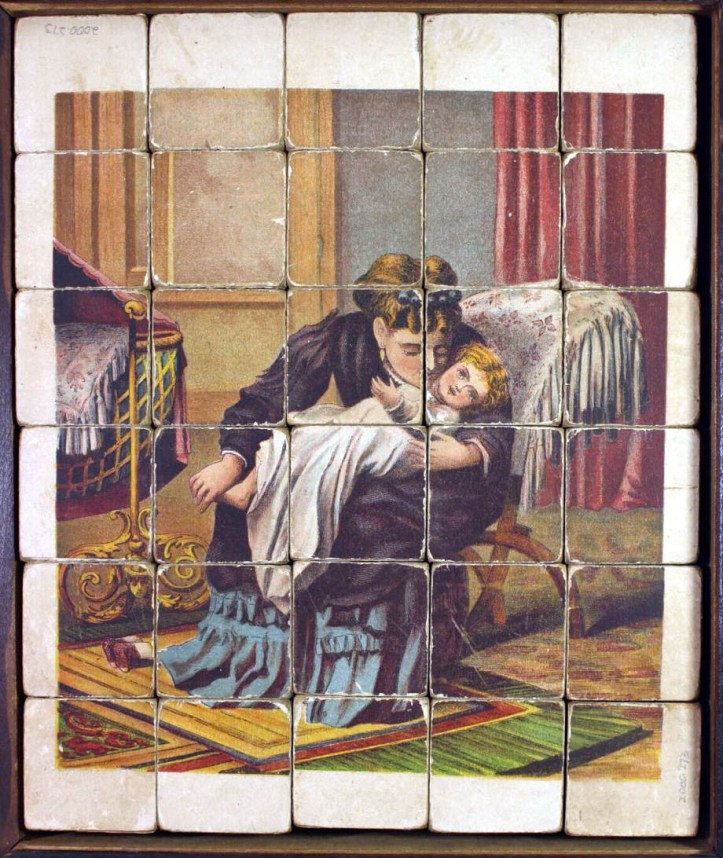
Aunt Louisa’s Cube Puzzles: My Mother. 1888. Wikimedia Commons
“The capacity to be puzzled is the premise of all creation, be it in art or in science.”
Erich Fromm
What would life be like if we never experienced puzzlement, if we were always clear and certain, without doubt?
Living without puzzlement would make us feel bored and stuck. With everything plain and uncomplicated, life would hold no surprises; it would be static, with little excitement and no creativity.
Many times, as life goes by, we are all fumbling in the dark, wondering what may happen, hoping that life will be good to us.

Vicky in Bath. 2003.The Happy Isles – Magic Puzzle Company – 1000 pieces. Sarah Becan. Flickr
“Life is like a puzzle, but you don’t get to see the box.”
Eddy Yu
A jigsaw puzzle without the picture on the box as a guide is a pretty tough challenge. Life, too can be tough, just like a puzzle, as the quotation tells us, and we do not have any guiding image to help us through.
‘Not seeing the box’ of life, however, means we will have to be creative if we want to move on. Without a clear roadmap of which way our life will go, with no ready-made picture-box image of the future, to some extent we will need to be the ‘puzzle solver’ of our own lives, taking responsibility for ourselves and the direction in which we will travel.
We will, of course, experience doubts and fears along the way, wondering if we are taking the ‘right’ direction through life, making appropriate decisions, weathering storms, coming to helpful conclusions.

Thomas Cole – The Voyage of Life (Manhood) 1842. Wikimedia Commons
This state of being uncertain may feel precarious; however, we need to experience it if we are to become wise, thoughtful and reflective. Without wondering, curiosity or questioning, there will also be no place for originality or creativity.
Life may be uncertain, unpredictable, and at times absurd, but that does not mean we are without any power.
We can still make decisions, but we need to make them with an awareness that things can, and do, change in the blink of an eye. Then we may need to use all the creative ways of thinking that we can muster.
2. Being puzzled helps us to learn
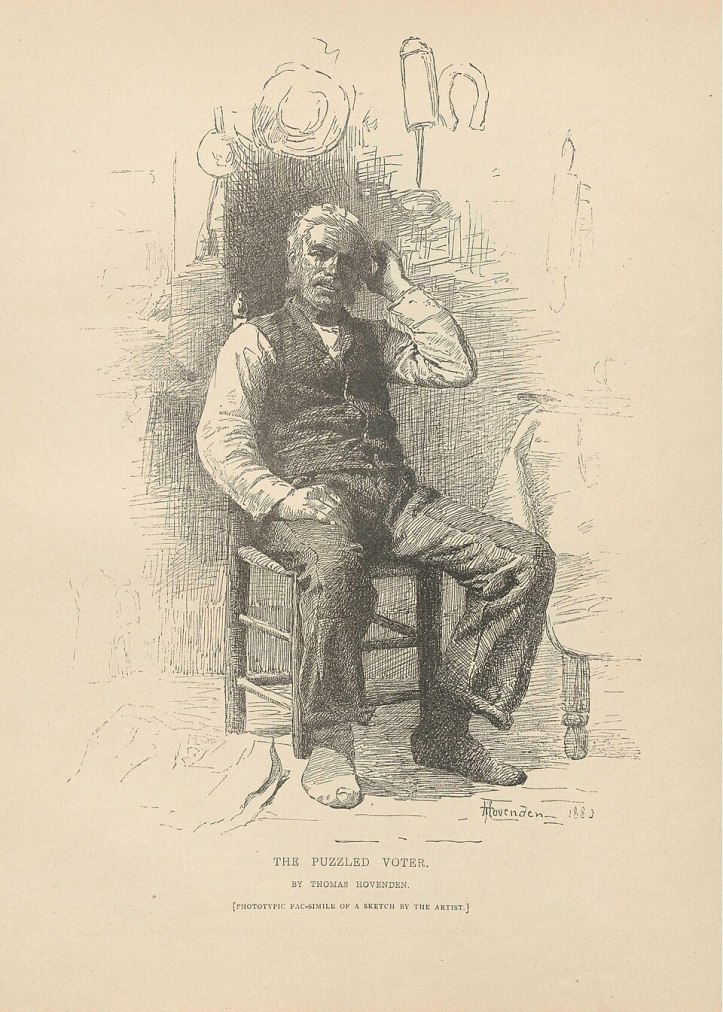
The Puzzled Voter by Thomas Hovenden. 1889. Wikimedia Commons
“..another way of learning for me is to state my own uncertainties, to try to clarify my puzzlements, and thus get closer to the meaning that my experience actually seems to have.”
Carl R. Rogers
Being entangled in ‘puzzlements’ can be a healthy, learning experience, even though it may feel uncomfortable at times. If we can face our predicaments, grapple with them, then, as Rogers says, we may begin to understand, and to find ‘meaning’ in our lives.
Not only this, but if we can accept that the way through will, inevitably, be puzzling and unclear, then we will experience the rewards of a life that is potentially ‘fluid, perplexed and exciting.’
“I realize that if I were stable, prudent and static; I’d live in death. Therefore I accept confusion, uncertainty, fear and emotional ups and downs; because that’s the price I’m willing to pay for a fluid, perplexed and exciting life.”
Carl Rogers
3. Puzzlement and paradoxes
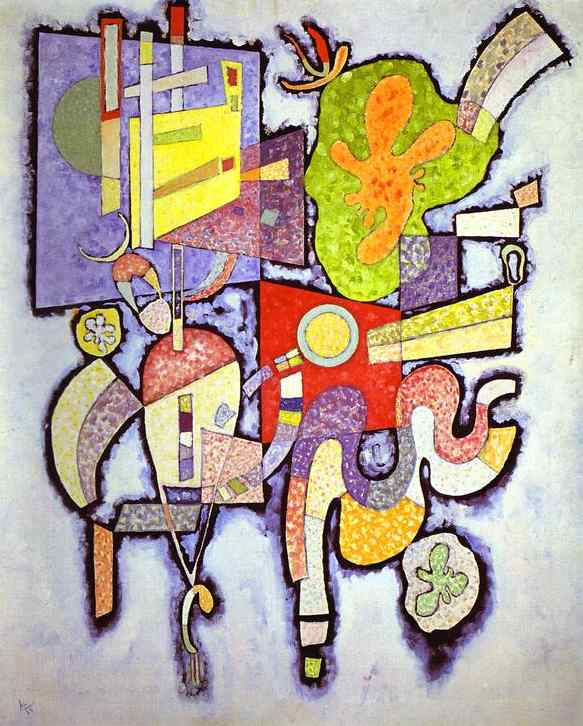
Wassily Kandinsky. Complex-Simple. 1939. Wikimedia Commons
“The art of simplicity is a puzzle of complexity.”
Douglas Horton
“Creativity happens in the transition between order and chaos.”
Andrew Davenport
Puzzles are very often paradoxical; they can be both simple and complex. We may feel at a loss to solve them, in a state of perplexity, confusion and chaos. Paradoxes can create extra perplexity, for they are about seemingly contradictory statements, or images, where both sides of the contradiction can be true.
They teach us that there are no absolutes, that reality and truth are complex issues, that contrary views can both contain the truth, that nothing is as it seems. These are valuable lessons that can only guide us on our path through life.
“Take the road to contradiction, it’ll lead you, I promise, to the palace of wisdom.”
Frank Lentricchia
If both sides of the contradiction are true, can we hold onto the truth of both sides simultaneously in our minds? Are we flexible enough to do this?
“What we call the beginning is often the end. And to make an end is to make a beginning. The end is where we start from. “
T.S. Eliot.
Eliot’s words present us with a somewhat perplexing paradox, apparently contradictory, certainly puzzling. When we take time to think about his words, we will understand that he is alluding to the cyclical nature of time, and of life. This quotation is pointing to the fact that time doe not run in a straight line, it can move in a spiral or circle, and that endings can therefore signal new beginnings.
If we stay with a puzzle, such as the one presented by Eliot, taking appropriate breaks, out of an apparent jumble of ideas and thoughts can emerge something clear and comprehensible.
Have you ever been stuck when doing a crossword, given up in frustration, and then solved it at first look hours later?
Have you ever gone to bed thinking about what seems an insoluble problem and then woken up in the morning with some kind of answer? The power of our unconscious mind, if we trust it to help us through our perplexity, is immense.

Ślewiński Śpiąca kobieta z kotem 1896 (Sleeping Woman With Cat)Wikimedia Commons
“It is a common experience that a problem difficult at night is resolved in the morning after the committee of sleep has worked on it.”
John Steinbeck, Sweet Thursday
- Hiding our perplexity
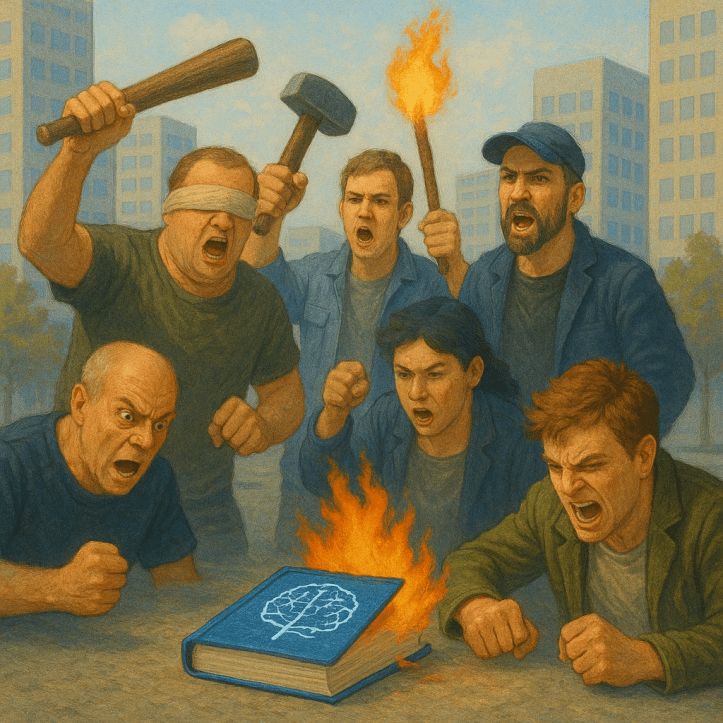
“It is the nature of stupid people to hide their perplexity and attack what they cannot grasp.”
John Gardner
Attacking what we do not understand can be a defence against covering up feelings of stupidity.
Not-knowing, staying with uncertainty, can, in fact, be a wonderful way of eventually coming to understanding, but this requires having the patience to wait until a solution emerges. It is certainly not stupid not to know an answer. Many people jump in with false information, just to fill the space with words, or with any kind of impulsive answer, or with criticism. This is in order to try to mask a lack of comprehension, and perhaps some envy.
“Obscurity is dispelled by augmenting the light of discernment, not by attacking the darkness.”
Socrates
“Mediocrity always attacks excellence.”
Michael Beckwith
- The wondrous perplexity of nature
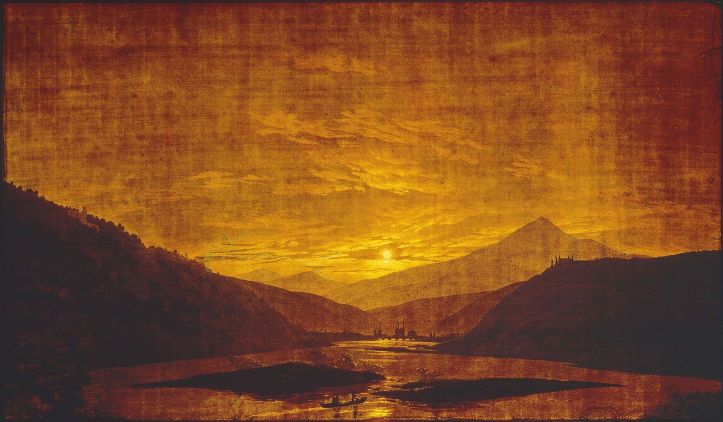
Mountainous River Landscape by Caspar David Friedrich.Between 1830 &1835. Wikimedia Commons
“I remember I would not stand still; I would not stop being perplexed by everything that spontaneously attracted me or caught my attention. I would never cease to look around me and observe myself in relation to nature: either crystal clear skies and sun-melting afternoons, or foggy winter days and weirdly tinted nights.”
Virginia Woolf
Nature itself can present us with many puzzlements and a multitude of unanswered questions, and yet, like Virginia Woolf, we may learn much about our own lives if we closely observe the natural world around us.
Looking at ‘ourselves in relation to nature,’ can help us be less perplexed, as we discover that everything is connected and we are part of a universal system.
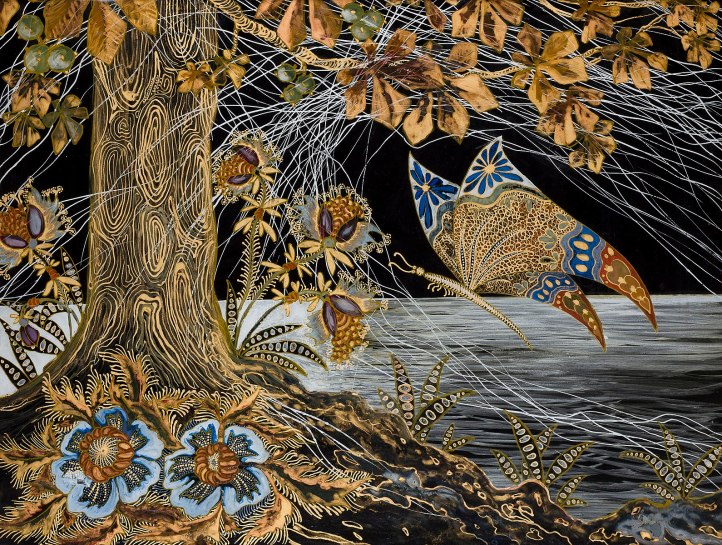
Michalina Janoszanka – Motyl. 1920-29. Wikimedia Commons
“And while I stood there I saw more than I can tell, and I understood more than I saw, for I was seeing in a sacred manner the shapes of things in the spirit, and the shape of all shapes as they must live together like one being.”
Black Elk, Black Elk Speaks
 Steffen Schobel. Heartbeat of a tree / Herzschlag eines Baumes. 2022. Flickr
“The goal of life is to make your heartbeat match the beat of the universe, to match your nature with nature.”
Joseph Campbell
Of course, there remain huge mysteries that still puzzle and perplex us; we may, however, gain comfort in our perplexity by ‘listening’ to the messages that nature sends us in a myriad of subtle ways. Nature can show us the importance of patience and waiting; it can provide the peace, the sweet scents and the stillness that we need for reverie and creativity.
“There is a way that nature speaks, that land speaks. Most of the time we are simply
not patient enough, quiet enough, to pay attention to the story.”Linda Hogan
I will end this post with a collection of beautiful images and thoughtful quotations around how nature can help us understand ourselves, our lives and the world…
“An individual’s harmony with his or her ‘own deep self’ requires not merely a journey to the interior but a harmonising with the environmental world.”
James Hillman
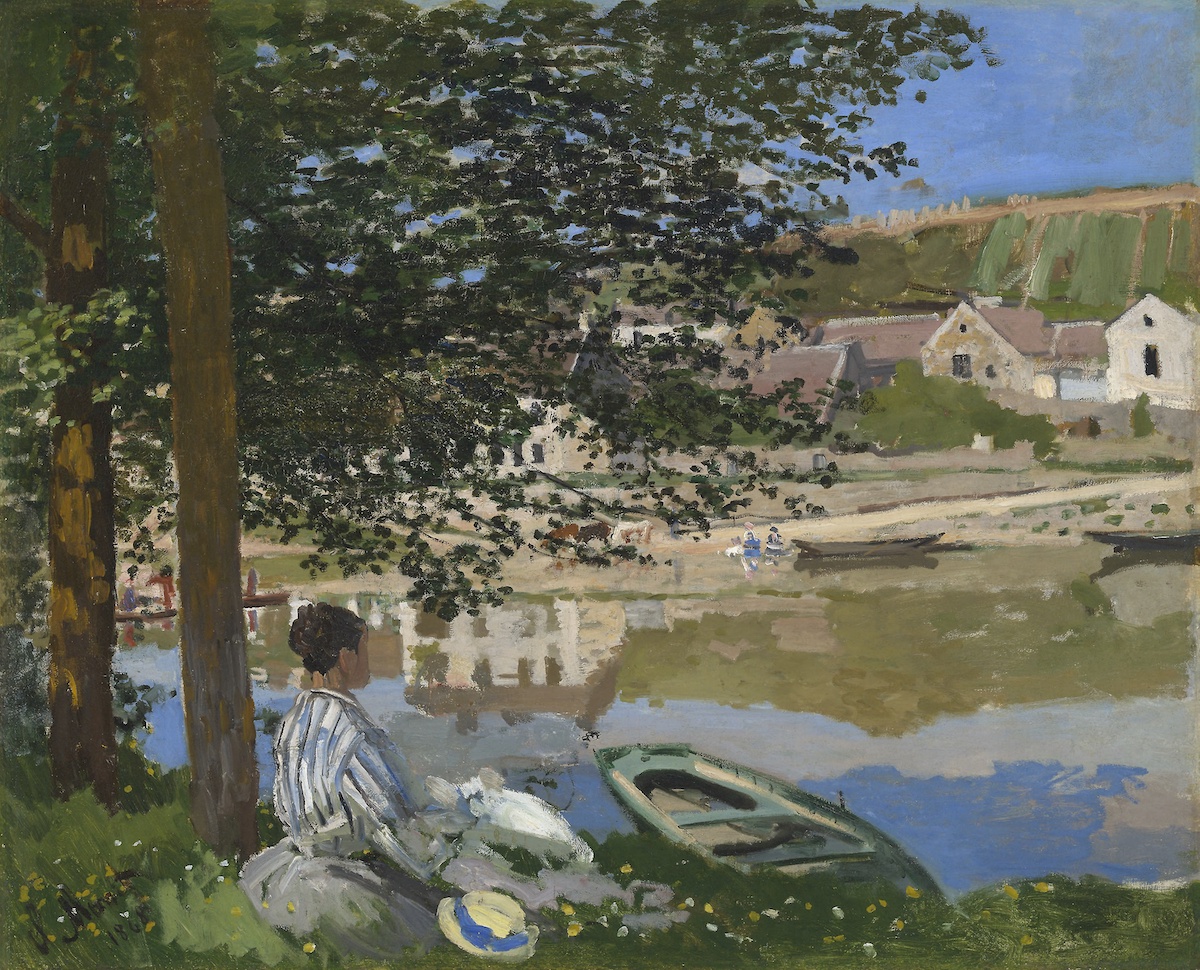 Claude Monet, On the Bank of the Seine, Bennecourt, 1868. Wikimedia Commons.
“My only desire is an intimate infusion with nature, and the only fate I wish is to have worked and lived in harmony with her laws.”
Monet.
“Observe the wonders as they occur around you. Don’t claim them. Feel the artistry moving through and be silent.”
Rumi
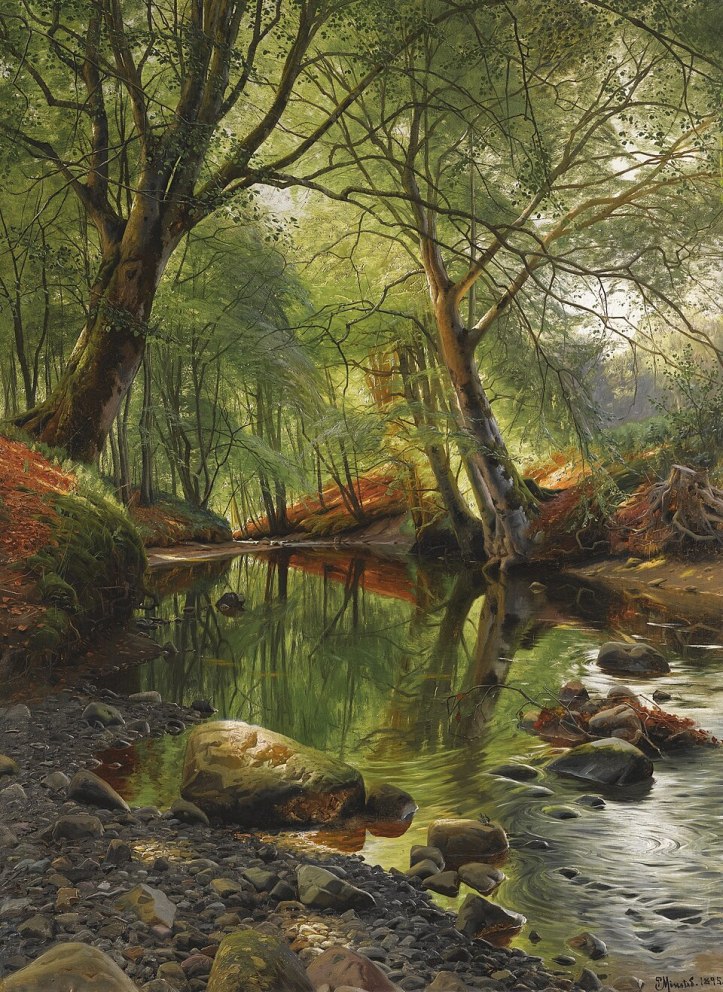 Peder Mønsted – A Woodland Stream. 1895. Wikimedia Commons
“Listen to the voice of nature, for it holds treasures for you.”
Native American (Huron) Proverb

Michalina Janoszanka – Wiosna.(Spring) 1920-29. Wikimedia Commons
“Look deep into nature, and then you will understand everything better.”
Albert Einstein
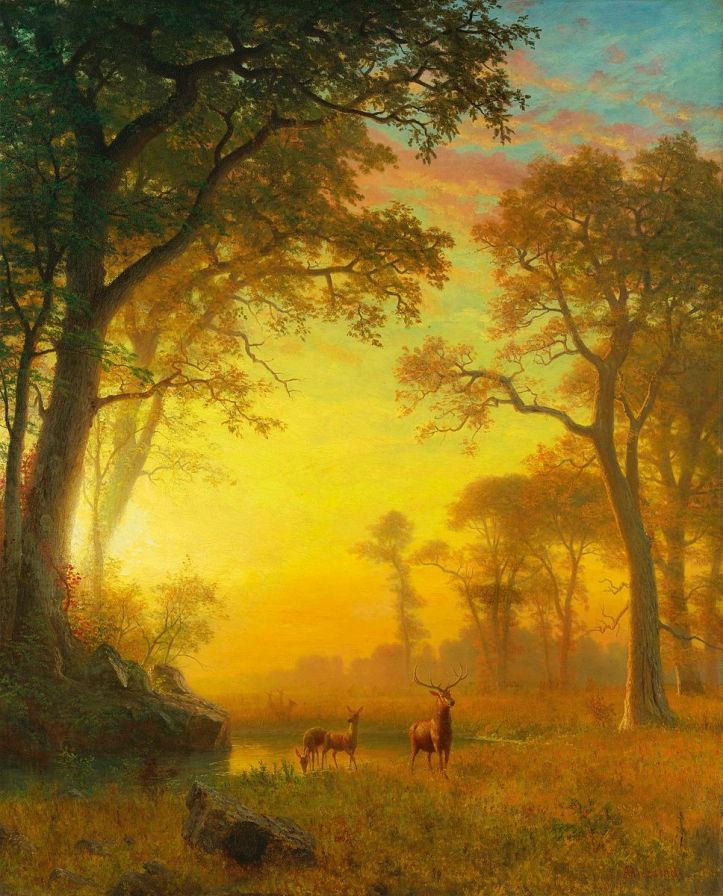
Light in the Forest – Albert Bierstadt. Wikioo 1870s.
“Come forth into the light things; let nature be your teacher.”
William Wordsworth

Puigaudeau, Ferdinand du – The Sun Setting on the Sea. c. 1930.Wikimedia Commons
“Earth and sky, woods and fields, lakes and rivers, the mountain and the sea, are excellent schoolmasters, and teach of us more than we can ever learn from books.”
John Lubbock
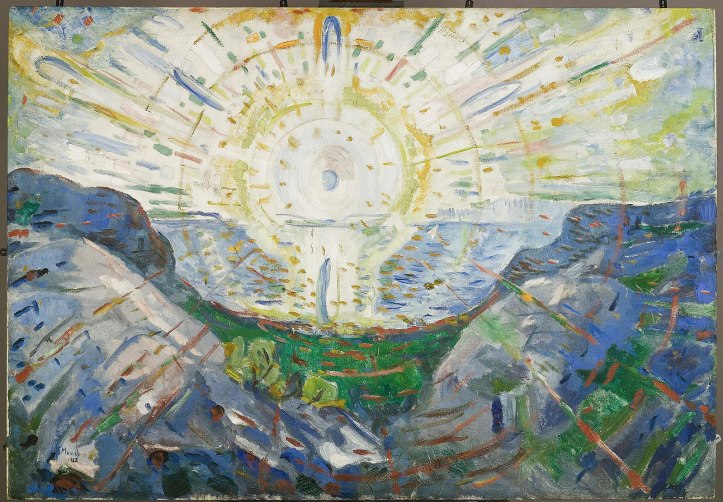 Edvard Munch – The Sun. 1912. Wikimedia Commons.
“For those who have experienced the joy of being alone with nature there is really little need for me to say much more; for those who have not, no words of mine can even describe the powerful, almost mystical knowledge of beauty and eternity that come, suddenly, and all unexpected.”
Jane Goodall
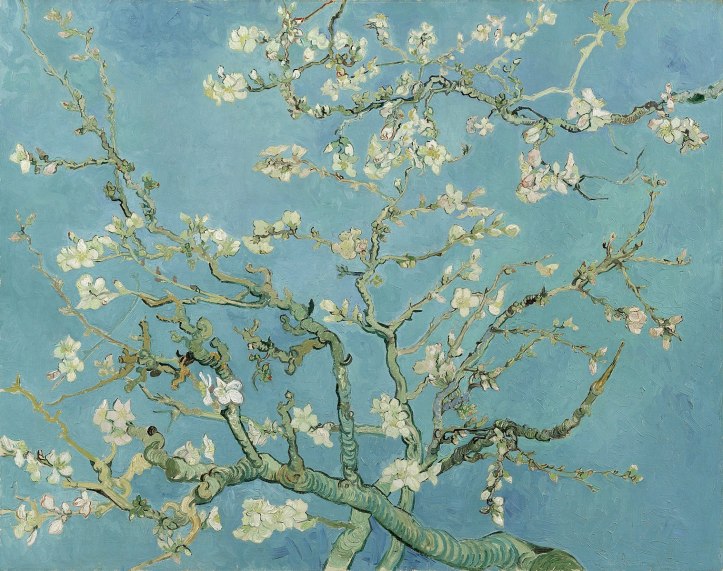
Vincent van Gogh – Almond blossoms. 1890. Wikimedia Commons
“And so the spring buds burst, and so I gaze,
And so the blossoms fall, and so my days …”Onitsura
© Linda Berman
 waysofthinking.co.uk
Linda, such amazing pieces of art, I truly enjoyed them all
LikeLike