
- Responsibility
 Robbie Wraith. Alexandra, Reflection. Flickr.
Being accountable definitely means acting and thinking in a responsible manner. This implies that we will have some understanding of the effect we have on other people, in terms of how we behave and relate to them. Responsibility to others involves being trustworthy, reliable and honest, keeping our word, our promises and our commitments. It also means that we will have a strong sense of fidelity and duty to ourselves and others. Being responsible to ourselves means being real and genuine and having the confidence to remain true to our authentic selves and our ideals. It is related to being clear about our beliefs, ideas, boundaries and personal philosophies, and having the courage to remain faithful to all these in a tough world, even when others are disagreeing with or criticising us. Responsibility also involves self-knowledge and being aware of one’s ethics and moral principles. If we achieve clarity in our beliefs, then we will not feel constantly swayed by others’ views and we will know what is the right life-path for us personally. 2. Not blaming others“Accountability, is the state or condition of being accountable or responsible. That is right. We are responsible for what goes on in our heads.”
John Faulkner
“Accountability breeds response-ability.”
Stephen Covey

The Couple 3. The Couple, A Never-ending Story:ModulArt painting,1996. Leda Luss Luyken
Wikimedia Commons.
Owning our responsibilities takes courage and self-awareness, honesty and a willingness to examine ourselves, our beliefs and motives.”Take accountability… Blame is the water in which many dreams and relationships drown.”
Steve Maraboli
For the blamed person, it is confusing, stigmatising and very painful to be falsely accused and shunned, and the person doing the blaming does not gain any relief in the long term, as their problems still remain, unworked on.“When a man points a finger at someone else, he should remember that four of his fingers are pointing at himself.”
Louis Nizer
 Image by Michael Schüller from Pixabay
Why do we ultimately feel worse when we blame others? One reason is that people do not react well to being blamed and we will likely become unpopular ourselves. At some level, there must be a dim awareness that our issues and their solutions do not reside in the other. It is taking the easy way out to wantonly blame others in the short term; however, in the long-term, the act of blaming others will most often backfire and our unresolved issues will return to haunt us.“A bad mood is often the reason for blaming others; but very often blaming others causes bad feelings in us: the more we blame others, the worse we feel.”
Leo Tolstoy
“Since narcissists deep down feel themselves to be faultless, it is inevitable that when they are in conflict with the world they will invariably perceive the conflict as the world’s fault.”
M. Scott Peck
It is a hard fact, but nevertheless it is a truth, that we are all alone on this earth in many ways, and especially in terms of responsibility. We all need to take responsibility for our own lives and for ourselves; always blaming others when things go wrong for us could be seen as avoidance. We will not learn from our mistakes if we always see the fault as residing with others. We will not change or grow if we locate responsibility outside ourselves. Blaming someone, or something, else, is a way of dodging our own responsibility. Blame ruins our relationships and leaves no space for insight, self-reflection and change. The focus is always on the other, not the self, which will, inevitably, limit our ability to work on our personal issues.“To the extent that one is responsible for one’s life, one is alone.”
Irvin D. Yalom, Existential Psychotherapy
We are in denial, projecting our own misplaced fallibility and responsibility onto someone else, constantly passing the buck. The problems are ours, but we aim and focus them at another person, who is really not the target. In a perverse way, this is like hiding behind someone else, using another as a psychological human shield. When we accuse others of making us angry, making us late, or making us fail, we are concealing our need to be seen as perfect, avoiding our own vulnerabilities. How sad this is, because there can be such beauty in a person who can not only acknowledge and be accountable for their human imperfections and weaknesses, but can also celebrate them. Such imperfections can only enhance a person’s individual charms and they need to be embraced.“When you blame others, you give up your power to change.”
Robert Anthony

‘Beautiful Imperfection’ ‘This lovely ambassador welcomes guests to the Office at Bear Creek Lake State Park, August 2011.’ Virginia State Parks Staff.
Wikimedia Commons
“There is beauty and humility in imperfection.”
Guillermo del Toro
- Humility
Being humble does not mean that we lack confidence, are insecure, or have a low opinion of ourselves. It means that we will have enough of a sense of accountability to others to not continually put ourselves in the forefront, before other people.
Humility is also about being aware of our limitations and not feeling we can do anything and everything.“True humility is not thinking less of yourself, but thinking of yourself less.”
C.S. Lewis
As life passes, and we gain in awareness and maturity, the hope is that we will learn to be humble and be able to ‘forget’ ourselves.“Be bold enough to know that you can make a difference. Be humble enough to know that you’re a limited creature.”
Alexander Den Heijer.
Why do we need to forget ourselves? What does ‘forgetting ourselves’ really mean? The poet Mary Oliver has neatly encapsulated this idea:“Develop an interest in life as you see it; the people, things, literature, music – the world is so rich, simply throbbing with rich treasures, beautiful souls and interesting people. Forget yourself.”
Henry Miller

Nicolas Lancret (c.1736) – Lovers in a Landscape. Wikimedia Commons
Shyness, self-consciousness, fear and lack of self-esteem can make us constantly ‘remember’ ourselves, anxiously aware of the self and how we are seen by others. This can be very debilitating and can mean we might find it hard to relate to those around us and be accountable to them.“Love yourself. Then forget it. Then, love the world.”
Mary Oliver
Forgetting ourselves means that we are able to turn our attention, empathy and focus to others and to the world around us. We do not feel self-conscious or or ill at ease because we have first ensured that our self-care has included mental as well as physical attention.
It is important also that we do not feign humility, as that would be lacking in accountability to both ourselves and others.
Alexej von Jawlensky – Frau mit grünem Fächer. 1912. Wikimedia Commons.
“If I only had a little humility, I’d be perfect.”
Ted Turner

Alexei Jawlensky – Young Girl with a Flowered Hat, 1910. Wikimedia Commons
“Nothing is more deceitful than the appearance of humility. It is often only carelessness of opinion, and sometimes an indirect boast.”
Jane Austen.
- Caring, listening, and change.

Couple sitting – Ernst Ludwig Kirchner. 1917-1920. Wikioo
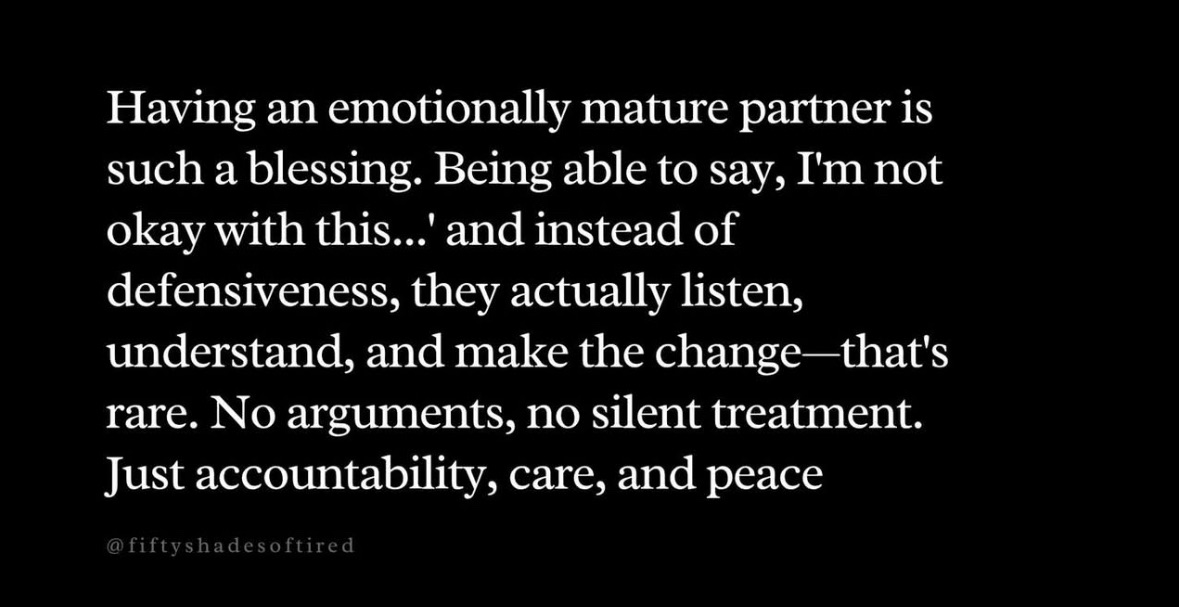
Quote from Facebook: @Fiftyshadesoftired
The quotation above is centrally important to the theme of this post. Being accountable to others is, indeed, an aspect of emotional maturity. It is a part of being aware of our responsibility not to hurt other people, as far as possible. Caring for people reveals compassion, and expressing this is important, despite any problems we may be grappling with ourselves. Awareness of who we are enables us to see others around us with more clarity and to be less hampered by projections from our own inner world. Clearing emotional ‘obstructions’ from our past can mean that we will be able to respond to others in the present without having ‘ghosts’ from our past intruding into our way of seeing others. In this way, we will be having better and more honest interactions with other people in the present. This approach will likely mean that, as the quotation states, we will be more able to listen, and to respond rather than react defensively, in a way that is going to lead to self-reflection and change. Working on ourselves, to improve the way we relate to ourselves and the world will mean that we have choices to act, and think, in ways that are constructive and freeing. We will learn to develop our own ways of thinking, our own ways of being accountable, and, in time, these decent and fair ways of being will come more naturally to us.What did Camus mean by this statement? My interpretation is that he is saying that if we possess real integrity, we will not need external laws and regulations, we will know how to be in the world from knowledge and awareness inside ourselves. Camus is referring to the fact that we all need to take responsibility on a personal level for how we act in the world, rather than having to obey external standards and rules. Being responsible and accountable for oneself can result in unexpected rewards; even though our problems may feel considerable, discovering that we do have some power to change things can be an enormous relief.“Integrity has no need of rules.”
Albert Camus

Grant Wood – Fall Plowing.1931. Wikimedia Commons
© Linda Berman“Life is not accountable to us. We are accountable to life.”
Denis Waitley
 waysofthinking.co.uk