

Edvard Munch – Despair (1894). Wikimedia Commons
“The worst enemy to creativity is self-doubt.”
Sylvia Plath
“Our doubts are traitors,
and make us lose the good we oft might win,
by fearing to attempt.”William Shakespeare, Measure for Measure
There are times in our lives when we all wrestle with the pains of self-doubt. We know what it feels like to question ourselves repeatedly, and to be unsure about our decisions, our thoughts and beliefs.
Taken to extremes, this can, as the quotations above emphasise, stunt our creativity, making us afraid to try anything new. We may feel emotionally paralysed, trapped by a fragile ego, missing valuable opportunities to achieve and succeed in life.
The battle against frequent self-doubt can, indeed, be silent and painful; in this post I will explore some of the underlying contributory factors. Next week, in part 2, I will include some possible ways to manage the challenges that self-doubt can face us with.
# What are some of the ways of thinking that cause us to doubt ourselves?
- Expectations and reality
Unrealistically high expectations are a prime contributor to self-doubt; often, people imagine that, for example, they will achieve perfection immediately they make a start on a project, or that they will feel constantly enthused, brimming with ideas, confidence and enjoyment of their creative process.
Of course, this is not always the case, for there are many bumps along the road to creativity. Self-doubt invariably creeps in at times and haunts us, especially when we feel stuck or uncertain about the way forward.

Van Gogh – Hospital Garden in Arles. 1889. Wikimedia Commons
“The greater the artist, the greater the doubt. Perfect confidence is granted to the less talented as a consolation prize.”
[Modernism’s Patriarch (Time Magazine, June 10, 1996)]”
Robert Hughes
This quotation makes a salient point; how many times have you come across people brimming with confidence, only, disappointingly, to discover that they lack real talent when it comes to the actual work they do? One might think that the opposite would be true, but this is rarely so.
Moreover, it is as if the self-doubt is an inherent part of the creative process for the truly talented, making them rethink, reconsider, reassess. This is where uncertainty and the experience of self-doubt can be helpful and positive. (The ‘less talented’ will, no doubt, be happy with their ‘consolation prize’ of self-assurance, even in the face of inferior work.)
“Doubt is often the beginning of wisdom.”
M. Scott Peck
 Quentin Massys. Wikimedia Commons. An Allegory of Folly. Early 16th century.
“The fundamental cause of the trouble is that in the modern world the stupid are cocksure while the intelligent are full of doubt.”
Bertrand Russell.
So many wonderful, famous artists suffered torturous self-doubt; however, they still carried on producing great works despite their profound uncertainties about self and work.
Whilst self-doubt can be paralysing, then, it can, paradoxically, contribute to success and a thoughtful, considered, fuller way of being in the world:
 Édouard Manet – Oysters. 1862. Wikimedia Commons
“I can’t think of anyone I admire who isn’t fuelled by self-doubt. It’s an essential ingredient. It’s the grit in the oyster.”
Richard Eyre
Whilst doubting ourselves in an extreme way will inhibit us, a little curious self-doubt and questioning can only enhance the creative process, like the piece of grit in the oyster, which can produce a pearl.
2. Undermining messages from our inner voice

Les voix intérieures – 3ème mouvement (1984-85) Didier Mazuru. Wikimedia Commons
“I seek strength, not to be greater than other, but to fight my greatest enemy, the doubts within myself”
P.C. Cast
“The real difficulty is to overcome how you think about yourself.”
Maya Angelou
Destructive feelings of self-doubt are frequently encouraged by a harsh voice inside us that is toxic, self-blaming and critical, often inherited from a parental figure from the past. We may not altogether be aware of the existence of this voice, so accustomed are we to its lurking presence.
If we have not faced this critical internal speaker, perhaps in psychotherapy, then it will constantly replay inside us, telling us how bad and inadequate we are, creating more reservations and worry, making our life much harder than it needs to be.
This is a kind of self-torment, plaguing us with anguish, catastrophising, and negative, self-doubting ruminations. It is crucial to gain awareness of this, in order that we can understand its roots and prevent ourselves from becoming stuck in the most negative conclusions about ourselves and our work.
 Abandoned House (1887) by Alfred Sisley. Wikimedia Commons
“Every time you doubt yourself,
a door closes within,
locking away pieces of you
until your soul feels like an abandoned house.”Sean DeLaney, When Life Begins to Whisper: A Journey Beyond Answers
Challenging the inner voice is crucial, if we are not to let it destroy our creative urges.

Vincent van Gogh – Red Vineyard at Arles (1888) Wikimedia Commons
“If you hear a voice within you say you cannot paint, then by all means paint and that voice will be silenced”
Van Gogh
- The effect of others
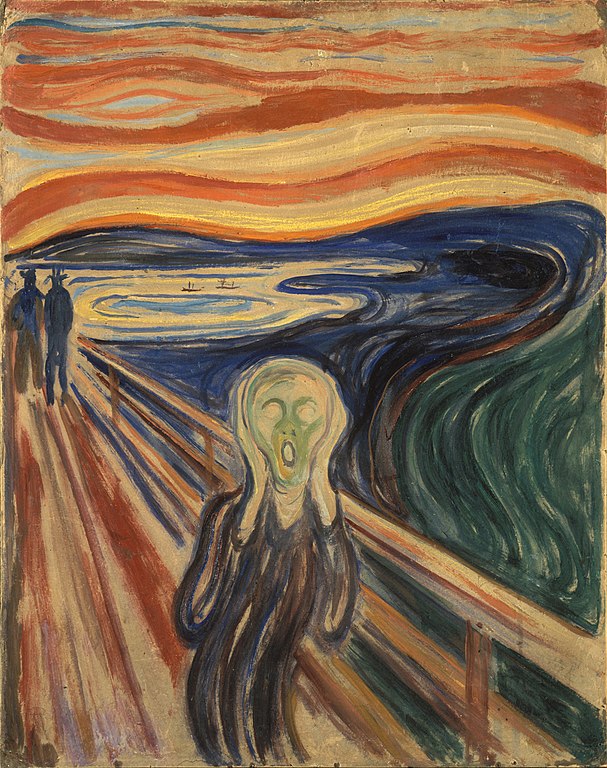 Munch. The Scream. Wikimedia Commons.
“Literature is strewn with the wreckage of those who have minded beyond reason the opinion of others.”
Virginia Woolf
Do you spend time worrying about what other people think of you?
We all do this to some extent, but if we do it to excess, it can be emotionally depleting of both energy and spirit and allow a crippling self-doubt to take us over. Constantly searching for the approval of others is a fruitless and self-destructive quest.
“Don’t let others tell you what you can’t do. Don’t let the limitations of others limit your vision. If you can remove your self-doubt and believe in yourself, you can achieve what you never thought possible.”
Roy T. Bennett, The Light in the Heart
This uncertainty about our own abilities and talents, as we have seen, can affect the best of us:
“I don’t believe anyone ever suspects how completely unsure I am of my work and myself and what tortures of self-doubting the doubt of others has always given me.”
Tennessee Williams
It is not always easy to brush off others’ detrimental opinions and comments. Perhaps without realising it, we can give our power away to others when we feel dependent on their constant affirmation and assent.
Often, the roots of this lie in our past, with unmet needs for love and approval, which can continue into adulthood.
When our self-image is poor, we can tend to persuade the world that we are not worth much, as if we are unconsciously telling others to agree with us. Unintentionally, we can transmit our negative views about ourself to those around us, subtly putting ourselves down.
Perhaps we do this by revealing a lack of confidence, frequently apologising or doubting our abilities publicly, finding eye-contact difficult, or maintaining a head-down, hunched, undeserving, shy posture, indicating low self-regard.

Alexej von Jawlensky Gesenkter Kop. (Lowered Head.)f 1909. Wikimedia Commons
“There is only one real misfortune: to forfeit one’s own good opinion of oneself. Lose your complacency, once betray your own self-contempt and the world will unhesitatingly endorse it.”
Thomas Mann
“No one can make you feel inferior without your consent.”
Eleanor Roosevelt
When others disapprove of us, unless a part of us agrees with them, their views will not be able to affect us.
“No name-calling truly bites deep unless, in some dark part of us, we believe it. If we are confident enough then it is just noise.”
Laurell K. Hamilton
- A mind closed to ourselves…
A disapproving and censorious approach to life, with rigid views about right and wrong, may also mean that we are constantly critical and uncertain of ourselves, creating self-doubt within. If we are shut inside an entrenched mindset, we are constrained by our own restricted, dichotomous worldview.
Allowing ourselves to relax judgemental and rigid notions about ourselves will mean that we are less dependent on others’ opinions, freer to be whoever we wish.
We also need to consider whether we value the other’s views anyway……
“We should forever forswear the masochistic process wherein we seek another’s approval before we have even asked ourselves whether that person’s views deserve to be listened to.”
Alain de Botton
Most people are principally concerned about themselves, even though we may sometimes feel they are judging us. This feeling can, in reality, be our own self-judgement, projected onto others.
- What are some of the ways we might hide self-doubt?

The Strange Masks – James Ensor. 1892. Wikioo
“He wanted to be the best, and when he wasn’t he went into meltdown. Self-doubt turned into hatred, hatred into anger, anger into rage…”
Simon Hattenstone. Guardian Sat 12 Jul 2025
Hiding one’s own insecurities behind all kinds of psychological masks is not uncommon; people may develop ways of being or behaving that attempt to defensively cover up their painful feelings of self-doubt. Perhaps they constantly seek assurance from other people, or develop a false self, a superficial persona that might be jokey or over-confident, “successful,” intellectual, superior, or extremely busy and important.
The words in the above quotation describe some of the post-traumatic reactions of actor Jeremy Renner, who survived a terrible accident with horrendous injuries; this involved being crushed and desperately injured by his own 6350kg snowplough in 2023.
Renner’s self-doubt after such an experience was enormous; it is important to hear how this ‘turned into’ other emotions, like hatred, anger and rage. These were, actually, defences, masks to avoid facing his own self-doubt; it can seem easier to be angry with others than to face own one’s pain, loss and sense of not being good enough.
This is a coping mechanism that can only lead to more misery, destruction and disturbance, affecting the relationship with others on the receiving end of such projections. In Renner’s case, however, after much soul-searching, the dreadful accident eventually brought him a new appreciation of the beauty of life.
To be continued next Tuesday in Part 2 of this post, when I will explore ways of getting through the agonies self-doubt.
© Linda Berman.
I have mastered my own self-doubts enough to be sure that I’d love you to become a follower of my blog! 😃 To become a subscriber of waysofthinking.co.uk for free, press the prompt (usually on bottom right of your screen) to receive regular updates straight to your email inbox. Thank you all for your support!
Thanks for this, Linda, which is helpful. It really is a ‘silent, painful battle’. I look forward to Part 2.
Best wishes
Angela
So glad it was helpful Angela. Sending my best wishes to you.