
Having explored in last week’s post some of the many factors contributing to self-doubt, I will focus today on some ways we might manage these distressing feelings.
- Recognising our need for supportive others

The Friends (c.1925-30) Ettore Tito. Wikimedia Commons
“In your moments of self-doubt, it helps to have someone in your life who believes in you more than you believe in yourself.”
Hrishikesh Agnihotri
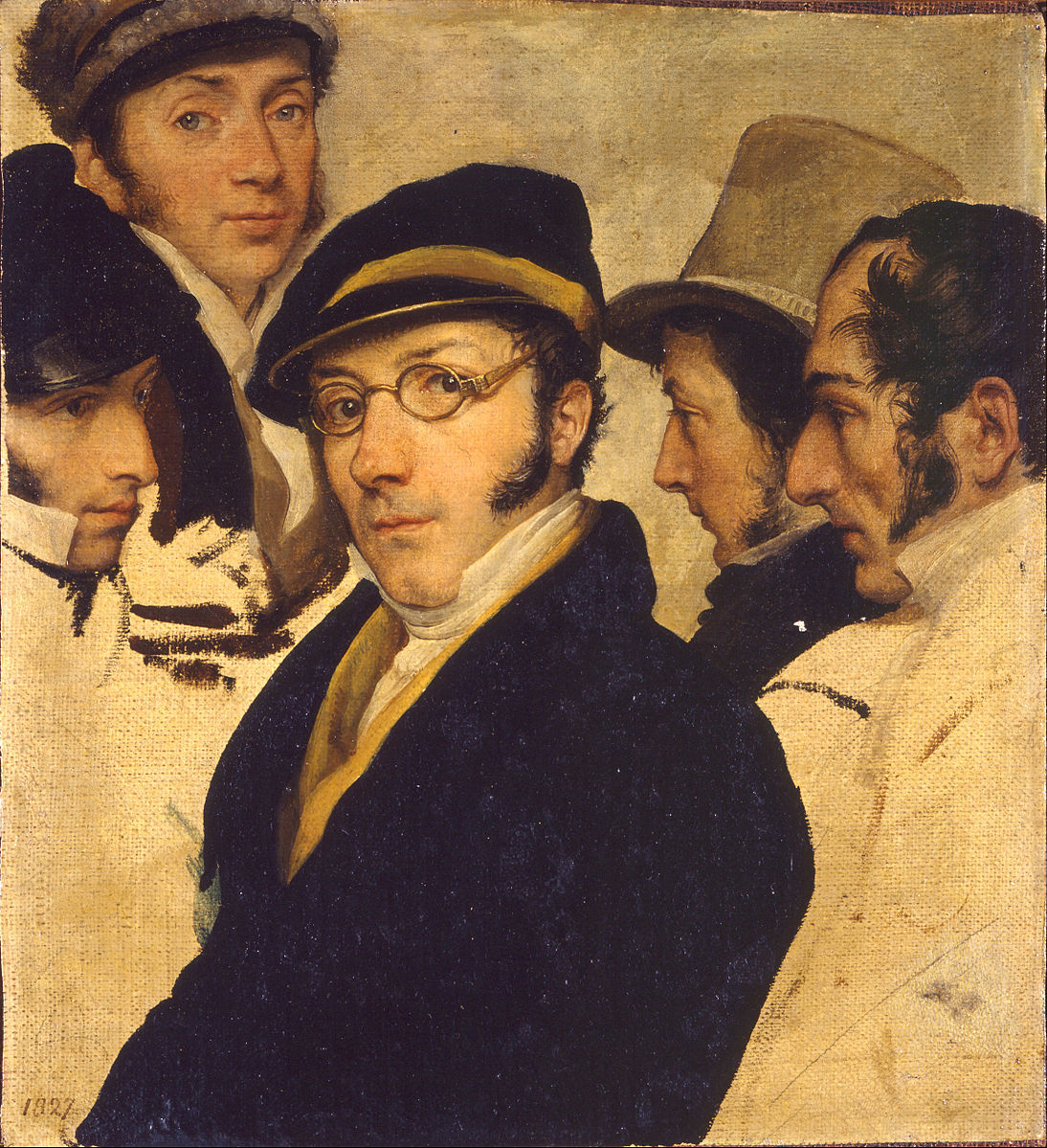 Francesco Hayez – Self Portrait in a Group of Friends. 1827. Wikimedia Commons
“I don’t have time to worry about who doesn’t like me … I’m too busy loving the people who love me.”
Charles M. Schulz
In order to help address our self-doubt, it can be really helpful to talk to trusted friends and share painful, personal feelings. Being isolated with our feelings makes them bigger, and more intense.
It is, however, important to assess the people to whom we choose to be close, as far as is possible. We need to try to select genuine people who will support and value us, stick by us and never turn against us. Even when there are disagreements, we can trust that they will think long and hard before speaking and acting, without being hampered by their own personal agenda.
Good friends can also help us move away from self-doubt triggered by hurtful others. Such loyal companions can often neutralise and invalidate malicious gossip-spreading and give us the strength to cope. They will most likely have a more balanced view, and encourage us to continue living in a way that is authentic and true to ourselves.
However, we do not need to have that many true and real friends…
“If you have two friends in your lifetime, you’re lucky. If you have one good friend, you’re more than lucky.”
S.E. Hinton

Paul Alexis Reading to Emile Zola, by Paul Cézanne. 1869-70. Wikimedia Commons
“Only my books anoint me,
and a few friends,
those who reach into my veins.”Anne Sexton
Good friends can affirm us, assuring us through their presence and their care for us that we are in the company of kindred spirits, that we are acceptable just as we are and need not suffer such painful self-doubt.
What we will need from a true friend is an honest reflection of who we are, of our value and our worth as people. In a relationship of safety and lack of judgement, we can explore our doubts about not being ‘good enough’ and be helped to challenge negative ways of thinking about ourselves.
A good friend will be able to remind us of our achievements when we are upset by what we regard as our weakness and failures. They will be able to offer us new perspectives and clear feedback on ourselves, validating us and confronting destructive thought patterns.
“It is an absolute human certainty that no one can know his own beauty or perceive a sense of his own worth until it has been reflected back to him in the mirror of another loving, caring human being.”
John Joseph Powell
If we have such friends, then we will value their care for us and their loving opinions and reflections of who we are. We will learn that we need only consider the thoughts of those whom we respect, and that the views of others need not cause us to doubt ourselves.
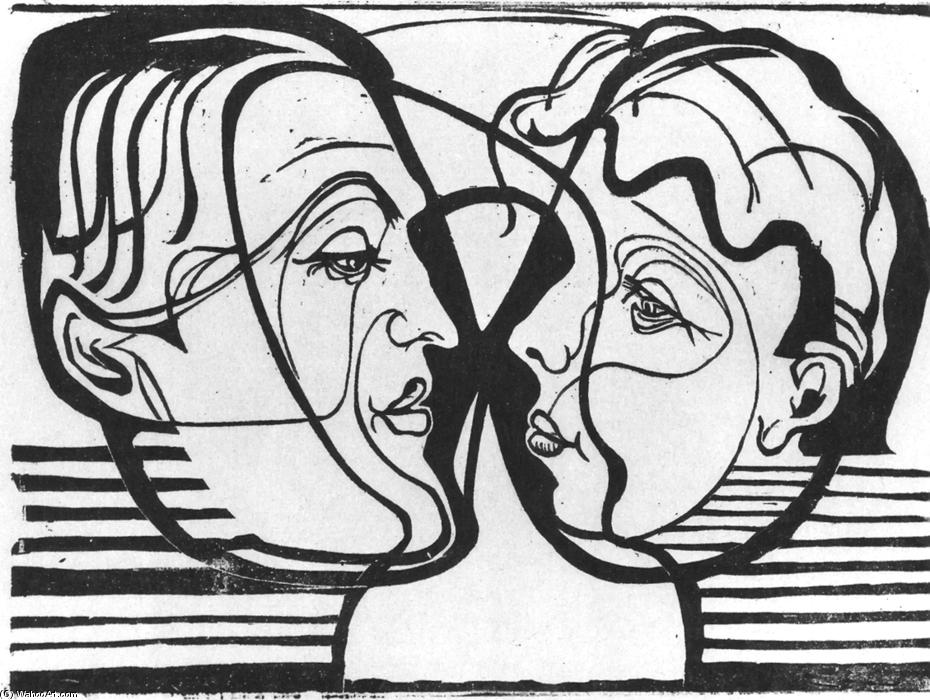 Two Heads Looking at Each Other. Ernst Ludwig Kirchner. Wikioo.
“The only way to truly see yourself is in the reflection of someone else’s eyes.”
Voltaire
Being genuinely reflected in the eyes of a trusted other can be very healing, helping us feel seen, heard and respected. A person who can see us relatively clearly is an asset in our lives.
“The one who has a good friend doesn’t need any mirror.”
Rumi.
We can, therefore, serve as mirrors for each other. Relationships offer a chance for personal growth, challenging some behaviour patterns, affirming others.
“Through others we become ourselves.”
Lev S. Vygotsky

Oval mirror – Frantisek Kupka. 1911. Wikioo
“To live without mirrors is to live without the self.”
Margaret Atwood.
- Having therapy or counselling : gaining self-knowledge

Iphigenie, Head of Woman. Anselm Feuerbach. 1870. Public Domain.
“True happiness arises, in the first place, from the enjoyment of one’s self, and in the next, from the friendship and conversation of a few select companions.”
Joseph Addison
It is important, in battling self-doubt and searching for support from another, that we become aware that we need at least a modicum of self esteem and self-care to have a friend in the first place. We need to work on being best friends to ourselves and it may be that we need therapy in order to achieve this stronger sense of who we are.
We all have self-doubts at times, losing confidence in our own abilities, questioning our beliefs and decisions. When such self-doubts begin to affect us in an extreme and debilitating way however, then it may be necessary to have some psychotherapy. Without such help, self-doubt can become crippling and exhausting, inhibiting our lives on a daily basis, interfering with work and relationships.
“I should have become an “I” before I became a “we”.”
Irvin Yalom, When Nietzsche Wept
Being riddled with self-doubts that are not addressed can mean that we will be unable to set clear boundaries for ourselves and be uncertain of who we are and what we believe. Only if we have some inner confidence, in terms of our identity and our abilities, can we truly share our authentic selves, our thoughts and ideas, with like-minded others.

Alexej von Jawlensky. Spanish Woman. Wikimedia Commons.
“I believe with all my heart that the clichés are true, that we are our own best friends and best company, and that if you’re not right for yourself, it’s impossible to be right for anyone.”
Rachel Machacek
Therapy can help many people to work through these and other related issues in the area of self-esteem and individuation. Through the therapeutic process, we can learn to develop self-knowledge, and to become aware of how our own ways of thinking can affect our concept of who we are.
In relation to self-doubt, we may decide that group psychotherapy might be helpful, allowing us to hear others’ experiences, exploring their feedback about us, and realising we are not alone with our feelings. Sharing such feelings in a group will inevitably encourage others to do the same, and this will certainly be helpful to us and to all the group members.
- Challenging a critical inner voice in therapy
We can also learn in this way to challenge an unkind, self-doubting inner voice, with a view to developing a more compassionate attitude towards ourselves and others, rather than being deprecatory and disparaging of who we are.
 Kelly Birkenruth – Looking Within [2019]Gandalf’s Gallery. Flickr.
“I learned patience, perseverance, and dedication. Now I really know myself, and I know my voice. It’s a voice of pain and victory.”
Anthony Hamilton
Many times, we might need to look within to find our true selves, and to discover our real, empathic voice that can soothe and reassure us. Perhaps that voice has been stifled from childhood; the unfortunate old saying ‘Children should be seen and not heard,’ is one that has silenced children’s real voices in a way that denies their individuality, and personal strength.
This attitude will result in an embargo on real feelings, and a silencing of a child’s developing selfhood. It will likely produce a tendency to fit in with others, to adapt to their ways, to deny true beliefs, thoughts and feelings. It will foster self-doubt and a lack of confidence in who we are, in our convictions, our decisions and our actions.
Such behaviour patterns are hard to rid ourselves of. Therapy may be needed to help with this, so that we might uncover the real person we are beneath the layers of pleasing others.
“There is nothing more meaningful than being true to yourself and finding your own voice. Follow your heart and don’t let anyone discourage you.”
Jane Fulton.
Many people suffer self-doubt in silence; they are unable to tell their story, fearing looking foolish, struggling to find their voice exactly because they doubt what they have to say, or they do not feel they are worthy of being heard.
Such an untold story, the story of our deepest doubts and fears about ourselves, can be excruciatingly distressing, especially if it is continually kept under wraps.
Risking being heard in a safe and confidential space can be cathartic and releasing. Discovering that we are not alone in experiencing self-doubts can be healing and enabling. It can help us find our voice and give us renewed strength to carry on.
Fears of not being understood or of being seen as ridiculous, of being the only one who feels such emotions or thinks such thoughts, can be rendered less painful by being really heard by an empathic other.
“When I have been listened to and when I have been heard, I am able to re-perceive my world in a new way and to go on. It is astonishing how elements that seem insoluble become soluble when someone listens, how confusions that seem irremediable turn into relatively clear flowing streams when one is heard. I have deeply appreciated the times that I have experienced this sensitive, empathic, concentrated listening.”
Carl R. Rogers
 Edvard Munch – Summer Night’s Dream. The Voice (1893) Wikimedia Commons
“It took me quite a long time to develop a voice, and now that I have it, I am not going to be silent”
Madeleine K. Albright
In addition, therapy can help us to stop comparing ourselves with other people, and to begin to set more attainable goals, rather than torturing ourselves with unreachable standards.
If we are able to do this, we will most likely find that we can ignore the old doubts about ourselves and live an authentic life. We can be clearer about who we are and about our own values and beliefs, regardless of the views of those who might be unsupportive.
“When men speak ill of thee, live so as nobody may believe them.”
Plato
“Believe in yourself and there will come a day when others will have no choice but to believe with you.”
Cynthia Kersey.
“The journey into self-love and self-acceptance must begin with self-examination… until you take the journey of self-reflection, it is almost impossible to grow or learn in life.”
Iyanla Vanzant
- Learning to trust ourselves and our intuitive powers to cope with self-doubt
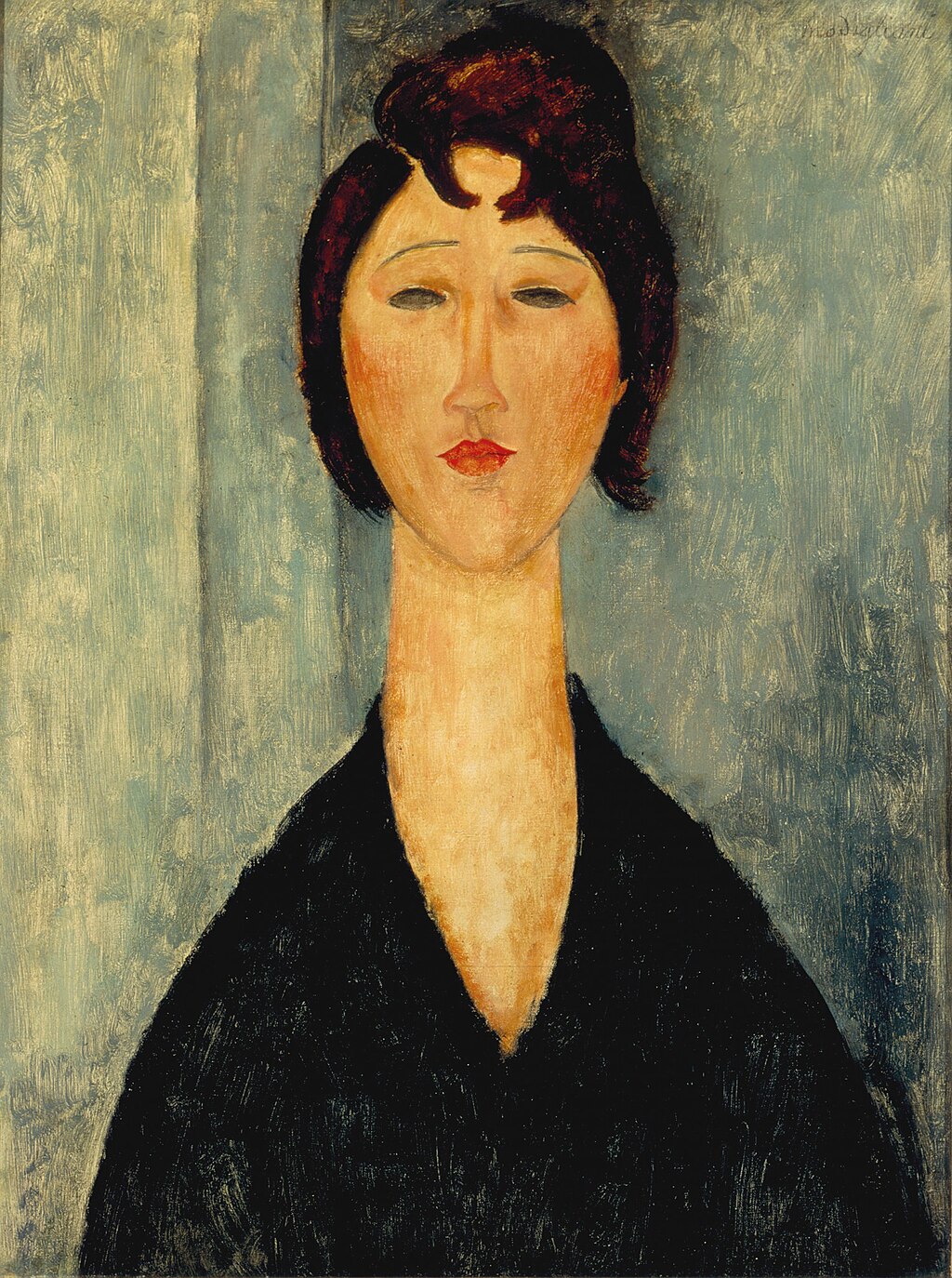
Amedeo Modigliani, 1918, Portrait of a Young Woman. Wikimedia Commons
“Trust thyself: every heart vibrates to that iron string.”
Ralph Waldo Emerson
Self-doubt thrives on a lack of trust in who we are. Those who suffer excessively from such fears about their own value tend to have a low self-image and struggle to develop this trust.
Being able to trust in one’s own intuition, for example, is sometimes difficult. It does take courage to rely on one’s instincts. Trusting the self requires confidence, self-knowledge and a feeling of self-worth. It demands a conviction that we deserve to have such faith in our own opinions, decisions and beliefs, even when, or perhaps especially when, these differ from other people’s.
“As soon as you trust yourself, you will know how to live.”
Trusting oneself gives us a certain independence, a way of being that allows us to be alone and secure when necessary.
“Everything comes to you at the right time. Be patient and trust the process.”
Unknown.
The phrase ‘trusting the process’ implies that we need to develop faith in the fact that, ultimately, things will work out.
This may involve recognising our own ability to get through difficult times; life itself is a process, a different one for each of us and we need to develop some kind of trust, embracing what will unfold in time that is unknown now. Whatever one’s beliefs may be, trusting the process involves having the courage and resilience to wait, to stay with uncertainty, to go with the flow.
“Don’t push the river. It flows by itself.”
Barry Stevens.
An attitude of tolerance towards our own mistakes is important here. Many people see their mistakes as confirming how stupid they are, rather than offering opportunities for learning. They give themselves a hard time, exacerbating their self-doubts and blowing things out of proportion. One mistake makes them feel like a total failure, and they cannot let themselves be in any way fallible.
If we can have the courage and strength to forgive and be kind to ourselves, being tolerant of our mistakes and slip-ups, then we are more likely to emerge more confident and self-trusting.
In learning to be true to ourselves, we will have a greater chance of living a life that is free enough from self doubt to follow our instincts, our intuition and the deepest longings of our heart.

Amedeo Modigliani – Renée.1917. Picryl.
“I took a deep breath and listened to the old brag of my heart. I am, I am, I am.”
Sylvia Plath
“And most important, have the courage to follow your heart and intuition. They somehow already know what you truly want to become. Everything else is secondary.”
Steve Jobs
© Linda Berman
 waysofthinking.co.uk