
Quote 1
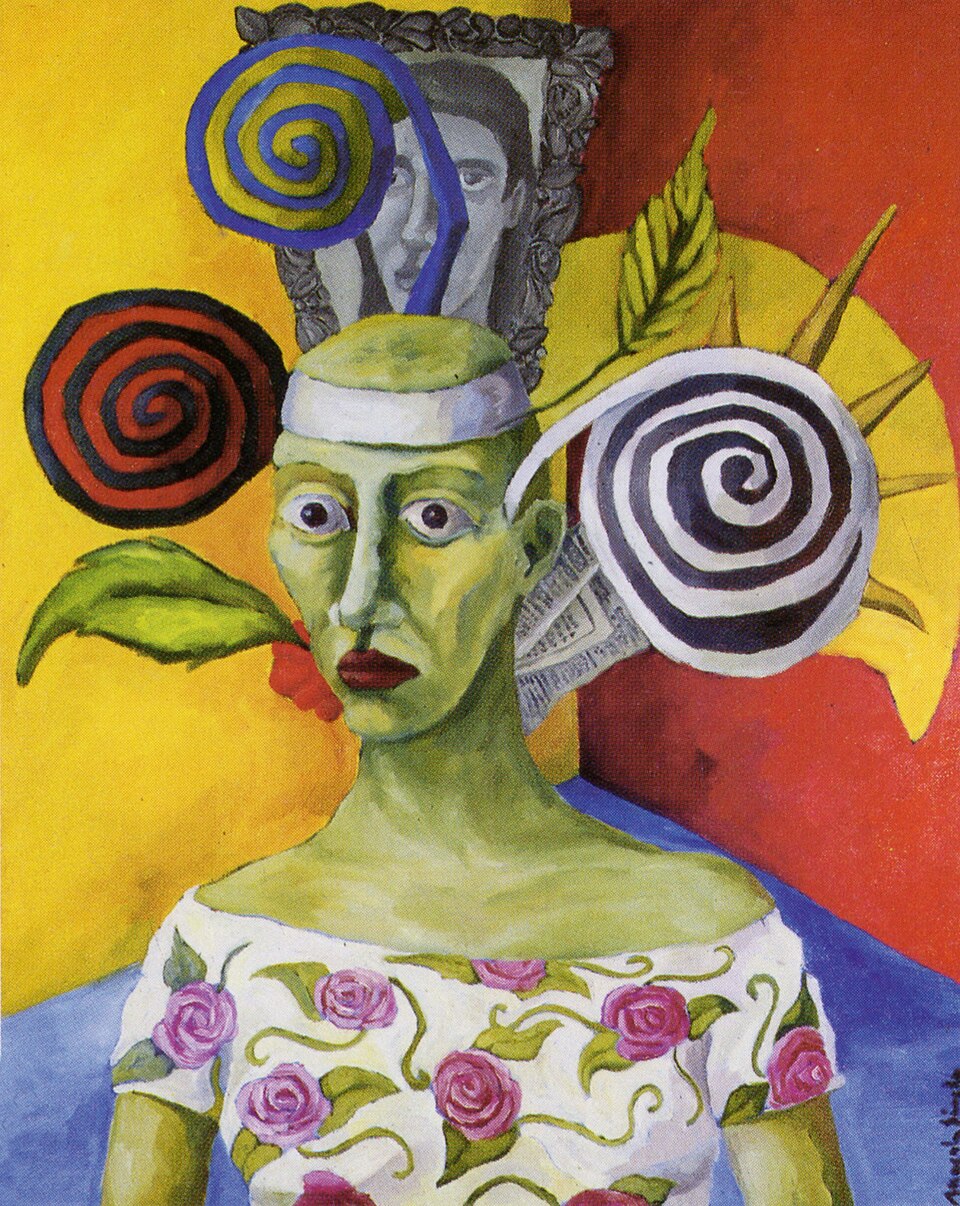 1999. The Madness.Magaly Sánchez Bustamante. Wikimedia Commons
“He wrote on a piece of paper with his pencil.
Psychosis: out of touch with reality.
Since then, I have been trying to find out what reality is, so that I can touch it.”Jeanette Winterson
What is reality? How do we cope with it? Can it ever be defined?
Winterson talks of psychosis as being ‘out of touch with reality.’ Is being in touch with reality, then, the definition of sanity?
Reality- and sanity- appear to be related to consensus. If the majority of people think, for example, that it is raining, then it is, usually, likely to be.
Mental illness and psychosis can involve delusions, hallucinations, or beliefs that are irrational, and behaviour that is impulsive and uncontrollable. Madness and reality can intersect and overlap, however, and we have to take care that we do not brush off as insanity things that we cannot explain, tolerate, or understand.
This is not to say that all ‘sane’ people see the world in the same way; each of our realities is different, and we create the world in which we live according to our individual ways of seeing, our attitudes, beliefs and our thoughts, all within the broad framework of reality.
“Your thoughts along with your feelings create your reality.”
Rhonda Byrne
“Reality is merely an illusion, albeit a very persistent one.”
Albert Einstein
Trying to ‘touch’ reality, as Winterson mentions, may seem an impossible quest. However, sometimes we might feel that we do ‘touch’ it, when we come across reality in all its fullness and, sometimes, in its pain and rawness. Perhaps we may experience being exposed to its extreme harshness when we lose a loved one, or witness the terrible and the tragic happening in the world around us…
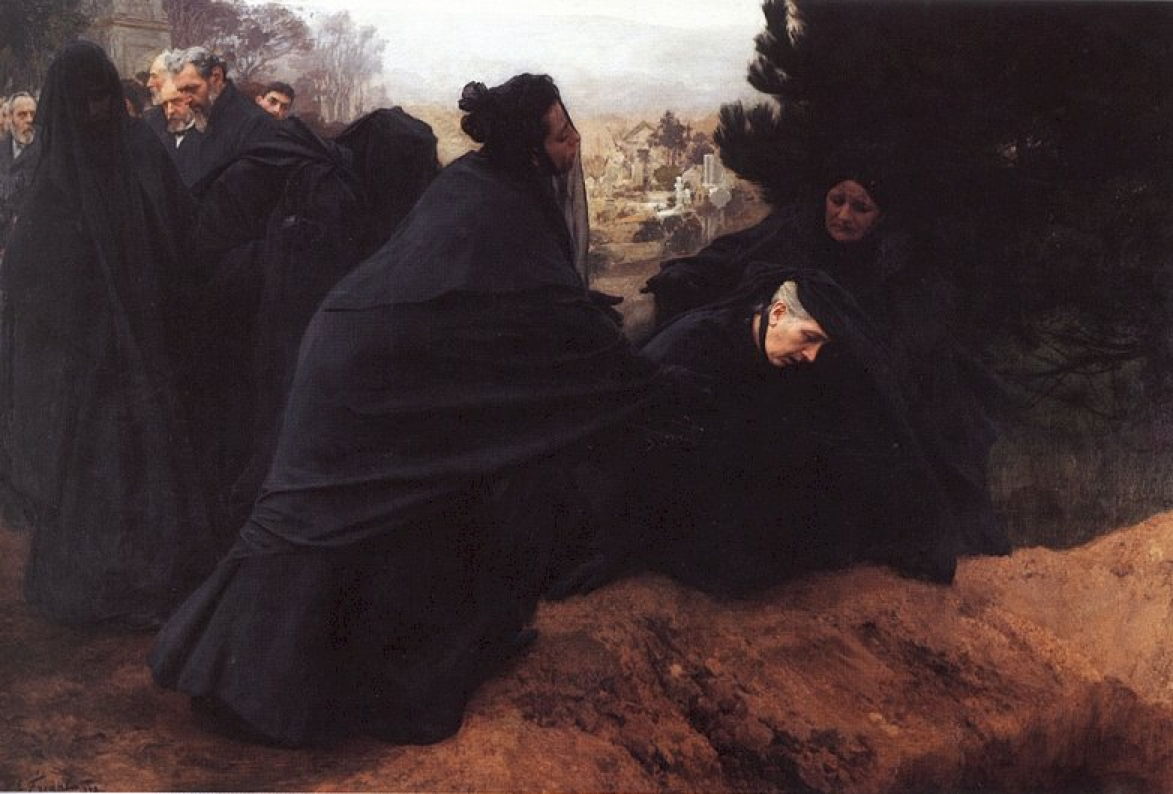 Émile Friant. Sorrow (1898) Wikimedia Commons
We may also feel, in the opposite way, that we ‘touch reality’ when we have a wonderful and awe-inspiring experience, perhaps seeing nature at her most sublime, as in the image following…
Quote 2
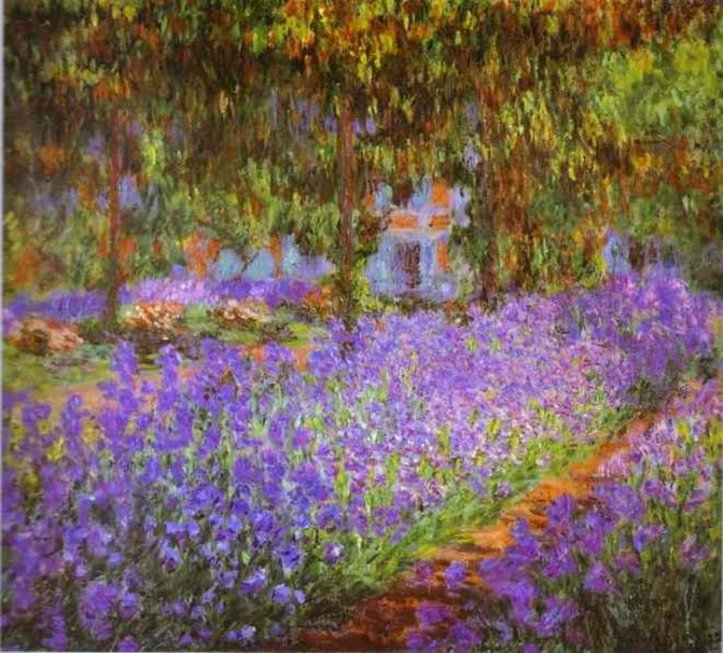 Monet. Monet’s Garden, The Irises. Wikioo.
“Empathy begins with understanding life from another person’s perspective. Nobody has an objective experience of reality. It’s all through our own individual prisms.”
Sterling K. Brown
It is difficult to grasp the fact that we may never be able to fully understand another’s reality; we can only try to grasp our own, and sometimes it is hard to do even that.
It may be possible to glimpse someone else’s way of seeing the world, to develop some empathy so that we can see things from another’s viewpoint, but not to fully enter into their way of seeing or being.
Are you and I seeing the wonderful lavender colour in Monet’s painting of Irises as the same shade? We cannot know, we can only give an approximate description of what what we see, or of anything else that we perceive or experience.
“Is it really possible to tell someone else what one feels?”
Leo Tolstoy
Yet, despite the yawning chasms between us, we are nevertheless intricately connected with each other. It is still possible to communicate with another across the invisible expanse from person to person, despite the inevitable gap in understanding.
We can try to express our thoughts honestly, with due consideration and discretion. We can make an attempt to understand another’s thoughts and being. With open and flexible thinking, challenging our assumptions and our subjectivities, it is likely that we will move in the direction of perceiving reality about self and other. We can begin the journey along this path, but we will never reach its endpoint.
Quote 3
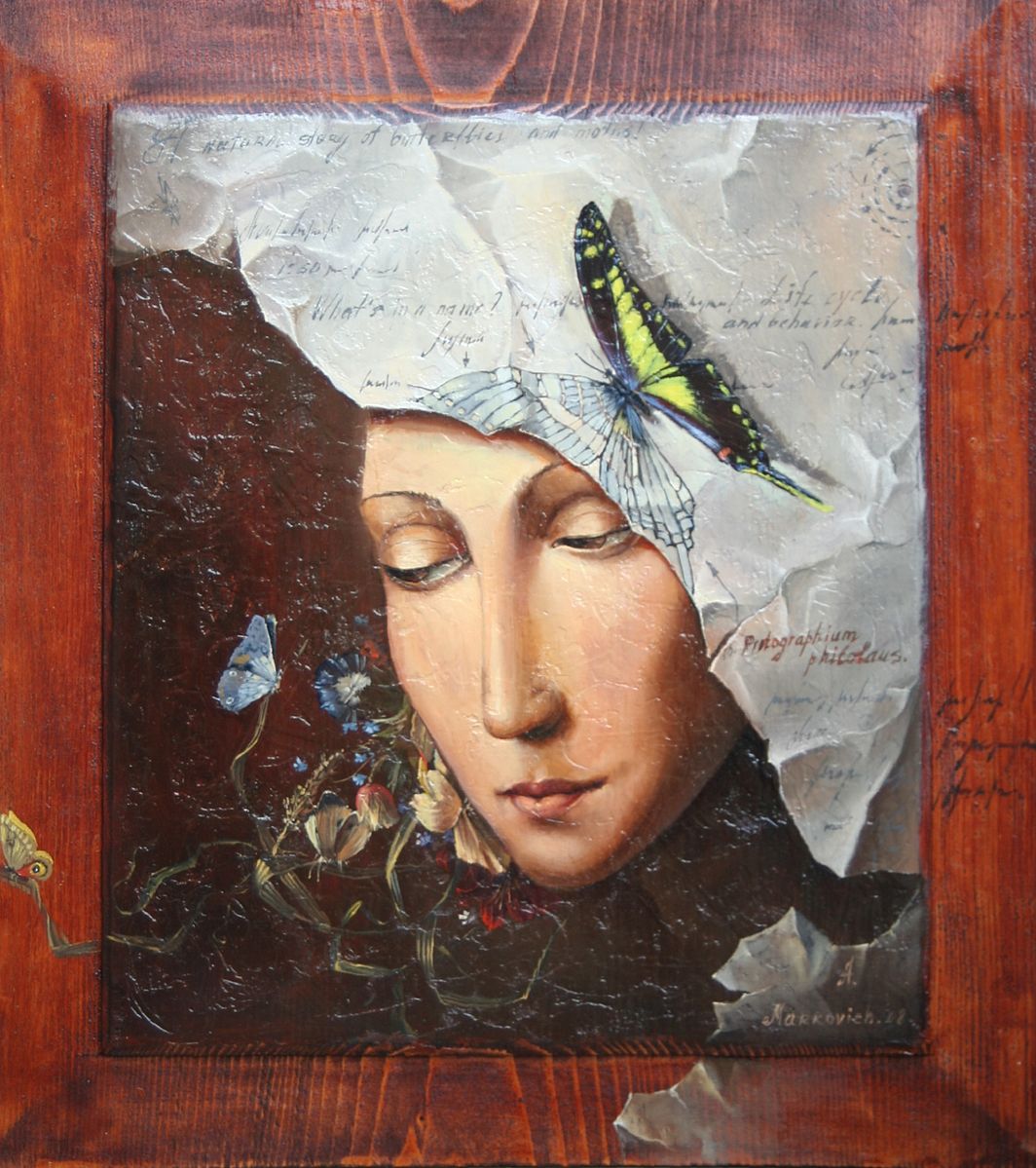 Anastasiya Markovich. 2008. Illusion of Reality. Wikimedia Commons
“I believe that, though illusion often cheers and comforts, it ultimately and invariably weakens and constricts the spirit.”
Irvin D. Yalom
Living under illusion and engaging in magical thinking are ways of avoiding facing reality. These involve a belief that we are capable of achieving results in the world around us merely through our thoughts, that we can influence events without any logic or reason.
It is akin to superstition; in its simplest, and often earliest form, it may be seen in a child’s jumping over the lines between flagstones, usually hoping to avoid something bad happening. It is borne out of a feeling of powerlessness; imagining that we have some kind of magical control over the world can be reassuring and comforting, despite its illusory and fabricated nature.
The psychotherapist, Yalom, believes that illusion is ultimately not helpful; he describes it as his ‘quarry’ in therapy; in other words he tries to help eliminate it and calls this his ‘war against magic.’ He fights against it, against allowing the ‘magic’ to pass unchallenged. Such ways of thinking will only result in erroneous conclusions, in distortions, and in pretence.
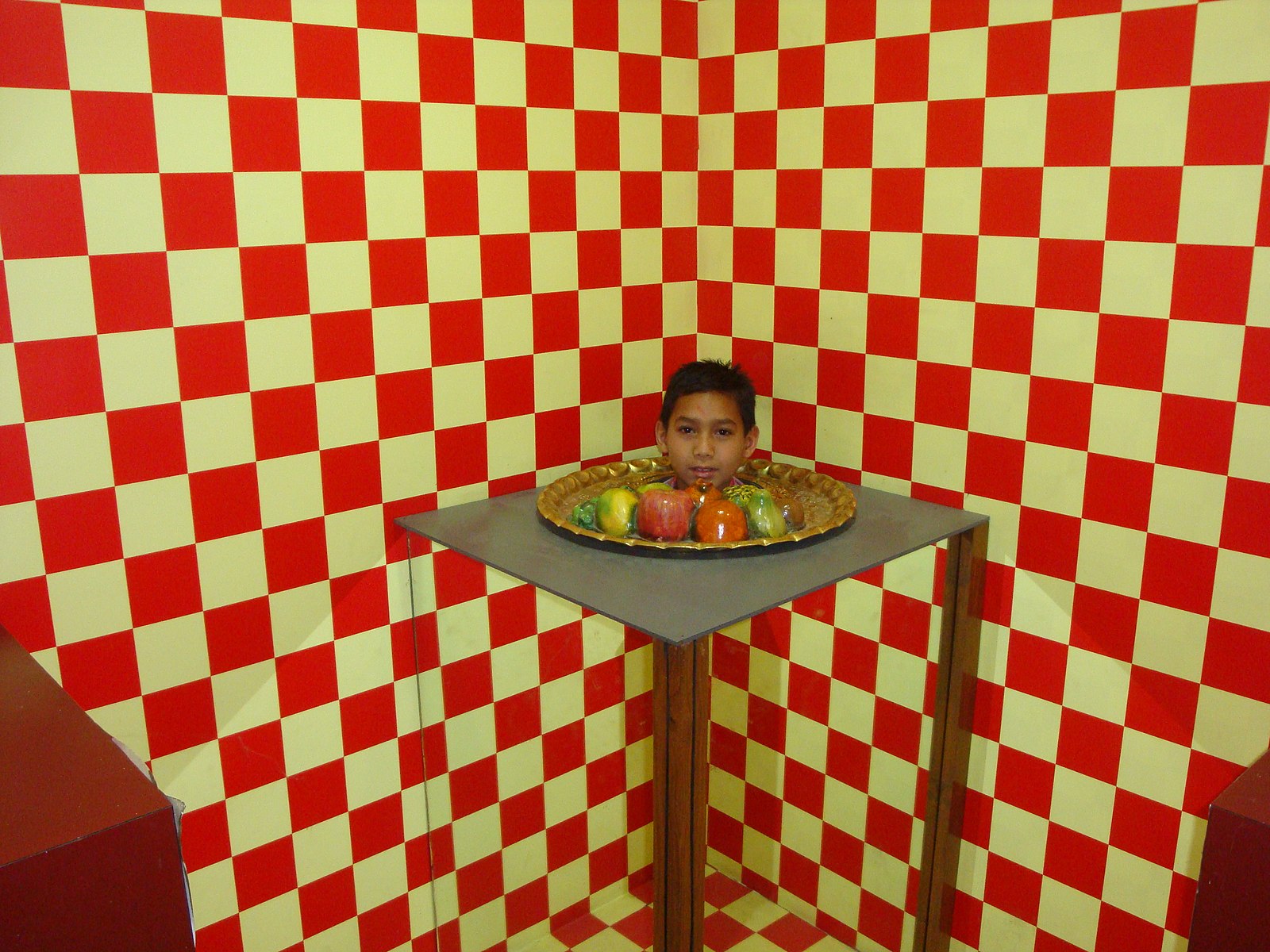
Regional Science Centre, Bhopal – Head on a Platter. The child entered the exhibit from the back and popped his head through the hole. 2012. Utkarshraj Atmaram. Wikimedia Commons
“We live in a fantasy world, a world of illusion. The great task in life is to find reality.”
Iris Murdoch
As mentioned above, ‘finding reality’ is no mean feat; it is actually, impossible to achieve in any total way. However, we can, and many of us do, spend our lives questing after reality… both the reality of the world outside and that of our inner world, the inner landscape inside us all.
 Inner World. Patrick Willems. 2018. Flickr.
“This inner world is truly infinite, in no way poorer than the outer one. Man lives in two worlds.”
Jung.
What is our inner reality? Within our minds, we all have an internal landscape, a vast and complex internal world of our creation, both conscious and unconscious, a blend of many aspects, including memories, dreams, beliefs, imaginings, experiences, fears, thoughts and feelings.
We are also firmly located in the world around us; the external landscape includes the entirety of our surroundings- our homes, workplaces, and the towns and countryside around us.
These inner and outer worlds are inextricably linked, forming a complex network of connections.
Many people live their lives believing only in conscious, rational thought, reacting ‘logically’ to the world around them.
In fact, there is a whole ‘other part’ of them, busily active, which they ignore or choose not to know about. However, if we are able to focus on our inner world, our inner reality, perhaps in psychoanalytical therapy, we will, inevitably discover a whole store of understanding in relation to ourself and our personal reality.
Quote 4

“You can avoid reality, but you cannot avoid the consequences of avoiding reality.”
Ayn Rand
Inevitably, if we constantly build castles in the air, living in a Walter Mitty-like fantasy world, avoiding reality, there will, indeed, be consequences.
Hiding from problems and dodging the difficulties of life will, inevitably, increase stress and anxiety. Escaping into addiction, illness, procrastination or avoidance, or repeatedly denying the reality of one’s life will result in a build-up of painful unworked-through issues. Not facing what is really happening within oneself, ones’s relationship, or one’s family, can allow problems to persist, develop and to fester.
“If you lack the humility to go back and tie up the loose ends in your past, then be prepared to forever be haunted by her ghosts, all of whom will come into your present and your future— staining everything and everyone with their leftover emotional and mental garbage.
C.JoyBell C.
Quote 5
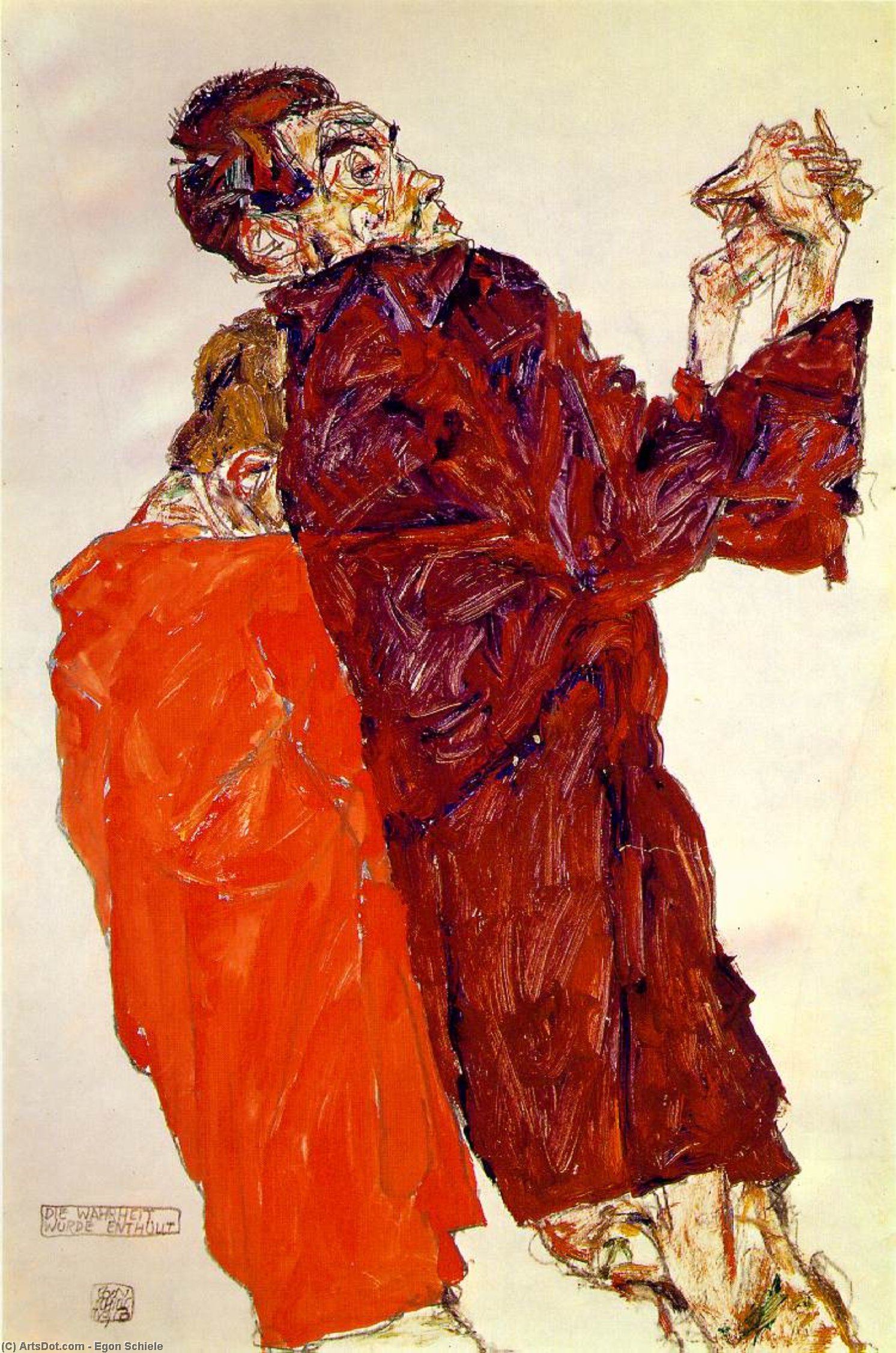
the truth unveiled 1913 – Egon Schiele. Wikioo.
“Every person must choose how much truth he can stand.”
Irvin D. Yalom, When Nietzsche Wept
So however can we tolerate a painful reality? Of course, there is no magic answer or solution, but there are ways of mitigating and managing the pain. Too much truth, too concentrated a reality can be distressing and threatening. In life, we tend to dilute and soften truth, as a defence, for ourselves and others. We all need healthy diversion and self-compassion, learning not to overload ourselves or deprive ourselves of relaxation and pleasant diversion.
“We have art in order not to die of the truth.”
Friedrich Nietzsche
The great philosopher is highlighting a profound reality; we all need some kind of art in our lives. If not art, we will surely find some other form of distraction that appeals to us.
Whether that is in the form of watching film or television, theatre, exercise, sport, getting lost in a gallery, painting, listening to or playing music, reading, writing… we need to immerse ourselves in something that absorbs our attention, in order to re-find our ability to face the difficulties, the unpalatable ‘truths’ of life. We all need to re-charge, to rest and relax, so that we can return to tackle the realities of life with renewed energy and vigour.
“Almost everything will work again if you unplug it for a few minutes… including you.”
Anne Lamott.
Whilst distraction can, at times be important, it is also crucial to allow ourselves to face pain and heartbreak. Finding ways of doing this, and discovering others who can help us through is central, and we need to give ourselves the permission, space and time to be sad, to grieve, to share our pain.
Other ways of coping can be related to finding some meaning in the reality of life, in what may have happened, although this may not always be possible. Even if we can only pull a tiny thread of meaning out of life, that can be a way of connecting with the wider universe, of placing ourselves in some kind of bigger story.
Understanding and learning from our painful experiences can also give us strength, purpose and fortitude in difficult times. It can take time for such meaning and understandings to emerge, but these can provide a way for us to deal with the pain of reality.
“To live is to suffer, to survive is to find some meaning in the suffering.”
Friedrich Nietzsche.
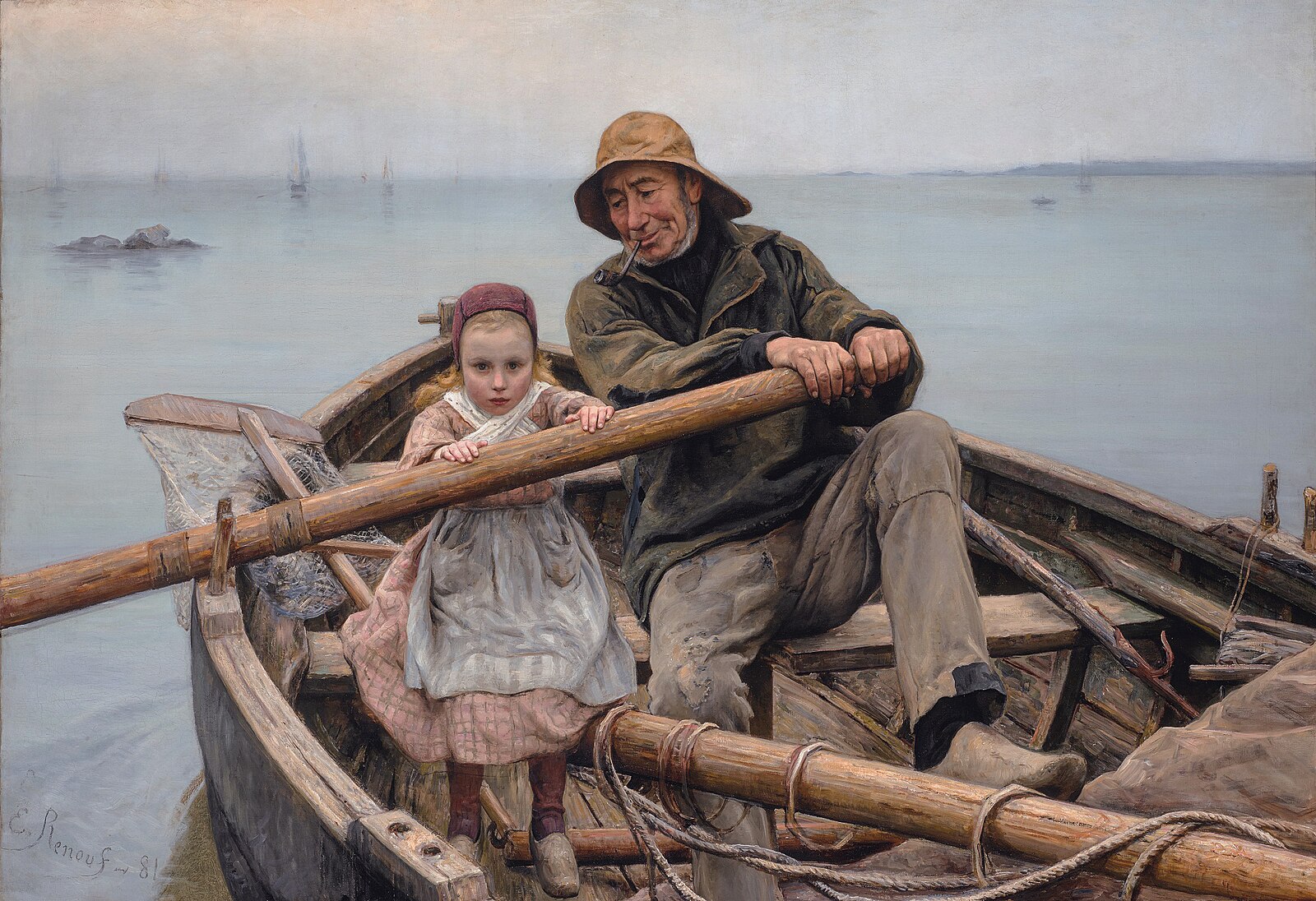
The helping hand, by Émile Renouf, 1881. Wikimedia Commons
“The way you get meaning into your life is to devote yourself to loving others, devote yourself to your community around you, and devote yourself to creating something that gives you purpose and meaning.”
Mitch Albom
“I have always believed, and I still believe, that whatever good or bad fortune may come our way we can always give it meaning and transform it into something of value.”
Hermann Hesse
© Linda Berman
 waysofthinking.co.uk
Umm…is there such a thing as reality…is there such a thing as truth…ha! is anything absolute?
LikeLike