
 Caspar David Friedrich – Wanderer above the Sea of Fog
“Develop an interest in life as you see it; the people, things, literature, music – the world is so rich, simply throbbing with rich treasures, beautiful souls and interesting people. Forget yourself.”
Henry Miller
“Sylvanus was more than shy of himself. A hot rush of blood causing him a curious discomfort, would mount up to his head at the merest approach to physical self-consciousness. He had to forget himself, or he couldn’t go on!”
John Cowper Powys
Forgetting ourselves means that we are able to turn our attention, empathy and focus to others and to the world around us.
Shyness, self-consciousness, fear and lack of self-esteem can make us constantly ‘remember’ ourselves, anxiously aware of the self and how we are seen by others. This can be very debilitating and can mean we might find it hard to relate to those around us.
That is why it is crucial to work on ourselves and become aware of who we are and how we relate to others. Only in this way can we avoid feeling self-conscious or or ill at ease, because we have ensured that our self-care has included mental as well as physical attention.

Leighton, Frederic; An Elegy. 1888. Wikimedia Commons
“To me there is in happiness an element of self-forgetfulness. You lose yourself in something outside yourself when you are happy; just as when you are desperately miserable you are intensely conscious of yourself, are a solid little lump of ego weighing a ton.”
Joseph Priestley
Our happiness does depend somewhat on our ability to turn outwards and forget ourselves…in a good way.
“To forget oneself is to be happy.”
Robert Louis Stevenson
 Thomas Moran – Grand Canyon of the Yellowstone. 1893-1901. Wikimedia Commons
“The really wonderful moments of joy in this world are not the moments of self-satisfaction, but self-forgetfulness. Standing on the edge of the Grand Canyon and contemplating your own greatness is pathological. At such moments we are made for a magnificent joy that comes from outside ourselves.”
John Piper
The title of this post may initially appear somewhat cryptic… what do I mean by forgetting yourself ‘in a good way’? I have often written about turning inwards into ourselves and journeying into our inner landscape. I have also discussed caring for the self and the importance of remembering who we are. Now here I am, at the beginning of a new year, apparently contradicting myself!
Yet here is the paradox: it is also important, at times, to do the opposite of focussing on our selves, that is, to forget oneself.
Mary Oliver, the wonderful poet, also suggests this form of forgetting when she urges us to “Love yourself. Then forget it. Then, love the world.” Her words remind us of the importance of really looking at what is around us, and finding much to love in life and in the world.
All this needs to happen, she recommends, after having ensured that we have loved ourselves and given ourselves enough care. Then, and only then, is it the time to turn our focus away from ourselves, and outward, onwards and upwards!
- Experiencing the wonder in the world
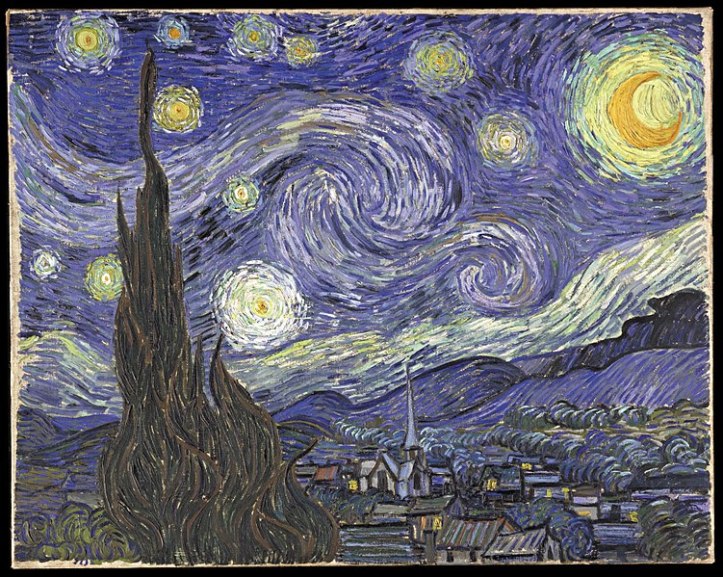 Starry Night. Van Gogh. Wikimedia Commons.
“When our eyes are graced with wonder, the world reveals its wonders to us. There are people who see only dullness in the world and that is because their eyes have already been dulled. So much depends on how we look at things. The quality of our looking determines what we come to see.”
John O’Donohue
How we see the world around us is, to some extent, an individual choice. Our inner attitude determines our ways of seeing, and our perception of the outer world depends on our internal world.

Paul Klee. 1920. Landscape with Yellow Church Tower.
“We only see what we look at. To look is an act of choice.”
John Berger
It is important to note, however, that internal turmoil and unresolved anxiety can blur our viewing lens. If we are too preoccupied with, or encumbered by, past or present concerns, we cannot allow ourselves to ‘be’ in the world and will tend to drift through life without really being impacted by what is around us.
Our true vision will be defective; we will not focus. It will be hard to forget ourselves and our disturbed inner world when we are so beset by unsettled feelings and such a sense of disorder, and we are unlikely to notice what is really happening around us.
Unless we come to know ourselves, we will see others, and the outside world, through a screen clouded by our own imaginings, projections and distortions. In addition, we will be unaware of this bias, if we have not examined ourselves psychologically and attempted, perhaps in therapy, to clear away the ‘debris.’
“Human beings, by changing the inner attitudes of their minds, can change the outer aspects of their lives.”
William James
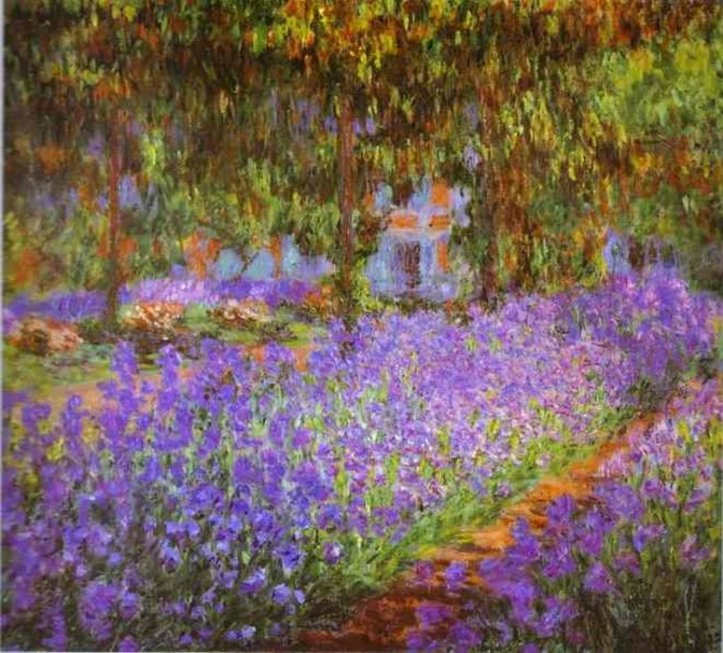 Monet. Monet’s Garden, The Irises. Wikioo.
“What is sacred is what is worthy of our reverence, what evokes awe and wonder in the human heart, and what, when contemplated, transforms us utterly.”
Phil Cousineau
If we are free enough to really experience the world, we will discover the awesome and wonderful aspects of our universe, which, as the above quotations remind us, will affect our internal landscape. We have the choice to think differently, to appreciate in amazement the wonders of the world, if we can work at coming to terms with who we are… and can then forget ourselves.
- Forgetting ourselves for others
 Winslow Homer: To the Rescue. 1886. Wikimedia Commons
“I hold that while man exists it is his duty to improve not only his own condition but to assist in ameliorating mankind.”
Abraham Lincoln on Man’s Responsibility.
Do we owe it to others to sometimes forget ourselves and focus on them ? Have we a responsibility to improve ourselves, and thus, improve the world? What, if any, is our responsibility to others, and to the world itself?
Some would say we do owe the world something because of the fact we have had the chance of life at all. This is so amazingly unlikely that we need to show our gratitude through becoming better and better people.
- What, if any, is our responsibility to others in the world, and to the world itself?

Young Man Carrying an Old Man on His Back by Theo van Doesburg. c. 1904. Wikimedia Commons
“The worth of a human being lies in the ability to extend oneself, to go outside oneself, to exist in and for other people.”
Milan Kundera
“That which especially distinguishes a high order of man from a low order of man, that which constitutes human goodness, human nobleness, is surely not the degree of enlightenment with which men pursue their own advantage; but it is self-forgetfulness; it is self-sacrifice; it is the disregard of personal pleasure, personal indulgence, personal advantage, remote or present, because some other line of conduct is more right.”
James Anthony Froude
These words are expressing the importance of being able to forget oneself, even to the extent of sacrificing some of our own needs. This is sometimes crucial, especially in urgent situations where our helping others might mean the difference between life and death.
 Summer 1909 Frank Weston Benson. Wikimedia Commons
“You only get one life. It’s actually your duty to live it as fully as possible.”
Jojo Moyes, Me Before You
Being overly self-focussed can be detrimental; relationships will suffer and our view of the world will become narrow and restricted. We need a healthy ability to move fluidly between our inner and outer worlds.
Then we will develop an understanding of ourselves as well as being able to make constructive relationships with others and having knowledge about what is going on around us. Being self-absorbed and constantly turning inwards will mean that our ability to empathise with others will be severely affected.
 Teodor Axentowicz (1859–1938), Under the Burden of Adversity (date not known) Wikimedia Commons.
“As far as we can discern, the sole purpose of human existence is to kindle a light in the darkness of mere being.”
Carl Jung
 Telemaco Signorini: Contemplation. By 1901. Wikimedia Commons
“…the essence of gospel-humility is not thinking more of myself or thinking less of myself, it is thinking of myself less.”
Timothy Keller
- Creativity and self forgetfulness
 Portrait of the composer Nikolai Andreyevich Rimsky-Korsakov. 1898. Wikimedia Commons
“Composing gives me great pleasure… there is nothing that surpasses the joy of creation, if only because through it one wins hours of self-forgetfulness, when one lives in a world of sound.”
Clara Schumann
In the midst of intense creativity, it is nearly impossible not to forget ourselves. The true creative process is so all-consuming, so utterly mesmerising, that it is inevitable that our focus, our concentration and all of our attention is dedicated to it.
We are taken over, in the most constructive and delightful of ways. Even of the process is arduous, difficult and long, we can still gain some pleasure from our own passion, staying power, resilience and our ability to persevere.
I will end this post with some inspiring images and relevant quotations …

Leighton, Frederic; Cappella Palatina, Palermo;
“Self-forgetfulness in creativity can lead to self-transcendence.”
Sylvia Ashton-Warner

Frederic Leighton (1888) – Entrance to a House, Capri. Wikimedia Commons
“Flow is a state of self-forgetfulness, the opposite of rumination and worry… people in flow are so absorbed in the task at hand that they lose all self-consciousness, dropping the small preoccupations… of daily life.”
Daniel Goleman

Frederic Leighton (1874) – Palazzo Rezzonico. Wikimedia Commons
“Humility is not an exaggeratedly low opinion of yourself. Humility is self-forgetfulness.”
Peter Kreeft
 John Singer Sargent: An Out-of-Doors Study. 1889. Wikimedia Commons
“If happiness comes at all: which is by no means prearranged; it comes by the way, while you are seeking for something else. Something outside yourself, beyond yourself: in a brief absorption of self-forgetfulness.”
Caitlin Thomas
© Linda Berman
If you find my blog interesting, don’t forget to give it a follow! 💙😉