

Ling Jian – The Sun [2015] Oil on Canvas. Gandalf’s Gallery Flickr.
What is authenticity? There are several ways of describing this important concept. Being real, genuine, true to ourselves, experiencing congruence and achieving individuation…..however we describe this idea, it is a life goal for many.
Certainly, as therapists, we regard authenticity as vitally important, both professionally and personally, and very much a quality to encourage patients to achieve for themselves.
Why is this?
Below are 5 quotations which may have some answers to this question, as we think further and more deeply about the gift of authenticity…..
Quote 1.
Self-Portrait with Monkeys – Frida Kahlo. Wikioo.
“I never painted dreams.
I painted my own reality.I paint self-portraits
because I am so often alone,
because I am the person
I know best.So absurd and fleeting is our step through this world, that only leaves me at peace knowing that I have been authentic, that I have managed to be the most similar to myself.”
Frida Kahlo
After a great deal of suffering at the age of 18 from terrible injuries in a bus accident, the artist Frida Kahlo is acknowledging that ‘she knows herself better than anyone, and therefore she paints self-portraits, which are ‘her own reality.’
Her sense of aloneness is apparent from this short poem, together with the fact, that, despite the pain in her life, she is peaceful because she has been true to herself and is not in denial about her own reality and that of the world.
Kahlo obviously values being authentic above all, especially in view of the shortness and ‘absurdity’ of life. She painted herself, and others, with all their pain and suffering starkly depicted for us all to witness.
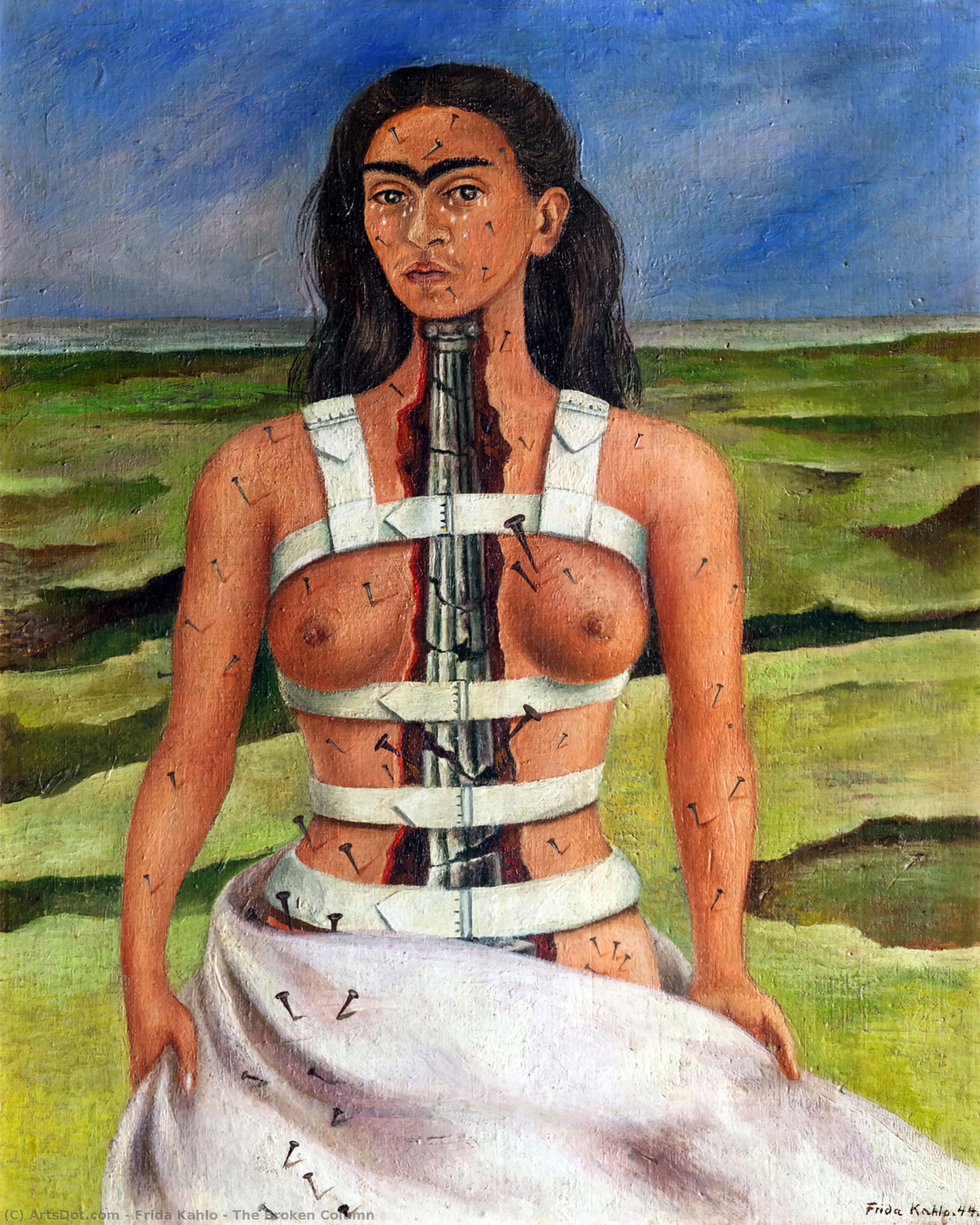 The Broken Column – Frida Kahlo, 1944. Wikioo.
Kahlo was not afraid to be her authentic self; she was in touch with her masculine and feminine sides, often dressing as a man in family photographs. She was unconcerned about going against the conventions of the day.
Quote 2.
 Sandra Kuck – Yin and Yang [2020] Oil on Canvas. Gandalf’s Gallery. Flickr.
“Maybe if you had been different,
you would have been what they wanted.
But maybe if you have been what they wanted,
you would have been different
than who you were supposed to be.”Morgan Harper Nichols
These words neatly encapsulate the issue of pleasing ourselves, in order to be authentic. Trying to fit into how we perceive other people would want us to be is like chasing our tail. Constantly searching for the approval of others will become a fruitless and self-destructive quest.
Many of us try to please others to some extent, but if this is done to excess, it can be depleting of both energy and spirit. It will mean that we cannot be our true selves.
How can we possibly become what we imagine everyone wants us to be? Obviously we cannot. It is a fact that we give our power away to others when we feel dependent on their constant affirmation and assent.
Often, the roots of this lie in our past, with unmet needs for love and approval, which can continue into adulthood. Being able to break free of such restrictions is a liberating experience, for which many people might need therapeutic help.
“Literature is strewn with the wreckage of those who have minded beyond reason the opinion of others.”
Virginia Woolf
Quote 3
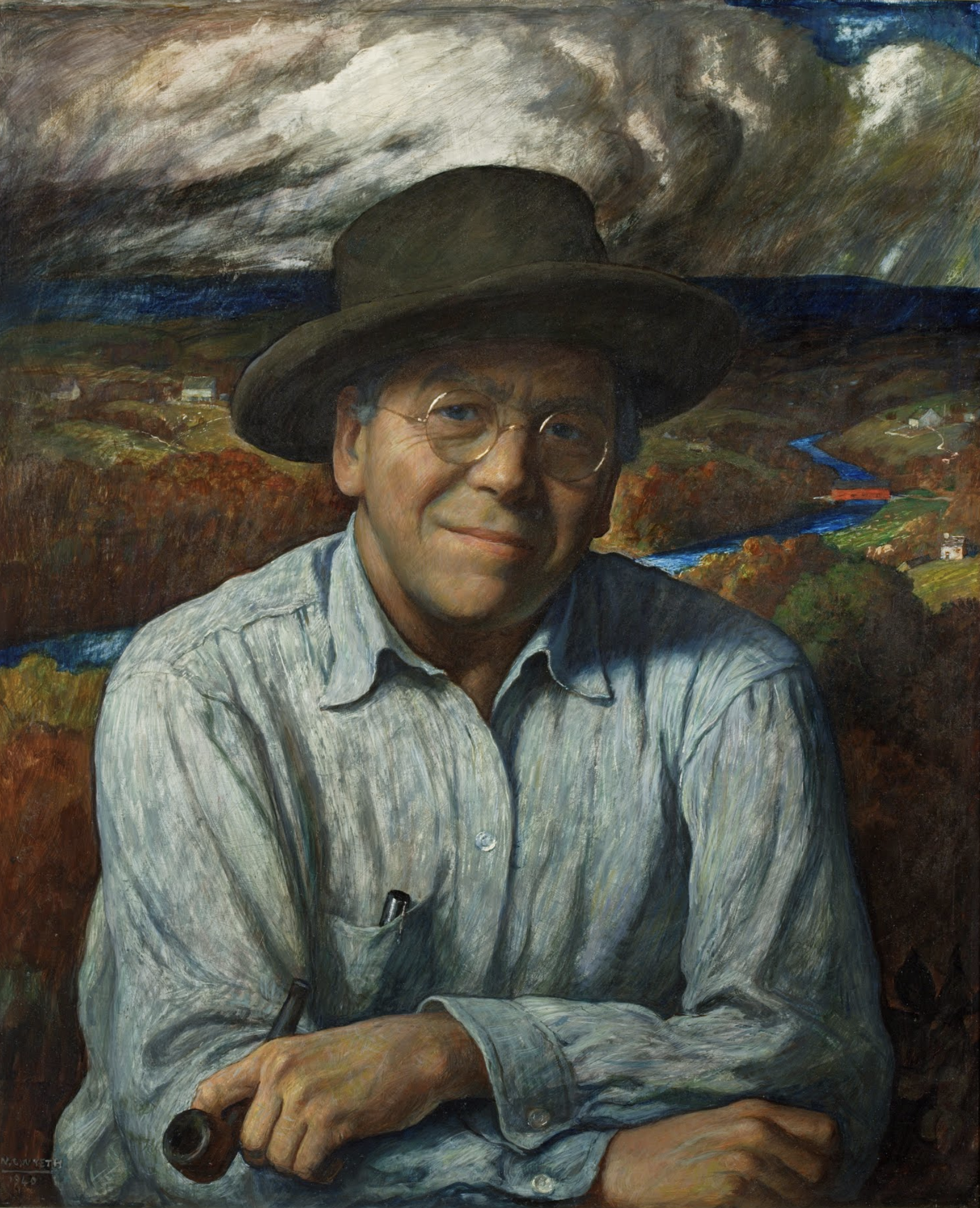 Newell Convers Wyeth – Self Portrait [1940] Gandalf’s Gallery.
“The privilege of a lifetime is to become who you truly are.”
Carl Jung
Jung’s wise quote sees the process of becoming yourself as a ‘privilege,’ the biggest one we could possibly have in our lifetimes. It is truly a freeing experience, one that is only achieved through facing the darker sides of ourselves as well as the ‘good’ aspects.
‘Everyone carries a shadow and the less it is embodied in the individual’s conscious life, the blacker and denser it is.’
Carl Jung.
Jung’s shadow refers to the darker parts of the personality of which we may be unaware.
If we remain in denial about the existence of our own shadow, we will tend to project that darkness onto others, disowning parts of ourselves we do not like. This is certainly not the way to achieve authenticity.
Real, authentic people, those who are true to themselves, tend to be warm, fair-minded, genuine, generous, open and honest. They are not afraid of their darker aspects, for they have come to terms with their existence and are in control of them.
They can be themselves, with confidence, knowing who they are. They tend to be people who are interested in you, and listen when you speak.
They do not put on an act, or pretend to be other than they are. Authentic people do not hide their neediness or their pain; that is part of what makes them likeable, for they do not have to be seen as perfect.
Quote 4.
 Ken Flewellyn – Express Yourself [2015]Gandalf’s Gallery Flickr.
“The one thing that you have that nobody else has is you. Your voice, your mind, your story, your vision. So write and draw and build and play and dance and live as only you can.”
Neil Gaiman
This encouraging quotation highlights our individuality and our uniqueness; we all have qualities that we can use creatively in different ways. It emphasises what we do have within ourselves: the ability to speak out and share our thoughts and ideas, the stories we have to tell about ourselves and our ability to be innovative and expressive ‘as only we can.’
The writer aims to give us the confidence to use our innate gifts and talents and to recognise that we all have something special to offer to others and to the world, whatever that may be. This is about sincere appreciation…. of ourselves.
Quote 5.
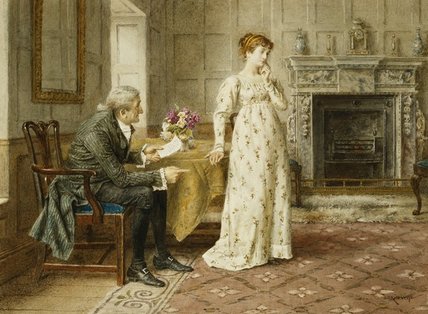
Some Paternal Advice – George Goodwin Kilburne. Wikioo.
“The paradigm of Western culture is that the essence of persons is dangerous; thus, they must be taught, guided and controlled by those with superior authority.”
Carl R. Rogers, A Way of Being
It is essential to include here a quotation from Carl Rogers, the ‘master’ of authenticity. His important words above refer to this vital quality.
In relation to psychotherapy, the concept of authenticity accords with Carl Rogers‘ theory of congruence on the part of the therapist, that is, being integrated and real, a genuine, sincere presence for the client.
Being congruent involves ways of thinking about how we relate to others, much self-examination and the wish to be sincere and honest with ourselves, personally and in our work.
Rogers is describing how our culture sees people as innately bad, needing to be controlled and firmly advised by others around them who ‘know better.’ There is no sense of trusting another person as an equal and bringing out their intrinsic self-knowledge.
The truth is that no-one knows what is right for anyone else. As parents and therapists we can only be there for others, helping them find who they really are in an atmosphere of safety, love, acceptance, empathy and care.
Many children grow up having to fit in, to mould themselves, and be moulded, into another person’s design. They have to pretend to be other than they really are. They often feel liked a ‘square peg in a round hole.’
Perhaps, to varying extents, many of us have felt like this. It may be that we were not allowed to express our feelings, to show anger, unhappiness, discontent, disagreement.
In some families there is a pressure to constantly comply with others, to adapt to their ways, to deny our own beliefs, thoughts and feelings. Thus the children have to develop other, false selves, masks, inauthentic personae, in order to feel acceptable.
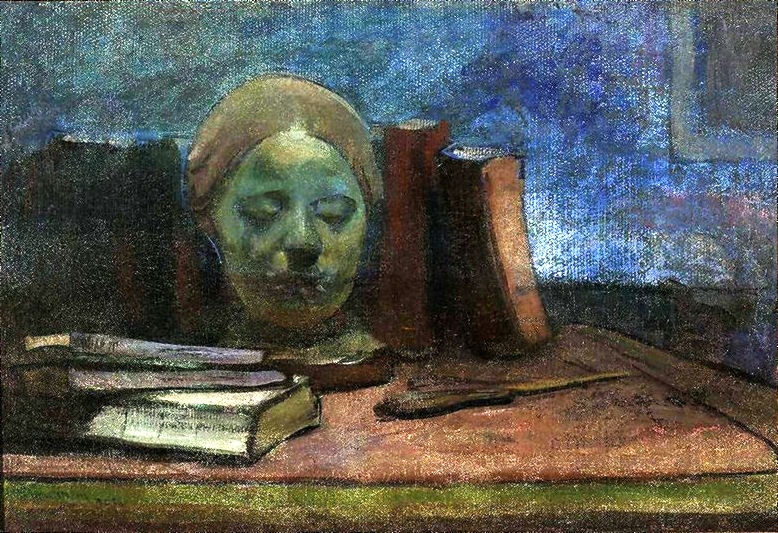
Władysław Ślewiński: Mask and books. c 1897. Wikimedia Commons.
Such behaviour patterns are hard to rid ourselves of, and many people spend their lives trying to please others and have long ago lost touch with their real self. Therapy may be needed to help with this, so that we might uncover the real person hiding beneath the layers of continuous adaptation.
Being unafraid to stand out from the crowd, despite the threat of being criticised, is highly important.
It is vital to strive to be true to ourselves, develop the resilience and courage to be authentic, and not allow ourselves to be cowed by others or by public opinion. Then our own true voice will be heard above the cacophony of life.
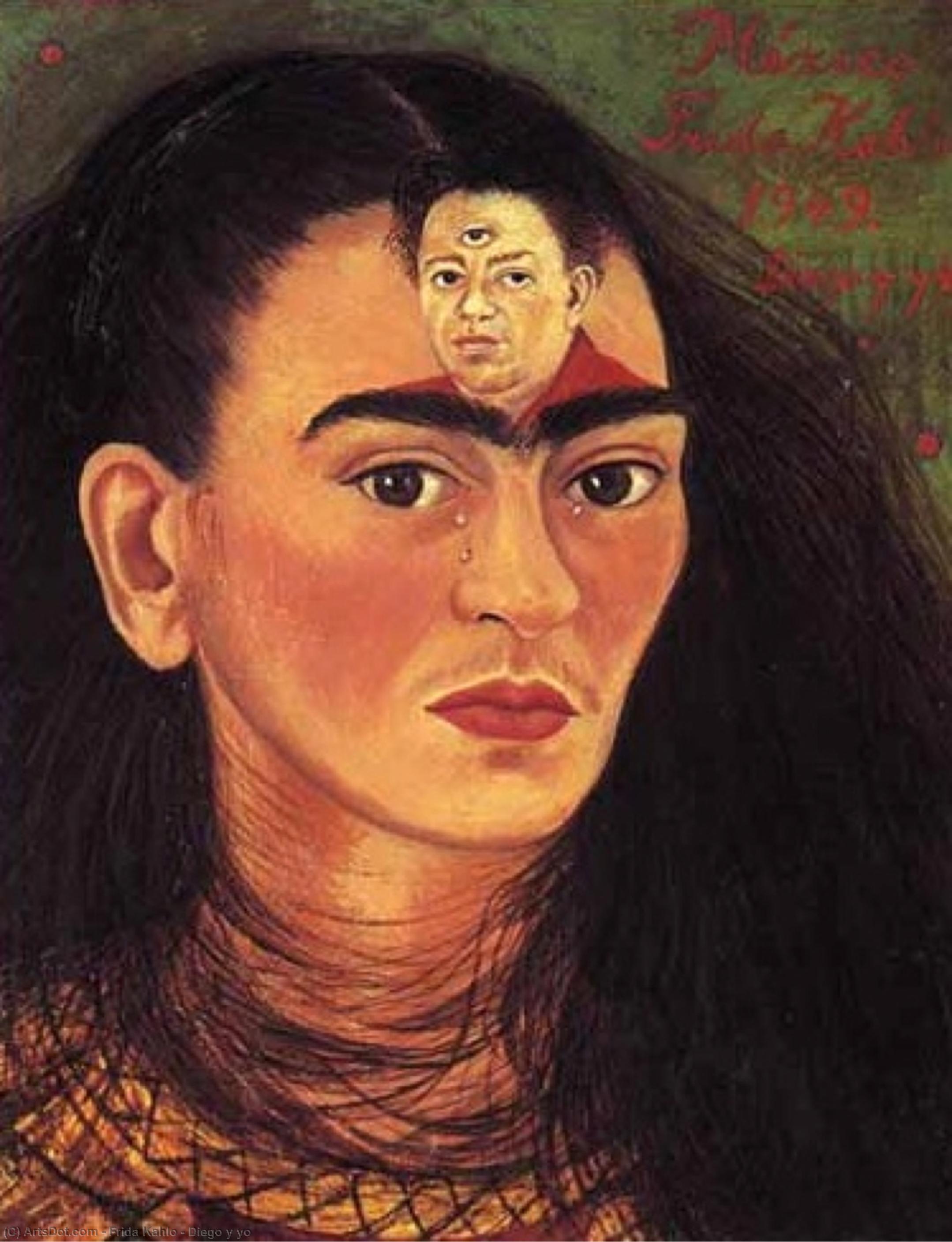 Diego y yo – Frida Kahlo. Wikioo.
“We have to dare to be ourselves, however frightening or strange that self may prove to be.”
May Sarton
© Linda Berman.
 waysofthinking.co.uk
It’s the May Sarton quote that I will carry in my mind today.
LikeLiked by 1 person
I’m so glad you liked the quote. Thanks for your feedback.
LikeLike