
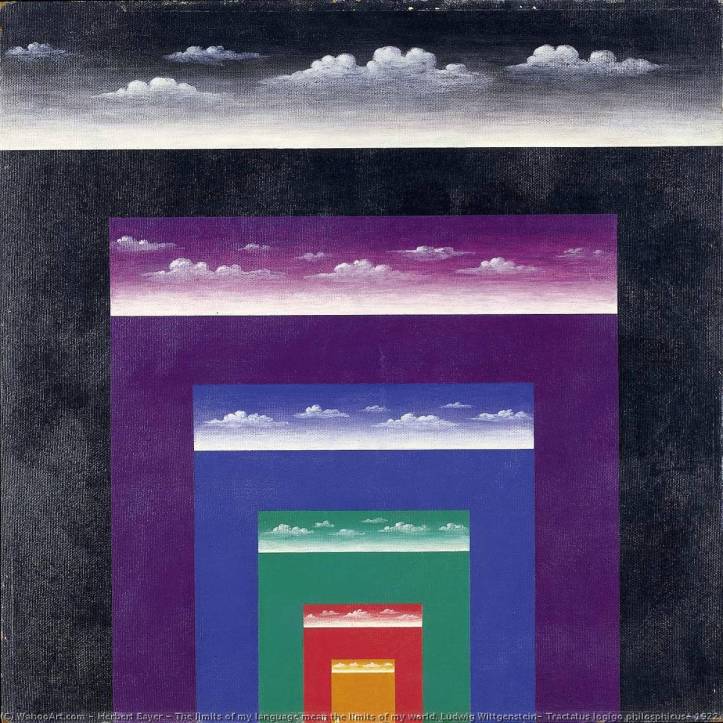
 The limits of my language mean the limits of my world. Ludwig Wittgenstein, Tractatus logigo philosphicus, 1922. From the series Great Ideas of Western Man – Herbert Bayer. Wikioo.
- Seeing Beyond The Limits
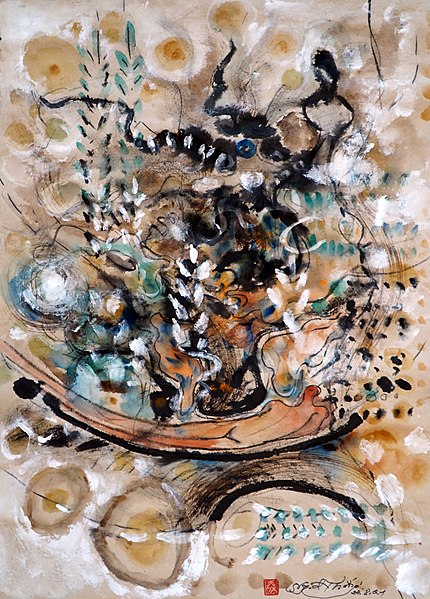
Hidden deep in the imagination – No 10 Painting Nguyễn Đại Thắng 2021. Wikimedia Commons.
“If my poetry aims to achieve anything, it’s to deliver people from the limited ways in which they see and feel.”
Jim Morrison
We all have limitations, however much we might wish we did not. Like it or not, we cannot fly, we cannot live forever and we cannot conjure riches out of the sky.
Having said all this, sometimes we might also tend to underestimate our abilities and magnify our own limitations, perhaps through low self-esteem or fear of change. With this in mind, I will begin this post about accepting our limitations with a warning: be careful not to limit yourself by diminishing the scope of what you can do.
Morrison’s quote above reminds us that some of us have limited ways of seeing, which can mean that we will only have a narrow view of ourselves and the world. He offers his poetry to help people through and to widen their horizons, stimulating their imaginations:
“I can make myself invisible or small.
I can become gigantic and reach the
farthest things.”
Extract from ‘Power’, Jim Morrison.
Imagination can take us out of the present, away from the past, and into an fantastical future. It can give us wings and the scope to ‘travel’ into any time and any place we want. It can offer us the freedom to be exactly who we wish to be. Imagination can enable us to be self-contained, to function more independently and confidently, to breach the limitations of reality.
Through using our imagination, we will discover that we are unique and that within us is a whole world of possibilities.
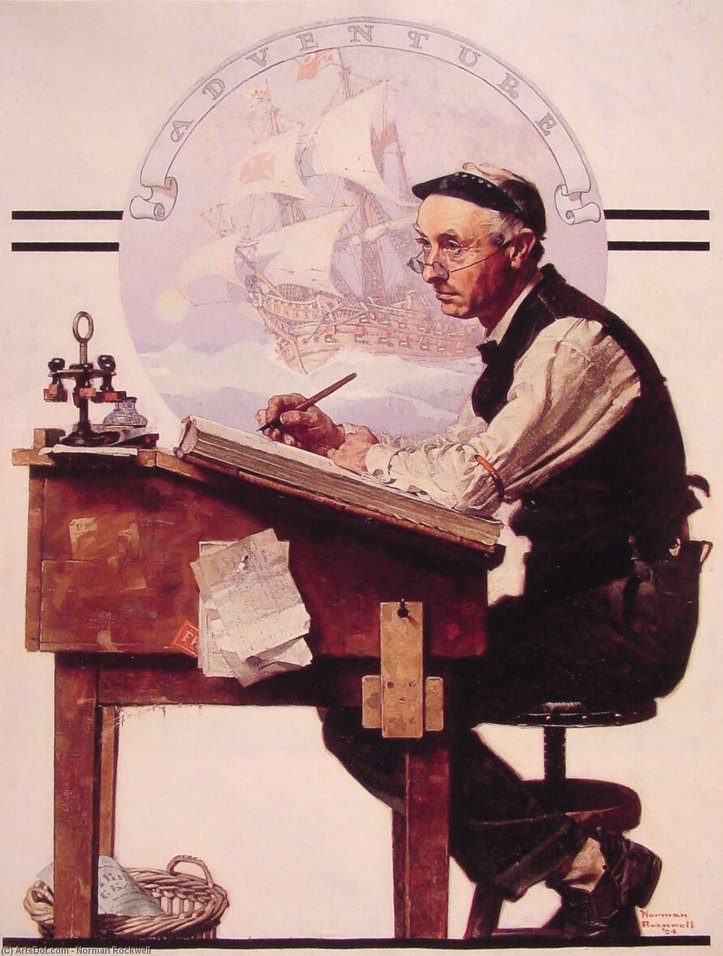 Daydreaming Bookeeper (Adventure) – 1924. Norman Rockwell. Wikioo.
“Adventure is not outside man; it is within.”
George Eliot
Our imagination helps us to develop our own ideas and thoughts and to risk departing from socially accepted norms and expectations, to challenge our limitations.
It is also important that we encourage ourselves and give ourselves growthful messages that are generous and caring, enhancing our own well-being and maximising our innate possibilities.
“A man cannot be comfortable without his own approval.”
Mark Twain
Appreciating our own qualities, valuing and believing in ourselves, are all crucial if we are to make the most of our potential. Sometimes we might need a friend to help us get in touch with our good points. At others, it might be that we need a therapist to help us understand the roots of our lack of self-belief and to enable us to move forward, pushing the boundaries of our self-knowledge.
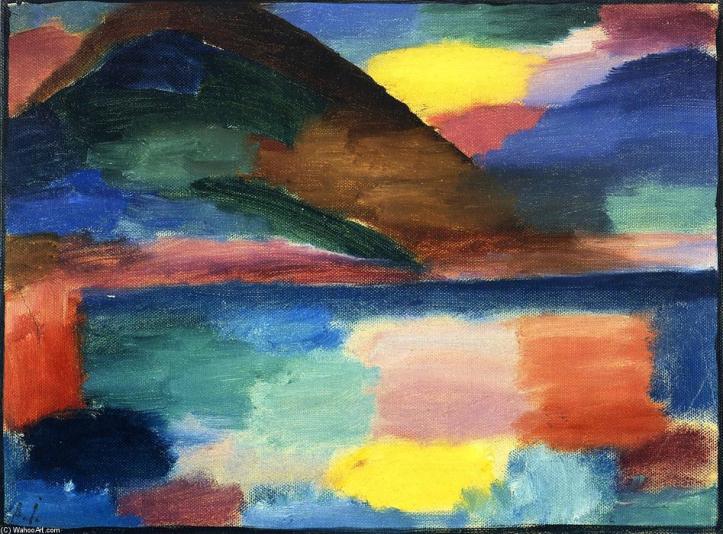 Summer Day in Ascona – (Alexej Georgewitsch Von Jawlensky)
“In the depth of winter, I finally learned that within me there lay an invincible summer.”
Albert Camus
- Balancing Up
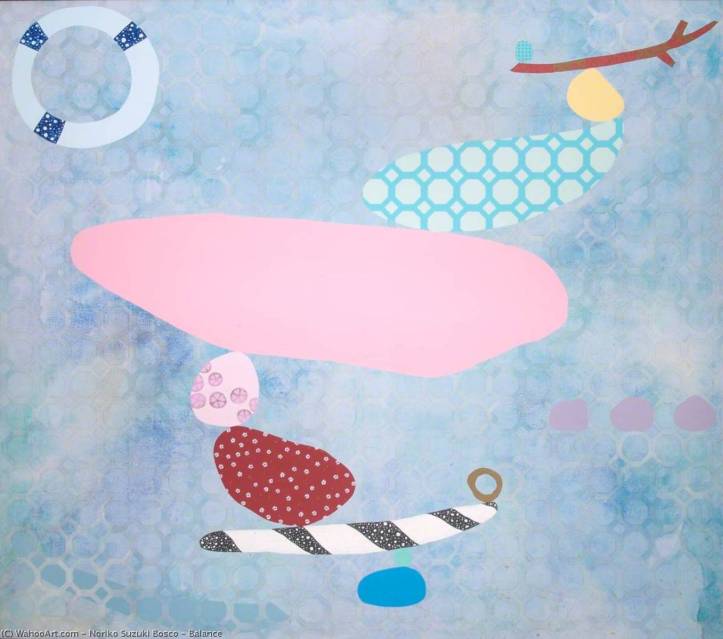 Balance – Noriko Suzuki Bosco. 1998. Wikioo.
“Consciousness is the awareness that emerges out of the dialectical tension between possibilities and limitations.”
Rollo May, The Courage to Create
Acceptance of our limitations is important if we are to live healthy and fulfilling lives; over-estimating our capabilities will likely result in an Icarus-like fall.
The quotation above refers to the fact that life is about balancing opposites, managing the inconsistencies and changes that constantly make our lives interesting and colourful…. and, at times, difficult. The ‘dialectical tension between possibilities and limitations’ is a phrase that perfectly sums up the dilemma in all our lives.
Recognising and accepting our limitations means that we will not overload ourselves with work, or allow others to do that to us. Gaining an acceptance of the fact that we cannot do it all, that we cannot succeed in everything, that we are unable to be magicians, angels, prophets or founts of all knowledge, is crucial.
Having realistic expectations, of ourselves and others, assessing risks, and not aiming too high, will mean that we will be able to function better in life. We will then also be able to focus on the possibilities, the opportunities and chances that are open to us.
We are, all of us, a blend of strengths and weaknesses; if we aim for perfection, or try to eradicate everything in us that feels ‘limited,’ then we are on a hiding to nothing. Unless we consider and balance the apparently contradictory, different ways of thinking about ourselves and the world, we will never see the whole picture in life.
“Life consists of two sides … light and dark. Joy and sorrow. Without a balance, one cannot fully experience a full and well-rounded life.”
JoAnn Ross
If we do not accept life’s ambiguities, and those within us, we will always have a partial and unbalanced take on the world inside and around us.
“What if you rested in between contradicting energies? What if you practiced holding contradictory views at the same time with no fantasy of them ever being resolved?”
Nate Green
Being able to keep two opposing views in mind simultaneously, without feeling that we have to come down on one side or another, gives us the ability to reflect, to weigh and balance opposites, to discover contradictory truths that may both have value. Knowing that we have both limitations and abilities, and staying with this knowledge, without self-criticism, is, truly, ‘resting between contradictory energies.’
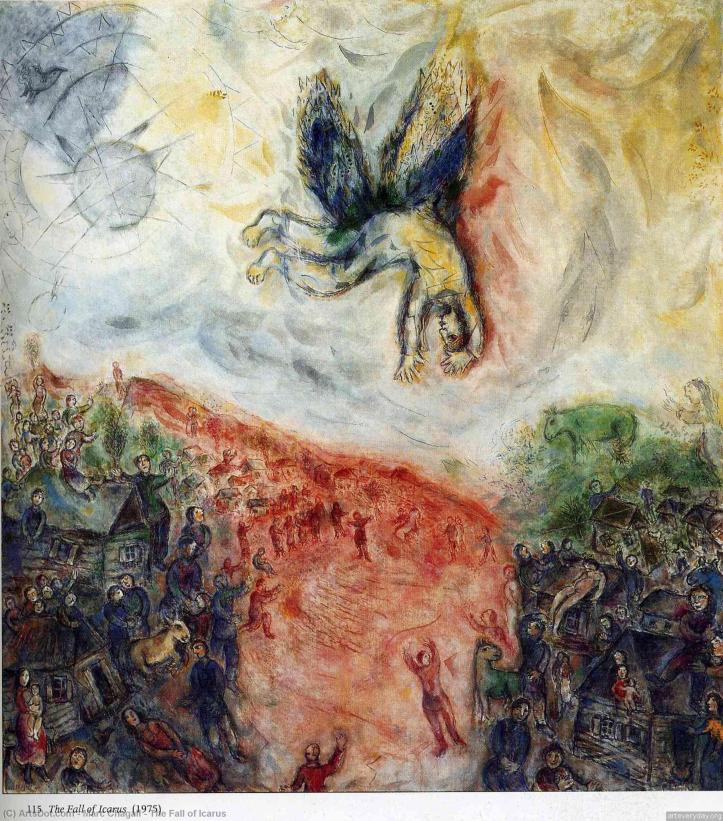 The Fall of Icarus – Marc Chagall. 1975. Wikioo.
“Be bold enough to know that you can make a difference. Be humble enough to know that you’re a limited creature.”
Alexander Den Heijer.
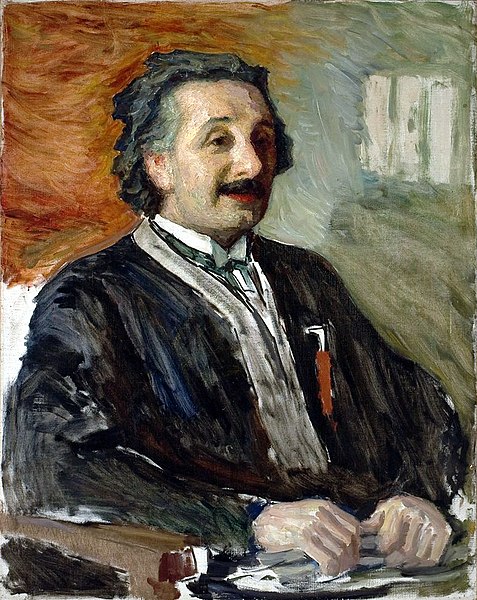
Leonid Pasternak – Albert Einstein (1924) Wikioo.
“The difference between genius and stupidity is: genius has its limits.”
Alexandre Dumas-fils
- Limitations in Therapy: Facing Disappointment
 The Magician – Rene Magritte. 1952. Wikioo.
“And so, it is not astonishing that, though the patient enters therapy insisting that he wants to change, more often than not, what he really wants is to remain the same and to get the therapist to make him feel better. ”
Sheldon B. Kopp, If You Meet the Buddha on the Road, Kill Him! The Pilgrimage of Psychotherapy Patients
Many people come to therapy expecting some kind of magic; they might think that the therapist knows it all and will hand them ‘solutions’ on a plate. The therapist then has to be careful not to fall into the trap of feeling over-powerful and able to work wonders, in reaction to these projections…
“The establishment of an authentic relationship with patients, by its very nature, demands that we forego the power of the triumvirate of magic, mystery, and authority.”
Irvin D. Yalom, The Gift of Therapy
Kopp was a very perceptive psychotherapist and writer; this memorable book, below, was written in the early 1970’s.

Kopp’s message is about each person becoming aware of the disappointments they will encounter in terms of the limitations in psychotherapy and by implication, in their life. The pain of this will likely lead, if worked through with the help of the therapist, to a sense of freedom, greater confidence, strength and self-actualisation.
“The most important things that each man must learn no one can teach him. Once he accepts this disappointment, he will be able to stop depending on the therapist, the guru who turns out to be just another struggling human being.”
Sheldon Kopp.
The writer warns that therapy is hard and is not to be undertaken lightly. Before this enlightenment happens, people often go through a difficult process in therapy. This process usually begins with the realisation that the therapist is not living up to all they had initially hoped for…. therapists have limitations.
They have boundaries, which are vital for both patient and therapist, but these might be experienced as frustrating by the patient. For example, time boundaries can be seen as unnecessary, or harsh, as can the therapist’s lack of self-disclosure, or giving advice or suggestions….
“The very best thing we can do for others isn’t soaking up their pain, it is actually holding space for them. Holding space for a person means giving them the room to grieve or vent while still maintaining our own boundaries.”
Mateo So
Realising that the therapist does not have any solutions might feel really upsetting. Sometimes, at this juncture, people become despondent, feel lost, or angry with the therapist. If the therapist doesn’t have the answers, then WHO DOES??

However, this phase in therapy can represent a crucial turning point. Negotiating such feelings with a sensitive therapist can mean that new learning will occur. Expectations of the therapist being the longed-for parent or god-like figure (“Buddha”) need to be explored, perhaps in the light of the person’s unmet needs from the past. They will need to learn to face the pain- and grief- of realising that the past cannot be changed, or rectified….
“Expectation has brought me disappointment. Disappointment has brought me wisdom. Acceptance, gratitude and appreciation have brought me joy and fulfilment.”
Rasheed Ogunlaru
In reality, it is only through personal ‘introspection’, an exploratory journey into self-understanding, that we can discover how to repair ourselves. Psychological renewal can occur, but only if we take responsibility for it and do not keep expecting an external solution. We can be helped along the way considerably by therapy, but all of us – therapists and patients alike- will have their limitations.
It is important that a therapist does not become burnt-out through overloading themselves with appointments and trying to find solutions for everyone. Ultimately this does not help the patient to work things through for themselves…
“Do what you can to help people but have the wisdom to accept your limits.”
Bryant McGill
- When Limitations Can Be Creative
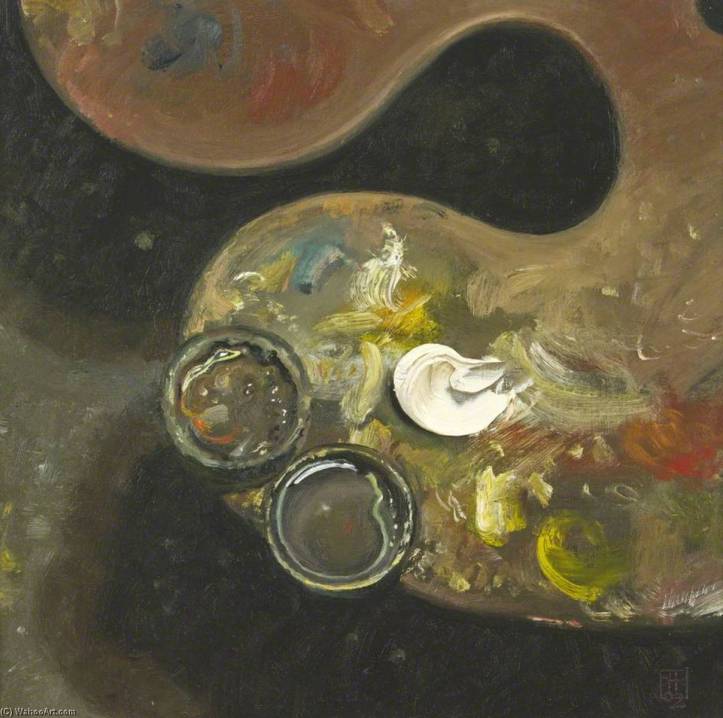 Limited Palette – David Hugh Cobley. 2002. Wikioo
“We all have limitations. They are worth befriending. They teach us a lot. They can show us what we most need to pay attention to and honor. They become our cutting edge for learning and growing and gentling ourselves into the present moment as it is.”
Jon Kabat-Zinn, Full Catastrophe Living: Using the Wisdom of Your Body and Mind to Face Stress, Pain, and Illness
We may wonder how our limitations can be helpful, how we can learn, through them, to be creative. What does ‘befriending them’ even mean?
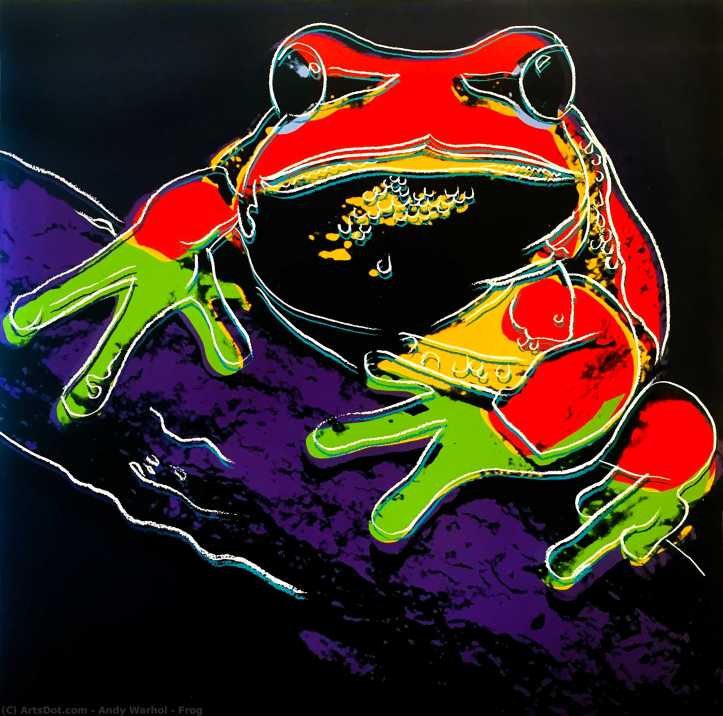 Frog – Andy Warhol. Wikioo.
“The Old Pond” by Matsuo Bashō
An old silent pond…
A frog jumps into the pond,
splash! Silence again.Translated by Harry Behn
The form of Japanese haiku poetry beautifully illustrates how limitations can benefit us creatively. The writing of a haiku is bound by a highly restrictive set of rules; there must be three lines, and no more than seventeen syllables; there are usually five syllables in the first line, seven in the second, and five again in the third. The poetry of haiku does not rhyme.
The brevity and conciseness of a haiku is part of what makes it beautiful; it often captures the ‘now,’ the present moment, with startling power and immediacy.
“The beauty of a haiku is its limitations.”
Nanette L. Avery
It would appear, then, that we can put our limitations, both internally and externally, to good use. They can sharpen our mind, and help us to concentrate on what is important.
“The way to get over creative block is to simply place some constraints on yourself. It seems contradictory, but when it comes to creative work, limitations mean freedom.”
Austin Kleon, Steal Like an Artist: 10 Things Nobody Told You About Being Creative
In a similar way to the haiku, a limited palette in art can create a sense of focussed unity, elegant simplicity, good composition, and harmony. Only a few colours are used, perhaps two or three, in order to produce a harmonious composition.
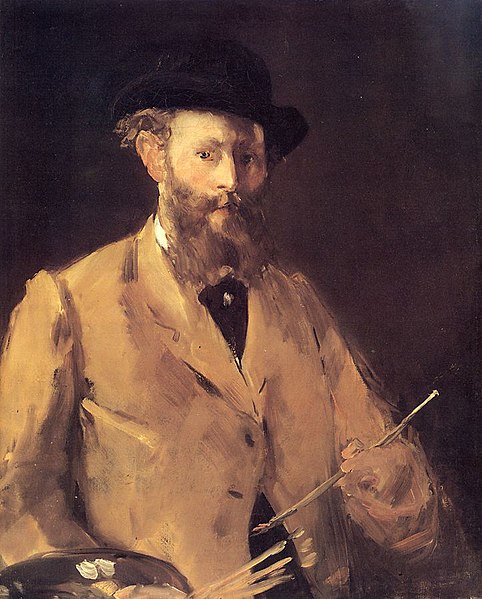
Manet. Self-Portrait with Palette. 1879 Wikimedia Commons.
“My freedom thus consists in my moving about within the narrow frame that I have assigned myself for each one of my undertakings. I shall go even further: my freedom will be so much the greater and more meaningful the more narrowly I limit my field of action and the more I surround myself with obstacles. Whatever diminishes constraint, diminishes strength. The more constraints one imposes, the more one frees one’s self of the chains that shackle the spirit.”
Igor Stravinsky
© Linda Berman.
 waysofthinking.co.uk
Again, as usual, Linda, you’ve chef’d up feast of fine art and fine wisdom. It is a paradox, isn’t it, that somehow genuine creativity flourishes in a box, thrives with limitations. The militant structure of the Shakespearean sonnet, the two-colour painter’s palette, the bounded limits of a piano sonata, and the gravitational inevitability of the dance, all genius somehow explodes within. The threadbare cliche of “thinking outside the box” can betray us.
Really appreciate your meticulous effort this week. Masterful. And all within the muscular limitations….of a blog.
LikeLiked by 2 people
Bob I do appreciate your thoughts about my blog! I agree about the limitations paradox, it’s strange but true. Thanks for your interesting comments 🤗🙏
LikeLiked by 1 person
[…] for help isn’t a sign of weakness; it’s a testament to your strength. It shows you’re aware of your limitations and are willing to learn and […]
LikeLike
Thanks for the reference.
LikeLike
[…] assist isn’t an indication of weak point; it’s a testomony to your power. It reveals you’re conscious of your limitations and are prepared to be taught and […]
LikeLike