
You can never have enough quotations about kindness. Although I wrote about kindness some years ago, it seems that there is always the need for further space to think about it…..
- Karma
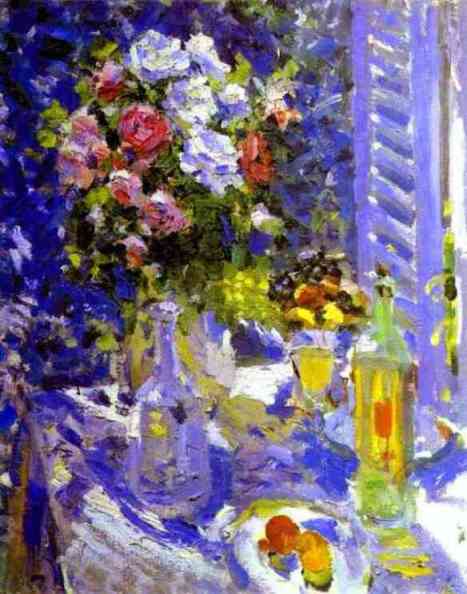
Flowers and Fruit – 1911. Konstantin Alekseyevich Korovin. Wikioo.
“Some day the kindness you give out will come back to you. Maybe not as soon as you’d like, but it will be here. Threefold, sixfold, tenfold. Your life will be full of ‘thank you’. Full of ‘I’m so glad you’re alive while I am.’ Blossoms everywhere. Love raining down on you. It will come.”
Emery Allen
Do you agree with this notion, that kindness returns to you? It seems to me that this may be so, for if you are consistently kind to people, then, inevitably, someone along the way will reflect and return your kindness. This is good Karma, a natural consequence of benevolent intentions and kind deeds.

Tibetan Endless Knot. Created by Rickjpelleg. Wikimedia Commons.
(Karma symbols such as the endless knot (above) are common cultural motifs in Asia. Endless knots symbolize interlinking of cause and effect, a karmic cycle that continues eternally. Wikipedia.)
“As no cause remains without its due effect from greatest to least, from a cosmic disturbance down to the movement of your hand, and as like produces like, Karma is that unseen and unknown law which adjusts wisely, intelligently, and equitably each effect to its cause, tracing the latter back to its producer.”
H. P. Blavatsky
An unkind attitude is very likely to produce hurt feelings, anger and resentment in others, which will, inevitably, rebound back to the unkind person. The Hindu, Jain, Sikh and Buddhist principle of Karma is related to how we act in the world. If we do bad, hurtful things, there will be consequences for us.
Equally, good energy will come back to us if we do good deeds. It is a matter of action and reaction. Whether or not you believe in Karma, there is no doubt that, if we constantly send out bad vibes and negative energy, we may get this boomeranging back at us in the future.

Boomerang. Peter Harlow. Flickr.
“One thing I do know for a fact is that the nicer we are to our fellow human beings, the nicer the universe is to us.”
Joe Rogan
- The Human Condition: Memento Mori
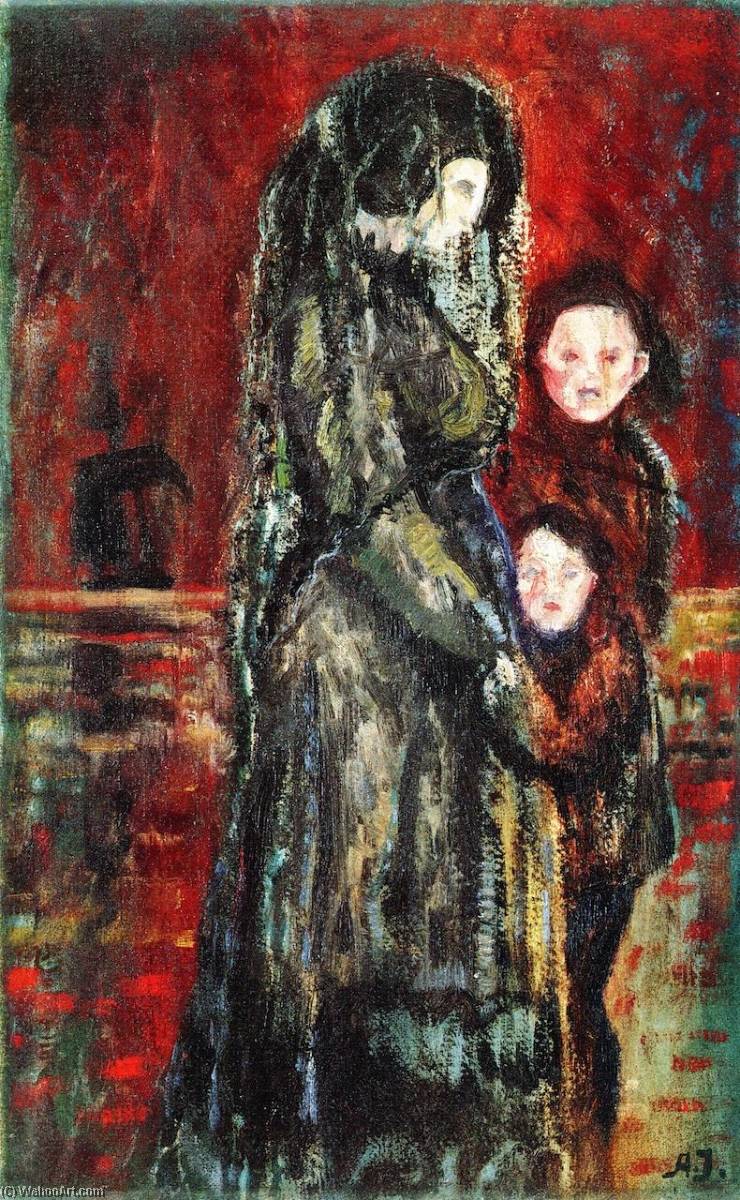 Mourning – Aksel Waldemar Johannessen. 1922. Wikioo.
“Consider it: every person you have ever met, every person will suffer the loss of his friends and family. All are going to lose everything they love in this world. Why would one want to be anything but kind to them in the meantime?”
Sam Harris
The philosopher and neuroscientist Sam Harris is alluding to the human condition; this is a term that encompasses the common needs, experiences and essentials of existence of every one of us. It refers to a state that universally affects all human beings on the planet.
We may be diverse in many ways, and our differences are highly important in society. At the same time, we are all deeply connected.
“Every man bears the whole stamp of the human condition.”
Michel de Montaigne
For example, we are all born and we are all going to die. We will, every one of us, age, and we will all struggle with the limitations of our biology. The quotation draws our attention to this fact, and asks the crucial question about why, in view of this, we are not all kinder to each other.

Small Deathbed Scene – Max Beckmann. Wikioo.
“Perhaps the real therapy occurred at the deathbed scene, when they moved into honesty with the revelation that they were fellow travelers, both simply human, all too human.”
Irvin D. Yalom, The Gift of Therapy
The awareness of potential loss of loved ones needs to overshadow any desire to be unkind. Sadly, this is not always the case.
Each of us is a blend of the other, and a part of an infinite, larger whole.
Instead of creating outsiders, fictional boundaries and divisions, instead of rejecting those who think differently, in the family, socially and globally, it is crucial to contemplate commonality and inclusion. It is important to feel and show hospitality, compassion and love, whilst we still have time on this earth.
This is a call to remember our humanness and our humanity, to feel the oneness of being human, and to remember Plato’s words at all times-
“Be kind, for everyone you meet is fighting a harder battle.”
Plato
If we treat others well, then we will be rewarded with love and respect. Attempting to dominate and to be selfish, pedantic, excessively rule-bound and rigid, will create only fear, anger and mistrust in those around us.
- The Kindness Of ‘Ordinary Folk.’

“Some believe it is only great power that can hold evil in check, but that is not what I have found. It is the small everyday deeds of ordinary folk that keep the darkness at bay. Small acts of kindness and love.”
J. R. R. Tolkien
The kindness of ‘ordinary folk ‘ is often expressed through small deeds or gestures, and experiencing this helps us to regain our faith in other people.
This kindness makes ‘ordinary folk’ extraordinary.
“My intention is to ‘seek the sacred in the ordinary.”
Clementina van der Walt
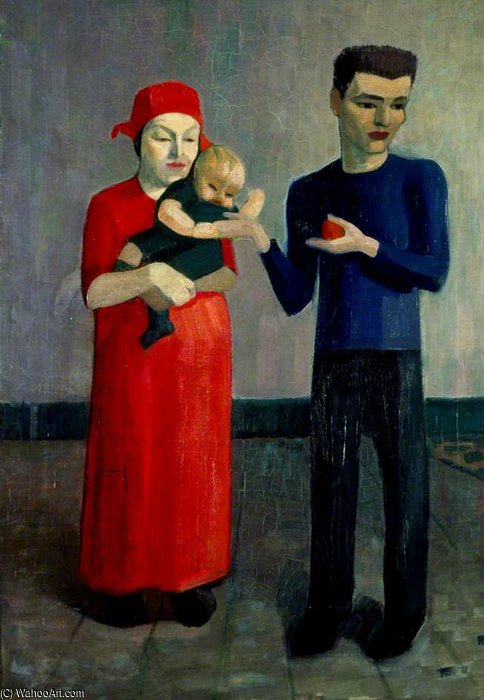
Family Group – Mark Gertler. Wikioo.
“Occasionally some individuals let the seeming ordinariness of life dampen their spirits. Though actually coping and growning, others lack the quiet, inner-soul satisfaction that can steady them, and are experiencing instead, a lingering sense that there is something more important they should be doing . . . as if what is quietly achieved in righteous individual living or in parenthood are not sufficiently spectacular.”
Neal A. Maxwell
We sometimes hear, or read about, ‘the kindness of strangers,’ the random acts that can sometimes surprise us… in a good way. In some instances, the stranger can be our salvation, rescuing us when we may be in need, helping us, sharing what they have, giving us food and shelter.
 Thomas B. Kennington – The pinch of poverty. Wikimedia Commons.
“How do we change the world? One random act of kindness at a time”
Morgan Freeman
There are usually some people around, depending on the circumstances, who seem receptive to our needs, and to whom we might go for aid in a dire situation.
In all human beings there is a propensity to help others from their early days; research indicates that children as young as eighteen months can show altruism. Sometimes, this wish to help others for no self-gain becomes uppermost in a person’s personality.
In other cases, however, this desire to assist others becomes warped and crushed under the effects of abuse or neglect; if a child is not shown love and empathy, they will not be able to express these emotions themselves.
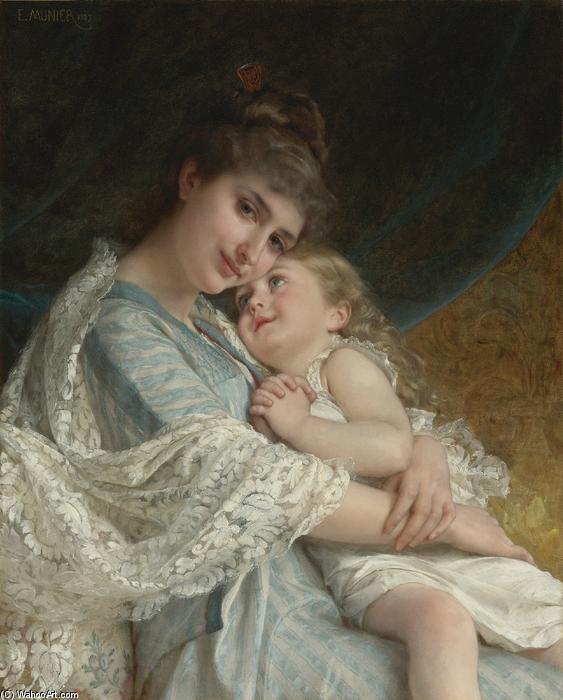
A Tender Embrace – Emile Munier. 1887. Wikioo.
“Kindness is ever the begetter of kindness.”
Sophocles
- Rippling
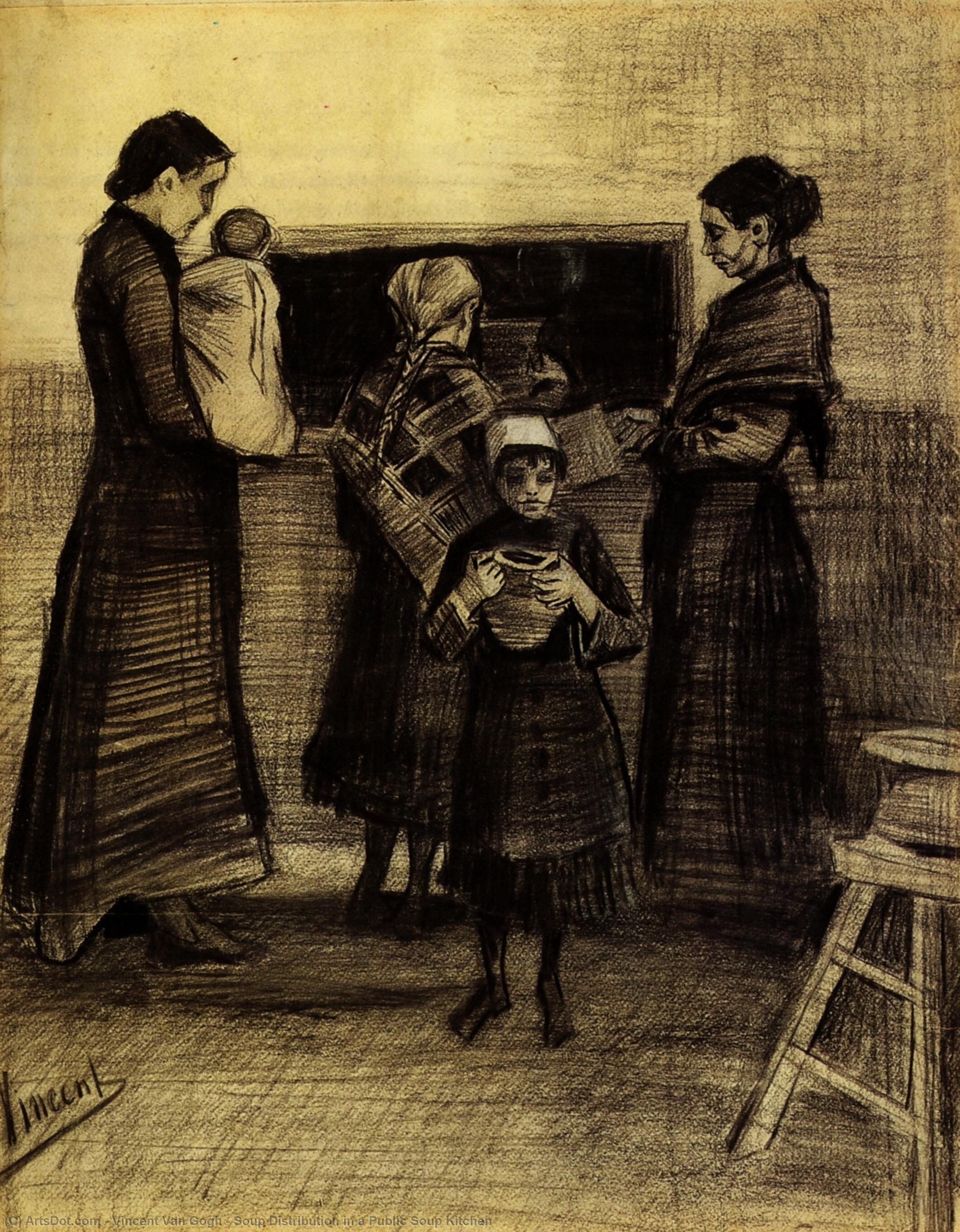 Soup Distribution in a Public Soup Kitchen. 1883. Vincent Van Gogh. Wikioo.
“Remember there’s no such thing as a small act of kindness. Every act creates a ripple with no logical end.”
Scott Adams
Kindness can have so many different aspects. Love, tenderness, gentleness, helpfulness, consideration, empathy, giving, attentive listening, friendliness….. all these come under the generous and spreading umbrella of kindness. It may be shown through words or gestures, expressions or direct action.
The phrase ‘random acts of kindness and senseless acts of beauty’ originated in 1982, coined by Anne Herbert. She published a book of the same name in 1992. Random acts of kindness are about helping someone, perhaps on the spur of the moment, who is in need.
Such acts, as the Adams quotation above says, will ripple outwards, they will spread in ways we might never know about. What we can know is that we have been there for another person, when they were in need.
The psychotherapist Yalom talks of rippling, in terms of the effect that we have on others around us.
“Rippling refers to the fact that each of us creates – often without our conscious intent or knowledge – concentric circles of influence that may affect others for years, even for generations. That is, the effect we have on other people is in turn passed on to others, much as the ripples in a pond go on and on until they’re no longer visible but continuing at a nano level.”
Yalom. The ripple effect .
Therapy Today May 2008, Volume 19 No 4
The ripple effect in terms of human behaviour, means that, for example, a small good deed will somehow expand outwards, dispersing and spreading to others. It is a kind of chain reaction, one that produces more and more changes, so that the small deed eventually becomes bigger than we would ever expect.
For example, if you smile at someone, they most often smile back, for smiles are infectious; you may have just started a ripple of smiles that will spread from person to person.
“Always find opportunities to make someone smile, and to offer random acts of kindness in everyday life.”
Roy T. Bennett
 Ice Thawing on the Seine The Ice Blocks near Vétheuil – Claude Monet. Wikioo.
“Constant kindness can accomplish much. As the sun makes ice melt, kindness causes misunderstanding, mistrust, and hostility to evaporate.”
Albert Schweitzer
© Linda Berman
I do hope you will be kind enough to support me by becoming a follower of my blog, which is entirely free; join my ever-expanding list of followers to receive regular weekly updates about the next week’s post straight to your email inbox. Thank you.
 waysofthinking.co.uk
Thanks for the piece about Kindness. I’m guessing that you already saw the LinkedIn live session, “The power of Kind, the perils of Nice.” Craig and I have been talking about this for months and done a coupe of presentations. We’re still not pretending to know the ‘answer,’ and we’re having some great conversations. Stay well. Mac 🙏
LikeLiked by 1 person
Thanks Mac. I haven’t seen the session you mentioned, but will take a look now! 😀
LikeLike
I confess. I was in a dark state, curtained in grumpitude when I started reading this week’s image/essay on kindness. But by the time I finished reading, the curtains had parted, the sun broke through, I wore a creaky smile.
The connection you perceived between kindness and Konstanin’s painting, “Flowers and Fruit” is sublime. Gave me chills. There’s a poet in you.
What can I say? I hope you can see that your weekly toil curating truth and beauty is itself, an act of kindness. I was grumpy. Now I’m grateful. With a grin. Thank you.
LikeLiked by 1 person
Dear Bob
Your comment is so heartwarming and touching to me. Thank you for such wonderful feedback. I’m really pleased my post changed your mood a little and made you smile. Your encouragement makes me smile too!
Best
Linda.
LikeLike