
 Going to Work – L S Lowry. Wikimedia Commons
“Conscientiousness comprises industriousness, self-control, stick-to-itiveness, and a desire for order.”
Daniel J. Levitin
- How do we understand the word conscientious?
Levitin’s quotation is a fitting start to the post; it points towards such concepts as diligence, care, dedication, resilience and staying power.
Etymologically, this word originated and developed from the Old French word conscience, a knowing what is right and just, having a moral sense, or a moral compass.
Conscientiousness can be an excellent quality; it will generally mean that a person will be reliable and hard-working, persistent, committed, considerate and full of integrity.
 Gustave Caillebotte. The Floor-Scrapers, 1876. Wikimedia Commons
A successful, fulfilling life will depend very much on being conscientious, both at work and at home. Being well-organised, committed, tenacious, responsible, attentive and thorough can indicate that we live our lives to the best of our ability. Generally, we, and others, will benefit from these admirably resilient qualities.
- Not being conscientious…
 David Hockney – Ian Watching Television [1987]Gandalf’s Gallery. Flickr.
“Without perseverance, our resolve crumbles at the first encounter with adversity, allowing distractions to veer us off course. To strengthen our perseverance is to forge an invincible spirit, undeterred by the seductive calls of distractions.”
Kevin L. Michel
In contrast, not being conscientious can result in the opposite outcome. For example, constantly turning up late, oversleeping, being incompetent, not completing projects, flouting rules and breaking promises are all features of those who lack conscientiousness.
Life will most likely be jumbled and disorganised, perhaps reckless and chaotic. There will be a lack of self-control in many areas, with long periods of time spent on the distractions of life, in order to avoid work or daily tasks. This is difficult for all of us at times, myself included!
“Conscientious people are self-disciplined, hard workers who spend the least amount of time on Facebook.”
Amy Morin
However, as I have said many times, life is full of contradictions. For example, this quotation presents the opposite view…
“The time you enjoy wasting, is not wasted time”
Marthe Troly- Curtin.
Often, we cannot make a definite statement without the opposite also being true. In order to complicate things even more, let us consider the following…
- Is being very conscientious always a good thing?

The Fool Who Would Please Every Man – 1903. John Byam Liston Shaw. Wikioo
“Nothing in all the world is more dangerous than sincere ignorance and conscientious stupidity.”
Martin Luther King, Jr.
A high amount of conscientiousness can sometimes be dangerous to ourselves. It can have unhelpful consequences and negative outcomes. Being over-conscientious may result in a compulsive aiming for an impossible perfection, in slowing down the process of our work and in making us feel we have failed. We can neither attain our own high standards, nor please everybody around us.
We may also be used and taken advantage of, in our efforts to please others and do things ‘properly.’ All this is not good for our health and wellbeing.
“Modesty and conscientiousness receive their reward only in novels. In life they are exploited and then shoved aside.”
Erich Maria Remarque

Sleeping Woman, Seen from the Back. Margaritte Putsage MSK Gent 1937-AJ Wikimedia Commons
“When your conscientiousness impels you to take on more than you can handle, you begin to lose interest, even in tasks that normally engage you. You risk your physical health. ‘Emotional labor,’ which is the effort we make to control and change our own emotions, is associated with stress, burnout, and even physical symptoms like and increase in cardiovascular disease.”
Susan Cain
We can, as a result of being over-conscientious, become more easily stressed, unwell and burnt out, obsessional, self-critical and dissatisfied. We may get caught up in trivial details, losing focus. Being too painstaking can also mean that we miss the simpler ways round problems, complicating our work and our lives, creating even more pressure and stress.

Complex-Simple. Kandinsky. 1939. Wikimedia Commons
“Conscientious people are apt to see their duty in that which is the most painful course.”
George Eliot
If there has been undue pressure to get things right in childhood, accompanied by criticism, threats and/or punishment, then we may grow into adults who are afraid of judgement, hampered in our adult life by irrational thoughts, extreme religious fears or absurd superstitions.
“Someday, maybe, there will exist a well-informed, well considered and yet fervent public conviction that the most deadly of all possible sins is the mutilation of a child’s spirit; for such mutilation undercuts the life principle of trust, without which every human act, may it feel ever so good and seem ever so right is prone to perversion by destructive forms of conscientiousness.”
Erik Erikson

Michelangelo. The Last Judgement (Detail)1535-1541. Sistine Chapel. Wikimedia Commons
“Superstitions, and especially the early cultivation of religion, with its “fear of the Lord” and of unknown mysterious agencies, are especially potent in the development of the instinct of fear. Even the early cultivation of morality and conscientiousness, with their fears of right and wrong, often causes psychoneurotic states in later life…”
Boris Sidis
- Art and conscientiousness
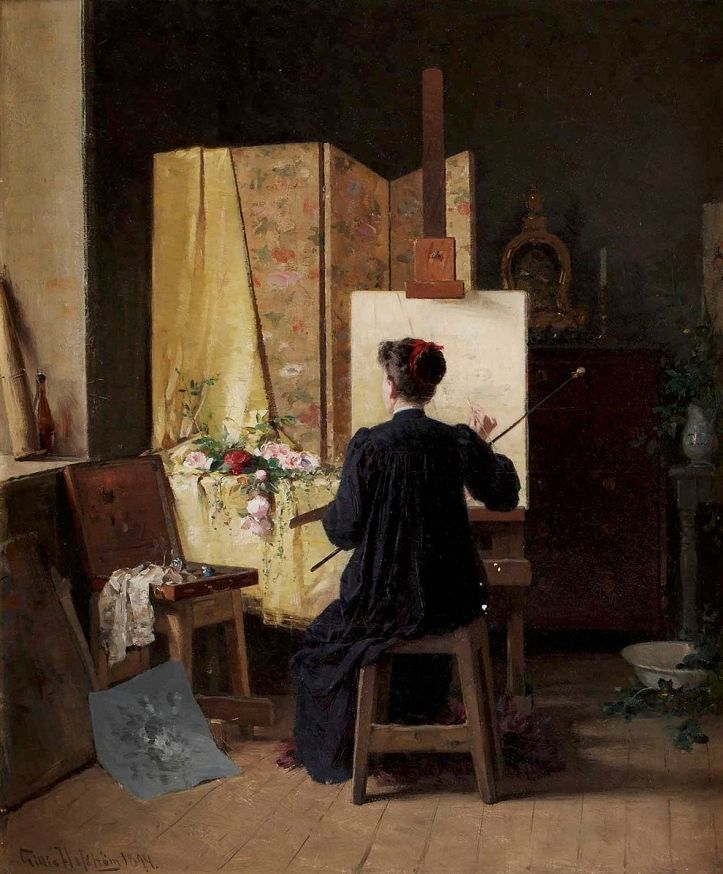 Gillis Hafström, In the Studio (1894). Wikimedia Commons
“The so-called conscientiousness of the majority of painters is only perfection applied to the art of boring.”
Eugene Delacroix
From childhood we have been encouraged to ‘colour within the lines,’ and many of us grow up doing just that, in all kinds of contexts. In terms of art, rule-breaking can introduce a note of freshness, interest and risk.
Releasing ourselves as artists from cautiousness and over-conscientiousness can be freeing when drawing or painting; instead of meticulously painting stiffly and in detail, it is often quite freeing to use whole arm movements, so that the result is not too tight or boringly precise.
We need first to learn to colour inside the lines, so that we can judiciously break these rules as we mature! Pushing boundaries in this audacious way, breaking the mould, creates excitement and delight and gives us an opportunity to rethink, to reconsider.
 Claude Monet, ‘Haystacks’, 1890. Wikimedia Commons
“Some aim to be deft, others to be laboriously careful. Neither dexterity nor conscientiousness is enough.”
Chai Lu
Monet has both dexterity and conscientiousness; he also has that magic touch, that je ne sais quoi that makes his work so magical. He certainly coloured outside the lines, but, actually, there are no lines.
He employs light and colour to achieve definition; contrasting colours are used to delineate some quite indistinct edges. What creates real interest is the fact that his conscientious approach is not centred around rules, but is focussed on finding ways to achieve an impression of a scene.
Had he been over-conscientious about traditional rules of art, the effects would have been lost and the work would not have been so ground-breaking.
- Allowing for creativity and messiness
If we are over-conscientious, in, for example, our leadership style, we may have an efficient team, but spontaneity and creativity will most likely be stifled beneath efforts to be hard working, neat, and on time.
“Perfectionism reduces creativity and innovation.”
Jim Kwik
Within a tightly ordered, fixed and controlled environment, some of us may be unable to experience the freedom that is necessary to creativity. Whilst being assiduous is, of course, important for all of us, it need not be at the expense of creative thinking.
- ADHD
Could messiness, in some cases, actually be an asset? Dr Edward Hallowell, an American psychiatrist, treats people with ADHD (Attention Deficit Hyperactivity Disorder). He says that he too has this condition; often people find it difficult to be on time and they put off work projects through procrastination.
Perhaps they appear to others lazy and disruptive. Hallowell emphasises that, whilst the person with ADHD can be regarded as irritating and ‘super-charged all the time,’ once they are diagnosed and have had some therapeutic help, they can discover that they have very special skills and abilities.
What they need is an understanding of this fact by others around them…
“In the world of people who don’t understand, they think our being late is evidence that we don’t care, and so we get marked down or fired, and the same things for filing and putting things away and being organised, again that’s godly, and if you’re not, that’s slovenly, and we want to get rid of the slovenly and when you do that, you get rid of your most gifted people…
Dr Edward Hallowell
Neurodiverse people can be creative, innovative and produce new ideas; Halliwell says this is far preferable to having a group of people with less ability who are always on time.
Having a lower degree of conscientiousness can mean that spontaneity and versatility are uppermost in a person. Instead of being over-cautious and super-organised, they can be people who will work very creatively outside the rules in a relaxed and imaginative way.
As in many areas of life, there are extremes in relation to conscientiousness; being at the over-conscientious end of the continuum can lead, as we have seen, to dissatisfaction and feelings of failure. At the other end, people may find themselves losing jobs or being criticised for lateness and untidiness.
Finding a comfortable balance between these two extremes is important for all of us. Although it is not always easy to discover the middle ground, this certainly is something for us all to strive for…
 Wassily kandinsky, A Centre, 1924. Wikimedia Commons
“Don’t avoid extremes, and don’t choose any one extreme. Remain available to both the polarities – that is the art, the secret of balancing.”
Rajneesh
© Linda Berman
 waysofthinking.co.uk
Happy 2025 &Thank you Linda as always for sharing such a thought provoking post which I can definitely relate to.
Take care 🙂
LikeLike
Hi Margaret- wishing you a happy and healthy new year, too! Thanks, as ever, for your encouraging and kind message about my latest blog post. I’m so glad it feels relatable, as that’s certainly part of my aim in writing it. I appreciate you taking the time to give me feedback.
Best
Linda.
LikeLiked by 1 person
My pleasure Linda.
LikeLiked by 1 person
So helpful. Will share with my artistic young person with adhd who is regularly reprimanded for lateness. Sad for those of us whose child spirits were broken by the belief that people peasing and hard work were the best code to live by. Off to paint outside the lines!
LikeLike
Thanks so much for your feedback,Phil. It’s much appreciated. I am glad you found my post helpful and I do agree with your comment about children having their spirits broken in the way you describe. Enjoy your painting!!
Linda.
LikeLike