
Quote 1

At the Window – William Merritt Chase.1889. Wikimedia Commons
“Man cannot stand a meaningless life.”
Carl Gustav Jung
All of us human beings, whatever our gender, race or creed, need meaning in our lives. We want to feel that there is a point to us being here, that we have some personal, individual significance and value.
Life is hard for all of us, full of struggles and uncertainties. Nothing lasts, neither the bad nor the good times. This unassailable fact in itself causes existential suffering. Many people need to grapple with this, perhaps in therapy, before they can begin to think about gaining some peace and happiness from their life.
Facing challenges and overcoming problems can bring a great sense of achievement and fulfilment, as can sharing our time with others and giving both materially and psychologically to our fellow human-beings.
In addition, spending a good deal of our lives gaining knowledge about ourselves and the world gives us a powerful sense of meaning and significance.
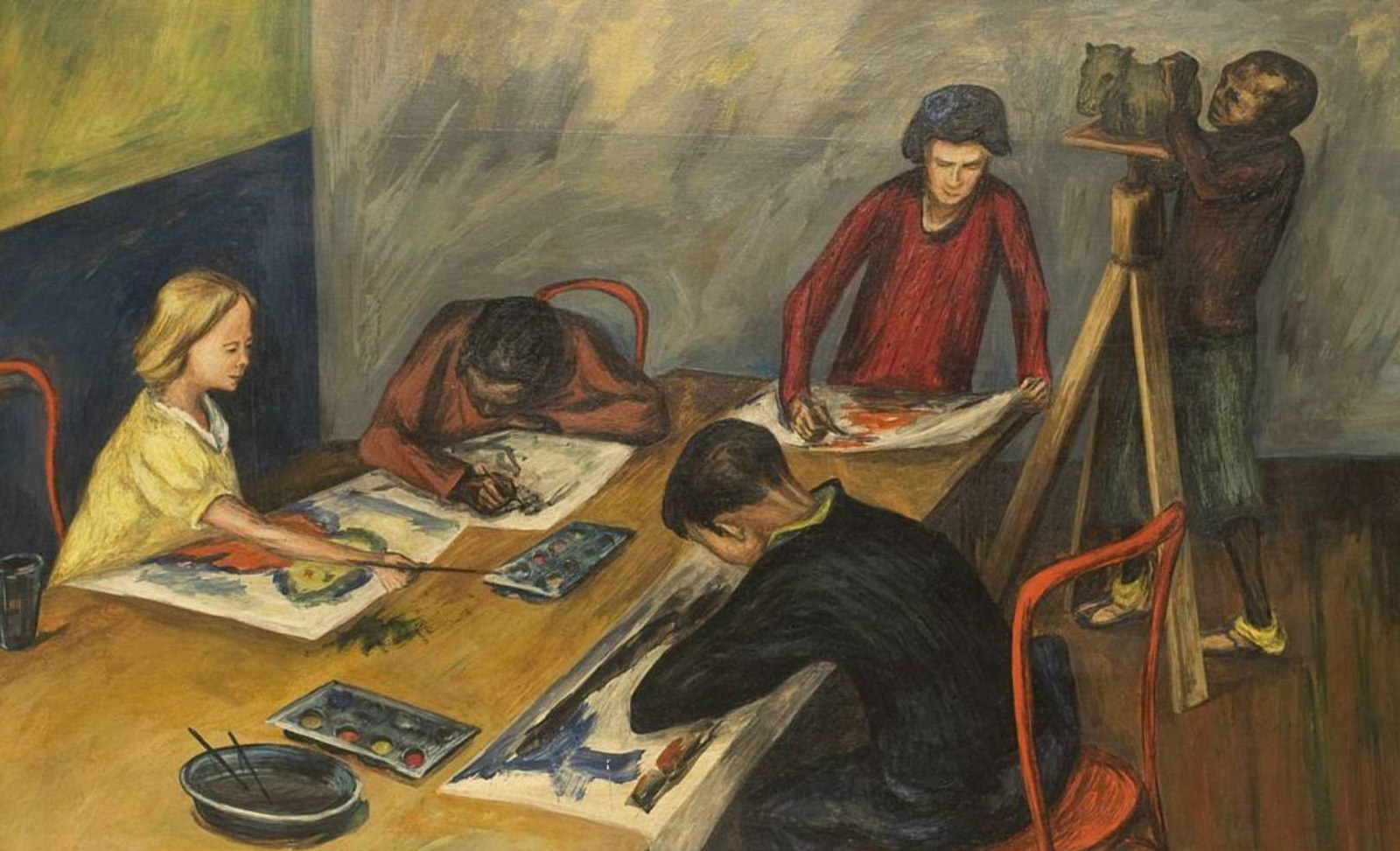 Mervin Jules – WPA Art Class 1945. Wikimedia Commons
“The modern world thinks of art as very important: something close to the meaning of life.”
Alain de Botton
Without learning about the wonders that life has to offer us, many people feel there is no point in being on this earth. Jung’s quotation at the beginning of this post underlines the fact that ‘a meaningless life’ can feel unbearable, empty and shallow, as if we are wandering aimlessly and endlessly over the earth, without purpose or direction.
There are some of us who go to great lengths and endure considerable pain in order to preserve their life’s meaning.
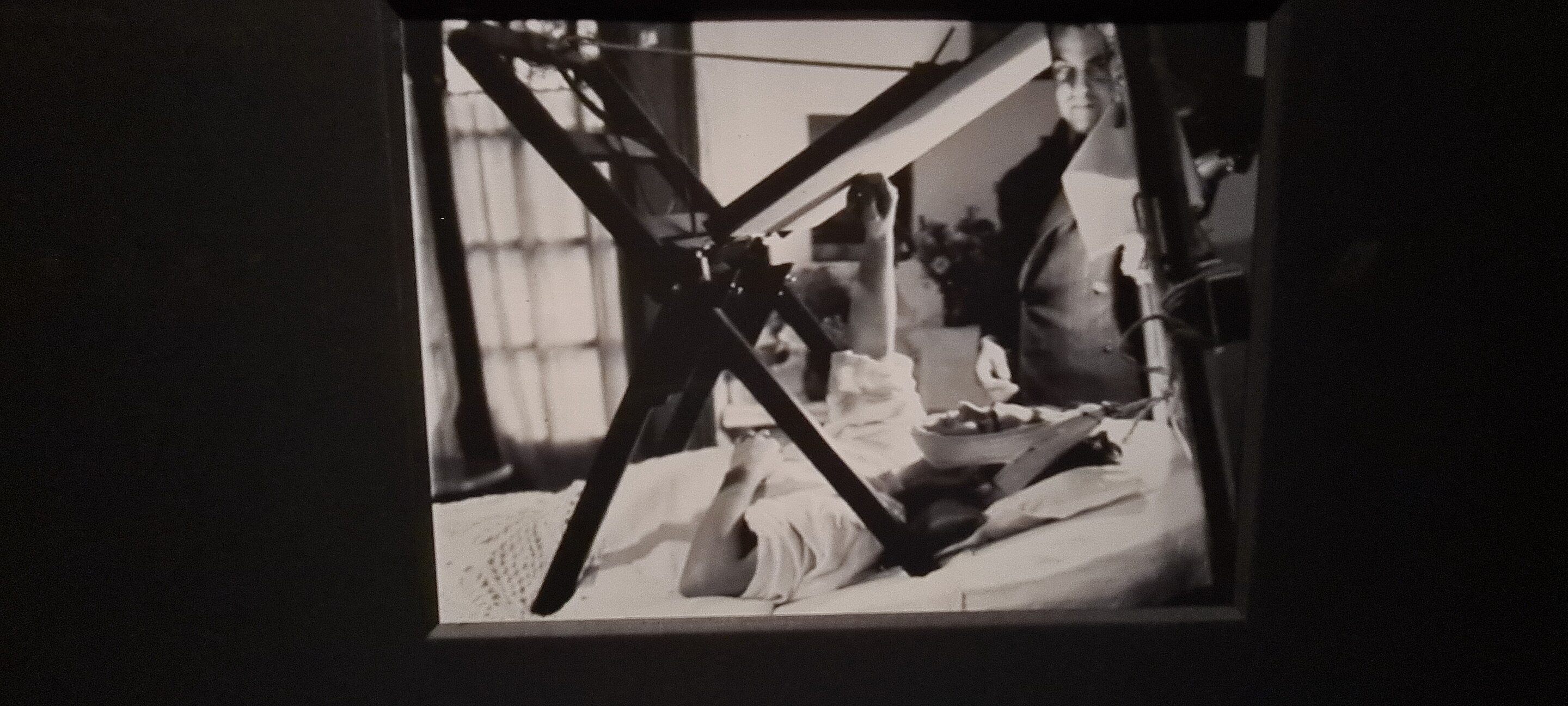 Frida Kahlo working in bed. 1936. (Author: Guallendra 2023.) Wikimedia Commons.
“To live is to suffer, to survive is to find some meaning in the suffering.”
Nietzsche
Finding meaning is an internal process that can help us cope with external misfortunes and challenges; such a discovery helps us endure some of the worst difficulties, giving us the will to go on and fulfil our purpose in life.
The brilliant artist, Frida Kahlo, despite her severe pain from spinal injuries, continued to paint from her bed, so passionate was her dedication to her work and so central was its meaning in her life.
Do you have a ‘why’ to live, an overarching purpose in your life that helps you to cope with pain and suffering? Those amongst us who do have this will find that they can cope better with the vicissitudes of life, being supported by a kind of inner light, giving them resilience and a determination from within to achieve their personal aim, whatever that might be.

The Last of England (c.1855). Ford Madox Brown. Wikimedia Commons
“He who has a why to live can bear almost any how”
Friedrich Nietzsche
The couple in the above painting are emigrating from England to Australia, as millions did in the 1850’s; they are facing the unknown and leaving their familiar home, but they need to seek a better life, to make more income, with a growing family to look after. They have an important purpose, and they are enduring great hardship in order to achieve their goal, and to give life its meaning.
Through the ages, people have turned to religion, spirituality and philosophy, art and music, family and community, and, later, to personal psychotherapy and many other such wellsprings of inspiration and information. This is in their quest to expand learning about themselves and the world and discover the meaning of their life.

Whitman, Walt (1887)Eakins, Thomas – Wikimedia Commons
“Musicians must make music, artists must paint, poets must write if they are ultimately to be at peace with themselves. What humans can be, they must be.”
Abraham Maslow
Quote 2

“The way you get meaning into your life is to devote yourself to loving others, devote yourself to your community around you, and devote yourself to something that gives you purpose and meaning.”
Morrie Schwartz
This quotation extends the scope of Quote 1, adding the important issue of community and caring for others as a way of making life extra meaningful. We all need relationships, connection and love from others, and these can enhance our whole lives and our reason for living.

Sunset along the California Coast. 2008. A Helping Hand. Wikimedia Commons.
“No one is useless in this world who lightens the burdens of another.”
Charles Dickens
These wonderful words by a master of English writing point to the fact that ‘lightening the burdens of another’ gives us a purpose in life. Whilst I must add that I think of no-one as ‘useless in this world,’ helping others gives us a sense of empowerment and purpose.
Research indicates that giving is good for our health and enhances our sense of wellbeing:
“Collectively, the latest research on altruism shows that being generous activates reward regions in the brain. This may have evolved as a biological reaction to helping others that motivates generosity and binds societies together with cooperation.”
Exchanging self-interest for caring for others can only strengthen our sense of purpose and meaning in life and our ways of thinking. As well as improving the lot of others, we will have stronger relationships and better mental health ourselves.
“The purpose of life is not to be happy, but to matter– to be productive, to be useful, to have it make some difference that you have lived at all.”
Leo Rosten
Quote 3

The Dance of Life – Edvard Munch.1899. Wikimedia Commons
“O Me! O Life!
BY WALT WHITMANOh me! Oh life! of the questions of these recurring,
Of the endless trains of the faithless, of cities fill’d with the foolish,
Of myself forever reproaching myself, (for who more foolish than I, and who more faithless?)
Of eyes that vainly crave the light, of the objects mean, of the struggle ever renew’d,
Of the poor results of all, of the plodding and sordid crowds I see around me,
Of the empty and useless years of the rest, with the rest me intertwined,
The question, O me! so sad, recurring—What good amid these, O me, O life?Answer.
That you are here—that life exists and identity,
That the powerful play goes on, and you may contribute a verse.”Source: Leaves of Grass (1892)
Whitman’s thought-provoking poem poses the kind of questions that we might all ask, as he ponders the meaning of our existing in the world. For example, he wonders about the ‘plodding and sordid crowds’ that he sees everywhere, what the point is in all these people, who seem to him shabby as they lumber along apparently aimlessly…
The answer to these existential questions and musings is then made slightly clearer: existence itself is the point of life, the reason we are here, each as a special individual. We are a part of the drama of the whole universe, to which we inevitably will add something of ourselves merely by being here.
Whitman is reminding us that everyone has a unique role in the world. No matter how small that role is, and despite life’s difficulties, there is value in being on this earth and contributing to the whole and continuing story of life.
- Victor Frankl and The Search For Meaning

Drawing from the Theresienstadt ghetto: In the living quarters. 1941. Wikimedia Commons
“Man’s search for meaning is the primary motivation in his life and not a “secondary rationalization” of instinctual drives. This meaning is unique and specific in that it must and can be fulfilled by him alone; only then does it achieve a significance that will satisfy his own will to meaning.”
Viktor Frankl (1959, p. 99)
We can learn much about finding personal meaning during the most horrendous of times from the work of Victor Frankl. He was an Austrian psychiatrist who survived three agonising years in concentration camps. He lost his wife, parents and brother in the horror of the Nazi camps.
What Frankl also witnessed, however, amidst all the terror and deprivation, was the strength and magnanimity of the human spirit. He saw some people giving away their last crust to others who were also starving.
After the war ended, Frankl still felt, perhaps more than ever, that he could find his own meaning in his years of terrible suffering and loss. He believed that meaning could be discovered in every person’s unique experience. It depended on how the individual thought about it and processed it.
Frankl founded Logotherapy, a humanistic therapy centred around meaning. It emphasised the importance of being aware that we also have the freedom to choose how we think about the world, about life and about what happens to us.
 Marc Chagall. The Birthday 1915. Wikimedia Commons
“An individual has not started living until he can rise above the narrow confines of his individualistic concerns to the broader concerns of all humanity.”
Martin Luther King, Jr.
Frankl saw the importance of transcending our experiences, rising above the everyday and the apparently mundane workings of our lives, in order to create meaning, to see patterns, to make life-stories and to discover our very individual life’s purpose.
His resolution of his own search for meaning became part of his own life story, as it will, in different ways, for us all.
Finding meaning in our lives appears to happen when we forget ourselves in the service of others or become very immersed in some external cause or work. It is through these kinds of experiences that we might discover our life’s objectives.
“True happiness… is not attained through self-gratification, but through fidelity to a worthy purpose.”
Helen Keller
Finding challenging and absorbing work inevitably gives us worthy goals and a sense of purpose; satisfying relationships, both personal and work-related, definitely help to make us feel that our life is worthwhile.
Developing ourselves, our talents, passions, gifts and abilities helps us know who we are and what direction we need to take in order to make living personally meaningful.
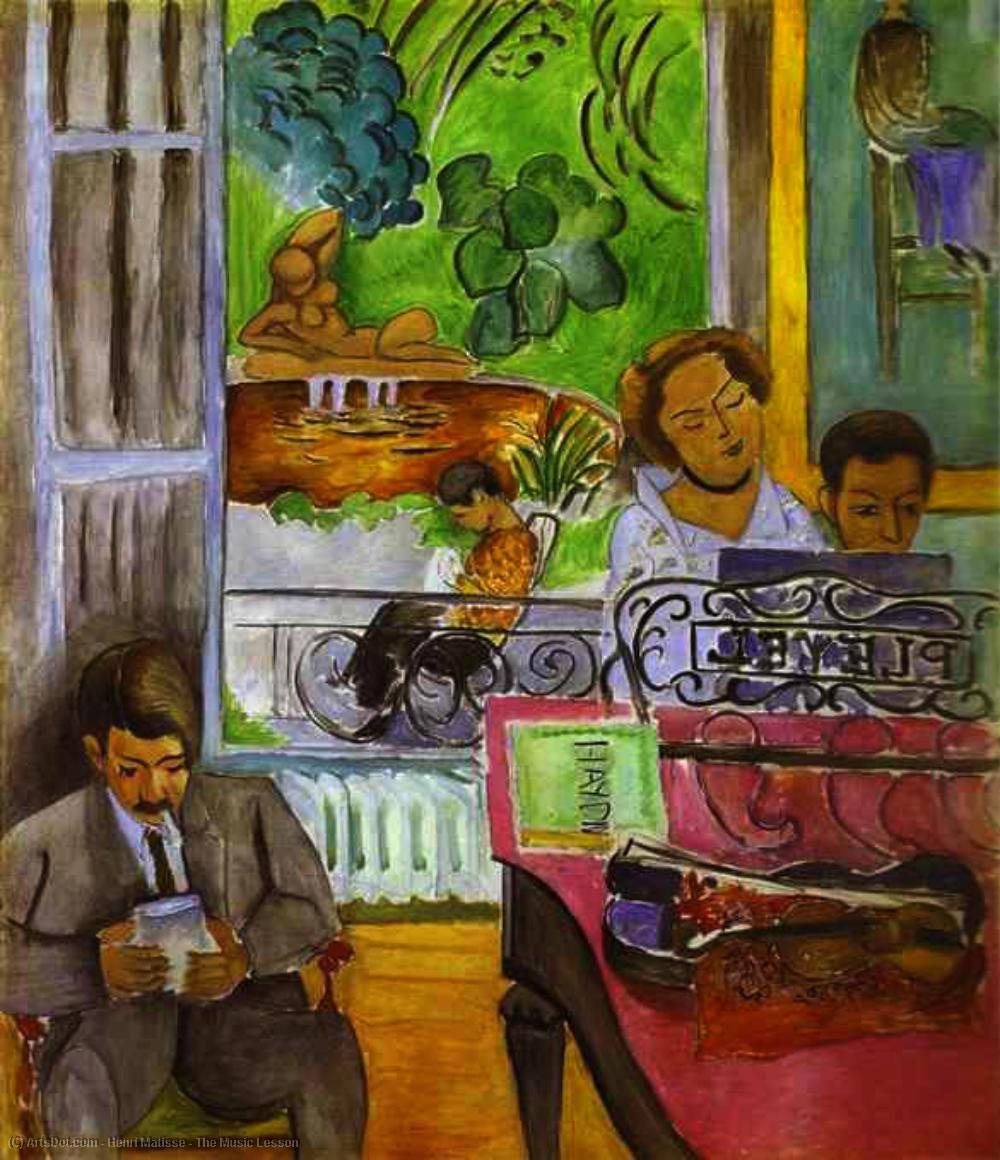
The Music Lesson – Henri Matisse. 1917. Wikioo
“If you can’t figure out your purpose, figure out your passion. For your passion will lead you right into your purpose.”
Bishop T.D. Jakes
 Caspar David Friedrich,c. 1817.Caspar David Friedrich – Wanderer above the sea of fog. Wikimedia Commons.
“The aim of life is self-development, to realize one’s nature perfectly.”
Oscar Wilde
Having an aim in life is motivating and fulfilling; it gives us a sense of why we are on this earth. It is important to find what makes you feel really alive and what fills you with a sense of being yourself, of having found what it is that fulfils and thrills you.

“Man is originally characterized by his “search for meaning” rather than his “search for himself.” The more he forgets himself—giving himself to a cause or another person—the more human he is. And the more he is immersed and absorbed in something or someone other than himself the more he really becomes himself.”
Viktor E. Frankl
© Linda Berman
 waysofthinking.co.uk
Ah Linda,
thank you so much for sharing yet again such a meaningful post.
Your posts always seem to come when I need it the most.
Hope all is well with you & yours. 🙂❤️
LikeLiked by 1 person
Dear Margaret
It’s really heartwarming to receive your comments. Thank you- your words are encouraging and I’m so glad that this post resonated with you. xx 🌹
LikeLiked by 1 person
Ah Linda,
You’re always welcome and I hadn’t thought that by commenting on posts could be encouraging to recipient as well as warming their ❤️ heart.
I’m all for that and thank you for allowing me that reflection.
Take care xx 🌹🌹
LikeLiked by 1 person
It’s definitely encouraging to receive such feedback!! X🌹
LikeLiked by 1 person