
Quote 1
 Leon Spilliaert. Self Portrait 1908 Wikimedia Commons
“There is no standard normal. Normal is subjective. There are seven billion versions of normal on this planet.”
Matt Haig, Reasons to Stay Alive
Do you try to be ‘normal?’ If so, can you say what normal is?
The word ‘normal’ can be defined as: usual, standard, conforming to the rules of society, ordinary, average, conventional…
If we were able to fully be any of the above, i.e. normal, average or standard, how uninteresting would we be!
The above quotation is an important statement about the concept of the ‘normal.’ Each individual on this earth has their own interpretation of ‘normal.’ In reality, if we think about it, this means that there is no normal.
Everyone can choose what kind of ‘normal’ they want to be, and who they want to be. Otherwise, there would be no creative diversity, no discussion, no new ideas, as everyone would look and think the same.
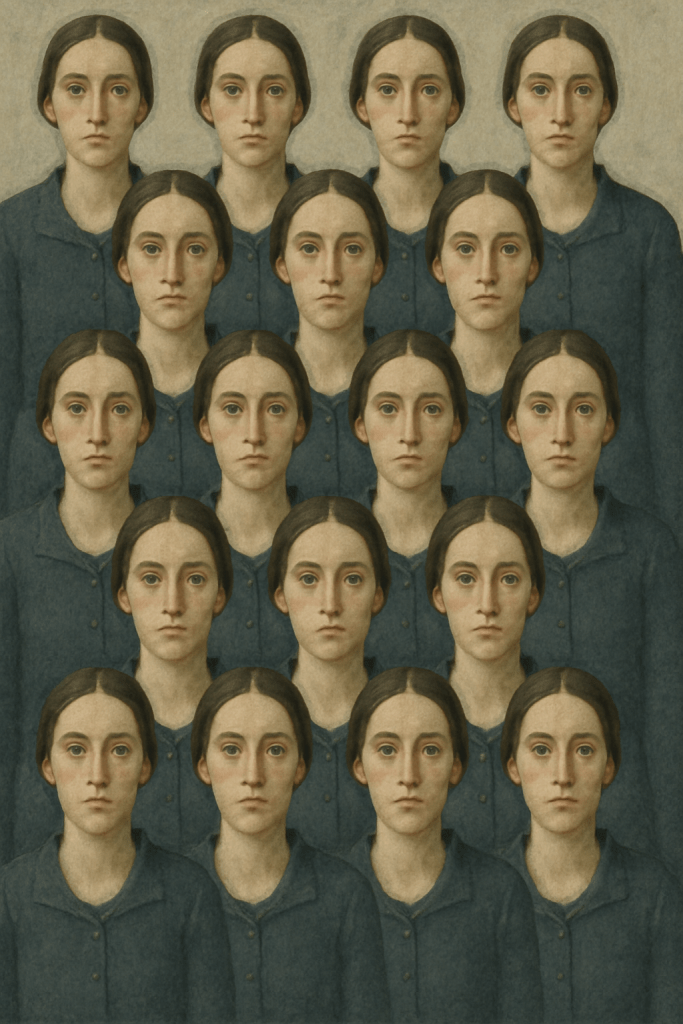
“How boring would this world be if everyone were the same?”
Halima Aden
*****
Quote 2
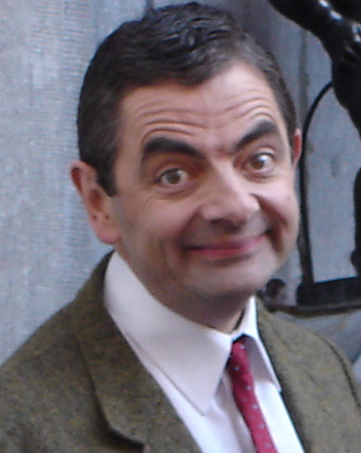
Rowan Atkinson and Manneken Pis in Brussels. 2007. Wikimedia Commons
“If you are always trying to be normal, you will never know how amazing you can be.”
Maya Angelou
We have seen that trying to be like everyone else can make us dull. The above quotation develops this notion, telling us, that if we ignore our individuality and specialness in an attempt to be ‘normal,’ then we will never know what talents and abilities are inside us. We will be denying our potential, and depriving the world of ourselves at our unique best.
Jung asserted that “To be normal is the ultimate aim of the unsuccessful;” he was referring to those who have no ambition to develop themselves and no interest in personal growth. They do not seek to be their best selves, or value their differences, perhaps because of a lack of confidence or opportunity, feeling stuck, depression, or having a low self-image.
“The purposeful life is an ongoing self-creation, an unveiled becoming.”
Yalom
Quote 3

Luncheon of the Boating Party
Pierre Auguste Renoir, 1880-81. Wikimedia Commons
“Because true belonging only happens when we present our authentic, imperfect selves to the world, our sense of belonging can never be greater than our level of self-acceptance.”
Brené Brown
There are those people who desperately want to feel that they belong, or to fit in with a group whom they admire. They want to be ‘normal,’ like the others, as they perceive them.
“To feel normal is to feel that you belong.”
Emily Nagoski
However, they need to accept themselves before others will, so that they can, in time, gain a feeling of belonging. Desperately seeking a group to be part of without having the necessary confidence and sense of self-worth will, inevitably, increase feelings of being unacceptable.
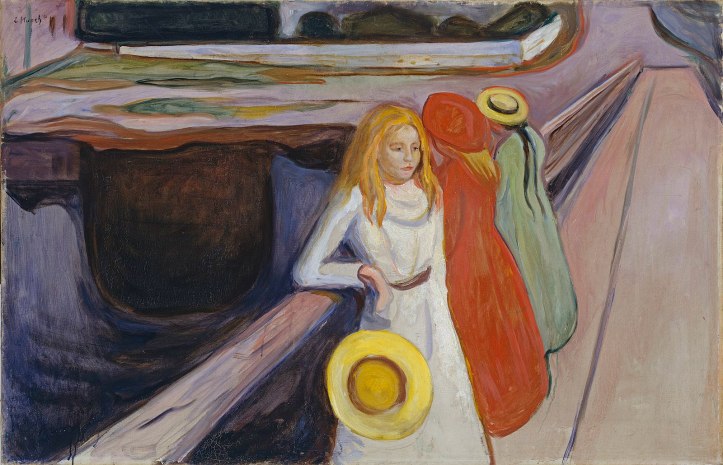
The Girls on the Bridge (1901) by Edvard Munch. Wikimedia Commons
“The greatest thing in the world is to know how to belong to oneself.”
Michel de Montaigne, The Complete Essays
Quote 4

‘Being different is difficult in a world that tells us there is a “normal.”‘
Sonya Renee Taylor
Many transgender people are finding the new UK Supreme Court ruling about the legal definition of a woman as corresponding with their biological sex, very difficult.
“Your anatomy doesn’t determine your gender identity and neither does the gender ‘binary.'”
Amnesty International
A person’s gender identity involves their deep feelings and inner convictions about who they are.
“All gender identities are valid and should be supported equally. If someone’s gender is outside of the gender binary or they don’t have a gender identity at all, it simply reflects the diversity of people’s identities.”
Amnesty International
“The thing about trans people is, we feel very normal. It’s the way we are, it’s only when people say you’re not normal that you feel that way.
I’ve always been extremely feminine, I always felt that way. I can’t say that I ever felt like a boy, I just had to live as a boy for the first 16 years of my life.”
Nikki Hayden. Guardian article.
“Maybe your weird is my normal. Who’s to say?”
Nicki Minaj
People who regard transgender men or women as ‘not normal,’ may have to reflect on their own definition of ‘normal.’ Many with these binary views are reassured now, as we discover in the media, as they see the world in binary terms.
“We all want to be normal, but it’s relative to individuality. My normal is not your normal.”
Dominique Jackson
The pain and despair this new Supreme Court ruling is causing transgender people is alarming to witness; they have always been marginalised in society and this will exacerbate their distress.
It is, of course, apparent that, whatever the outcome of the ruling, there would be many who would be upset and offended. This is a difficult area, and the feelings of those affected in any way, on all sides of the argument, must be heard and valued.
My focus today, however, is on the meaning of ‘normal’ and how the binary approach to gender can be limiting. It means that the sexual characteristics we are born with must determine our gender, which is forever fixed and cannot be changed. There is no choice involved, no matter how strongly a person disagrees with this.
“There is so much more we need to learn and understand. Therefore to be open to learning, understanding, and questioning our socially constructed gender box is, in my view, the absolute first step.”
Runa Magnusdottir, The Story of Boxes, The Good, The Bad and The Ugly: The Secret to Human Liberation, Peace and Happiness
For many, many people, their assigned sex at birth does not feel as if it matches their ‘real’ gender.
In fact our gender is on a spectrum, which reveals not just two possibilities, male or female, but many, many others, including not having an identified gender at all.
It is important not to label people, for all labels can be reductionist, restrictive, discriminatory, limiting, and a distortion of who people are. Attributing certain characteristics to a person or group rigidly categorises people, puts them into ‘normal’ boxes, as if human beings can be slotted into their ‘place’ like inanimate objects.
We need to accept that none of us are totally one gender; we all have parts of us that overlap with others, and no two people are alike gender-wise, or in any other way. We need to know that being nonbinary or transgender is entirely normal, and that this has been around for many thousands of years.
Supporting people who are non-binary or transgender can involve everyone around helping to create an atmosphere of acceptance and respect, ensuring that, in whatever setting, whether in the family, socially, or at work, there is an attitude of standing with, of tolerance, inclusiveness, acceptance and support.
Quote 5

“Madness is when people don’t put “normal” in quotation marks”
dilop
Not putting “normal” in quotation marks implies that there is, in reality, a standard to which we must all uniformly adhere. Using it without quotation marks may mean that people want the world to be in their control, they need certainty, conformity and compliance. This is about obedience to social norms, expectations…and prejudices.
These social norms are the ‘rules’ that are made by society, about what it considers suitable or acceptable. If these guidelines are not observed, then the person will earn the disapproval of many of those around them. Some of these social norms are helpful and of benefit, such as giving one’s seat on a bus to an elderly person. Others are positively harmful, discriminatory and downright ignorant.
In general, we all need to aim to be exactly who and what we are, embracing and valuing our own individuality, in whatever area we choose.
In Winnicott’s portrayal of a ‘normal’ child, he does not place inverted commas round the word; however, his explanation of this ‘normal’ child is wonderfully freeing, inclusive and reflective of reality…
 Child with Trumpet – Louis Valtat. 1910. Wikioo.
“What is a normal child like? Does he just eat and grow and smile sweetly? No, that is not what he is like. The normal child, if he has confidence in mother and father, pulls out all the stops. In the course of time, he tries out his power to disrupt, to destroy, to frighten, to wear down, to waste, to wangle, and to appropriate . . . At the start he absolutely needs to live in a circle of love and strength (with consequent tolerance) if he is not to be too fearful of his own thoughts and of his imaginings to make progress in his emotional development.”
Donald W. Winnicott
*****
Do become a follower of my blog to experience many different kinds of ‘normal!’
From next week I will be taking a 2-week holiday break. Then I’ll resume my usual weekly posts. See you next on Tuesday May 13th. 🤗 Linda.
© Linda Berman
 waysofthinking.co.uk
Interesting. I’ve never been considered normal. My sisters used the word “weird” while I was growing up. I felt that. Then, as a teenager, I decided “normal” meant “unique.” I have a few very wonderful, loyal friends who accept who I am. Otherwise, I don’t “fit” into “normal.” I’m a nice, loving, generous person, and am happy within myself. I am grateful for parents who understood my sensitivity and loved me unconditionally–meaning they loved me for who I am. My middle sister always said, “Janet, you’re so weird, but I love you anyway.” My eldest sister has a hard time tolerating me–no unconditional love coming from her side. C’est la vie!
LikeLike
Thanks for sharing this, Janet. It’s interesting to see the different interpretations of ‘normal’ and how they impacted on you.
Best
Linda.
LikeLiked by 1 person