

The Harlequin’s Carnival. Wikimedia Commons.1925. Joan Miró
“Ecstatic absurdity: it’s the confrontation with meaninglessness.”
Errol Morris
- The absurd: what is it and why can it be so painful?
What is the absurd and how does it affect our lives?
Proponents of existential philosophy often deal with this issue, as so many people are searching for meaning in life. However, whilst longing for meaning and clarity, it is inevitable that we will all face the pain of uncertainty, wondering what is the point of life, of loss… of feeling purposeless, bored, restless and alone.
Absurdity is experienced in the fact that everything ends, everything is temporary, and the universe does not seem to care. There are no guarantees, no definitive textbooks on living.
Questions abound and nobody answers.
‘Why do we suffer?’ ‘Who am I? ‘What is the purpose of life?’ ‘Why am I here?’ ‘What is the point in making plans when everything could change, perhaps collapse, at any moment?’
 Pietro Zuco. nobody. 2010. Flickr
“Today I suddenly experienced an absurd but quite valid sensation. I realized, in an intimate lightning flash, that I am no one. No one, absolutely no one.”
Fernando Pessoa
What was Pessoa meaning in these words? Was he saying he was worthless?
He was not; he was referring to the fact that he was suddenly aware that he had to face his long-held illusions about having a core self, of defining the self as fixed or durable. This is a construction, for he discovered that behind all the masks that we wear, there is no real ‘I.’
Pessoa had the realisation that there is no solid self, despite the fact that we all have a deep longing to actually feel that we are someone.
This concept of the self can be both unsettling and liberating. It is unsettling because it shows us that none of has a definitive identity, and reassuringly freeing because it means we no longer have to fear judgement or to struggle to preserve the image of who we think we are.
“The feelings that hurt most, the motions that sting most, are those that are absurd; the longing for impossible things, precisely because they are impossible; nostalgia for what never was; the desire for what could have been; regret over not being someone else; dissatisfaction with the world’s existence. All these half-tones of the soul’s consciousness create in us a painful landscape, an eternal sunset of what we are.”
Fernando Pessoa
- Sisyphus and absurdity
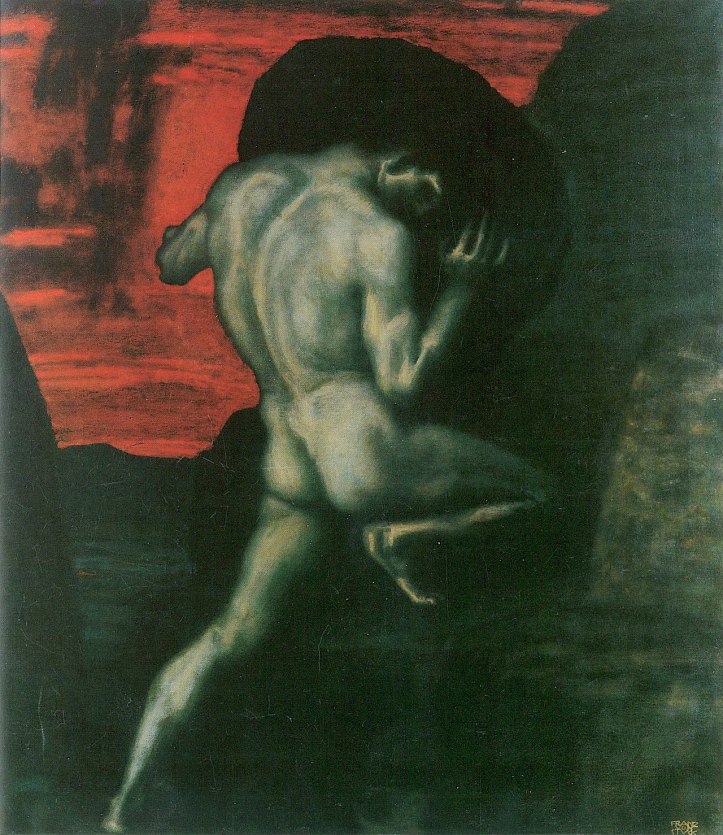 Sisyphus, the symbol of the absurdity of existence, painting by Franz Stuck (1920) Wikimedia Commons
“I leave Sisyphus at the foot of the mountain. One always finds one’s burden again. But Sisyphus teaches the higher fidelity that negates the gods and raises rocks. He too concludes that all is well. This universe henceforth without a master seems to him neither sterile nor futile. Each atom of that stone, each mineral flake of that night-filled mountain, in itself, forms a world. The struggle itself toward the heights is enough to fill a man’s heart. One must imagine Sisyphus happy.”
Albert Camus
This is a painting of Sisyphus undergoing the torturous punishment of having to roll a boulder up a hill over and over again, which rolled down every time he was near the top. The myth expresses the absurdity of life and the meaninglessness of our existence in the world.
However, the message of the myth is a powerful and helpful one, for it tells us of the importance of continuing to face life’s hardships with resilience and with fortitude in the face of seemingly impossible challenges.
Many regard this story as referring to psychological difficulties, to anxiety, depression and several other mental health related problems. Like Sisyphus’s tasks, such issues can seem to go on endlessly, and can appear to be utterly absurd, pointless and overwhelming.
Yet Camus felt that there could be personal growth for us all as a result of coming up against overwhelming problems in life, in the process of facing absurdity. Like Sisyphus, we will discover learning through the inevitable absurdity of the daily grind, whether that is related to an internal or external struggle.
Sisyphus found some purpose in his actions, despite their absurdity; this teaches us that it is the journeys in life, rather than their destinations, that can provide us with learning and enlightenment. Thus Camus concluded that Sisyphus could have been happy, despite the onerous burdens he experienced.
In art, literature and drama, people have expressed their approach to life and its absurdity.
“Some stories have to be written because no one would believe the absurdity of it all.”
Shannon L. Alder
Facing the absurdity of life means challenging our illusions. Imagining that life is about having a clear way forward, that it will make sense, that the universe will be fair to us if we focus on doing the ‘right’ things, all these are views that might be reassuring, but ultimately life will not give us any guarantees based on such ideas.
The world promises us nothing.
“Man stands face to face with the irrational. He feels within him his longing for happiness and for reason. The absurd is born of this confrontation between the human need and the unreasonable silence of the world”.
Albert Camus
So how can we ever manage to live with such uncertainties, with ‘the unreasonable silence of the world?’ How can we cope with all the unanswered questions?
 Shooting Star. Franz Stuck. 1912. Wikimedia Commons
“I looked up at the mass of signs and stars in the night sky and laid myself open for the first time to the benign indifference of the world.”
Albert Camus, The Stranger
Seeing the world’s indifference as ‘benign’ is a good way to deal with the issue of the absurd. If we think that we are the only one who suffers, that we alone are the butt of the uncertainty of the universe, then we will feel resentful and bitter. Acceptance is the key.
The Camus quotation above has long been significant to me personally. For many years, I experienced a painful sense of existentialist angst when alone in the middle of a large, busy city. I felt that no-one cared, the universe was indifferent, but in a malignant way, and I was in danger somehow, of annihilation… with no-one even noticing.
It took many sessions of personal therapy to realise that the malicious nature of the world was my own unconscious projection, that the reality was that I had to look at what my fears/rage/malice were about inside myself. Yes, the world out there can be malignant, certainly, but the reality is that there is good there, too. The greater reality was that I need to look within, not outside myself.
“The only journey is the one within.”
Rilke
During this time, I was reading Camus’ L’Etranger and I came across the quotation above. It helped me. The words ‘benign indifference’ comfort and strengthen me to this day.
As if to emphasise the learning further, years later, in the middle of a large city, I slipped and fell. Four kindly people immediately ran to my rescue…
- Getting no answers can herald the beginnings of creativity…
 Maruja Mallo – The Street Party [1927] Gandalf’s Gallery, Flickr.
“The realization that life is absurd cannot be an end, but only a beginning.”
Albert Camus
We have seen that there are no definitive answers. The only way in which we can make life significant is to discover our own personal answers. We each have to spend our lives finding our own, individual meanings and coming to terms with our temporality. This can be freeing and creative, although scary.
“Wherever we go, there seems to be only one business at hand—that of finding a workable compromise between the sublimity of our ideas and the absurdity of the fact of us.”
Annie Dillard
The writer here is pointing to the mismatch, the contradiction, in us humans… these lie between our lofty thoughts, our wonderfully inspired and spiritual sense of creativity, and the fact that we are couched in bodies that are temporal, fallible and, often, awkward. This is a conflict between the sublime and the absurd in us all, in life, in the universe.

Voilà la femme. Picabia. 1915. Wikimedia Commons
“Every painting must be completely absurd and useless, above all vis-à-vis the magic evolution of art.”
Francis Picabia
Picabia is here challenging the notion that art can serve a purpose, have meaning, or move us towards a higher, more refined kind of culture. He sarcastically mocks and derides ‘the magic evolution of art,’ regarding this serious approach to art as pretentious and erroneous.
“No intelligent idea can gain general acceptance unless some stupidity is mixed in with it.”
Fernando Pessoa
 Tragic comic masks – Roman mosaic.
“Everything is funny; the greatest earnestness is funny; even tragedy is funny. And I think what I try and do in my [writing] is to get this recognizable reality of the absurdity of what we do and how we behave and how we speak.”
Harold Pinter
It is absurd to look for happiness. The more you chase happiness, the less you find it, the harder it is to grasp. Even if you are not chasing it, perhaps you are waiting, waiting for something wonderful to happen.
Whilst people wait for happiness, they may miss getting on with their life; they will not see opportunities and will overlook what is in front of their eyes.
When we expect a saviour, we are a little like Vladimir and Estragon, in Beckett’s play Waiting for Godot:

Image:Waiting for Godot. Flickr. Silver TD.
The play may be seen as….
“…..a metaphor for the futility of man’s existence when salvation is expected from an external entity, and the self is denied introspection.”
(Sion, quoting Dukore.)
The protagonists are encaged in nihilism and passivity. They cannot think for themselves. They expect enlightenment, solutions and meaning to appear from outside as, absurdly, they wait and wait.
Crowd on a Street at Coney Island, by Reginald Marsh, 1928. Wikimedia Commons
“You will never be happy if you continue to search for what happiness consists of. You will never live if you are looking for the meaning of life.”
Albert Camus
- Absurdity and creativity
 Monet – Impression, Sunrise
“If at first the idea is not absurd, then there is no hope for it.”
Albert Einstein
This painting of Monet’s was initially criticised and mocked by people for being too hazy, and it was termed ‘wallpaper in its embryonic state.’ It was regarded as a sketch and the term ‘Impressionsim’ was used to describe it in a derisory way. However, it did come to represent the beginning of the highly successful and influential Impressionist movement.
- So how can we face the absurdity of life and still be happy?
“The only way to deal with an unfree world is to become so absolutely free that your very existence is an act of rebellion.”
Albert Camus
Faced with the random and uncertain nature of life, its strangeness, unpredictability and absurdity, how can we maintain even a small degree of happiness?
Camus’ quotation above counsels us to become quite defiant in the face of the absurdity of life; if we are determined, in our own small way, to become people who feel free, individuated, authentic, then we can learn to free ourselves from, for example, the tyranny of public opinion, or the inhibiting effects of being a people-pleaser.
Then our voice will be heard above the cacophony of life and we will experience the freeing nature of self-expression. Expressing ourself is a way of claiming our identity, of defining ourselves, of making our mark on the world. It is also about shedding labels- our own, and others.
“The human being either asserts autonomy by heroic self-assertion or seeks safety through fusing with a superior force: that is, one either emerges or merges, separates or embeds. One becomes one’s own parent or remains the eternal child.”
Irvin D. Yalom
“You’re under no obligation to be who people think you are. Change, grow, rearrange yourself. Free and beautiful things always bloom and spark with no holding back.”
Charlotte Eriksson
Whist we struggle with all this, it can also be helpful to share feelings with others about the absurdity of life, and sometimes be able to find humour in the human condition.
It is also highly important to acknowledge the fact that absurdity exists in life, to then accept it, and to work towards coming to terms with the fact that we will never attain a state of perfect peace or happiness.
Working on being compassionate to oneself and others will free us from clinging to false hopes, illusions and unreal expectations. In this way, we can come to value the strength we have within ourselves, and can make choices in relation to how we react to the often utter absurdity and randomness of the universe.
“Freedom is what you do with what has been done to you.”
Jean-Paul Sartre
I will end this post with some inspiring images and quotations relevant to the theme of managing the absurdities of life:
Pierre-August Renoir, Umbrellas, 1883
“Life isn’t about waiting for the storm to pass. It’s about learning to dance in the rain.”
Anonymous

Ramon Casas – Courtyard of the old Barcelona Prison.c 1894. Wikimedia Commons
“When we are no longer able to change a situation, we are challenged to change ourselves.”
Victor Frankl

Anna Ancher. Pink Rhododendrons and Laburnum in a Green Vase (1914)Wikimedia Commons
“In the depth of winter, I finally learned that within me there lay an invincible summer.”
Camus
© Linda Berman
As ever, a very interesting and thought-provoking post, Linda.
Thank you so much Lynne. Glad you liked the post!
Absurdity is absolutely absurd. Therefore: “You’re under no obligation to be who people think you are. Change, grow, rearrange yourself. Free and beautiful things always bloom and spark with no holding back.”
Charlotte Eriksson
Thank you, Linda.
You’re welcome Janet!
Did you feel a little absurd writing about the absurd, like it’s just one thing after another?
Oh Bob I always feel absurd!! 😉
Thankyou, very beautiful and helpful x
Thank you so much Carole. I’m delighted you liked my post.