
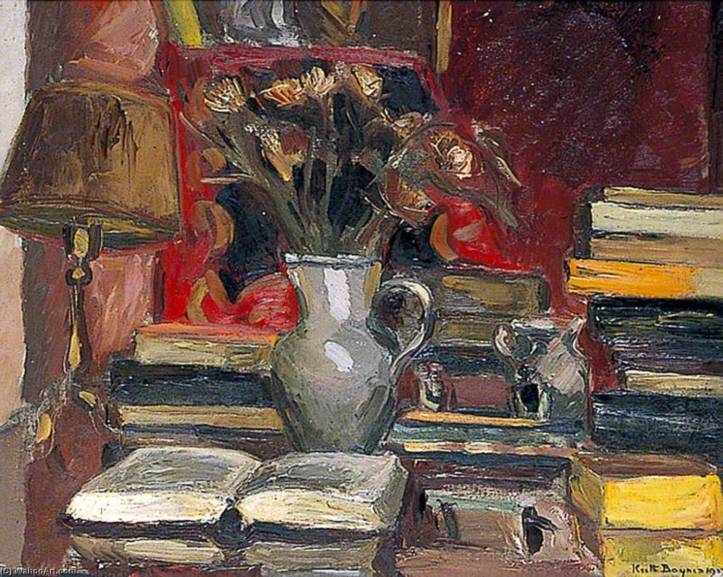
Still Life with Books, a Lamp and Jug of Flowers – Keith Baynes. 1927
“Books say: She did this because. Life says: She did this. Books are where things are explained to you; life is where things aren’t. I’m not surprised some people prefer books.”
Julian Barnes
What is it about books that is so attractive to us? Most people possess books, some have just a few, others line their walls with bookshelves. There are old books, new ones, dog-eared ones and pristine books. They can be shared, bought, sold, advertised, plagiarised, stolen, borrowed, left for others, stored, hidden away, or displayed with pride.
- Books that give us life….

Woman Reading at the Beach – Max Beckmann. Wikioo.
“She read books as one would breathe air, to fill up and live.”
Annie Dillard, The Living
The wonderful quotation above refers to the life-giving aspects of reading books. It is as if books are seen as essential to our survival, vital to our living and breathing selves. What does this really mean? How can books fill us with life, as we ‘breathe them in,’ like oxygen?
Books can enhance our mood, change us, entertain us, offer temporary escape, distract us, refresh us and give us glimpses of other lives, other worlds. Books teach us, inform us, and they stimulate our ideas, imagination and our creativity. All these are qualities we need to live happy and comfortable lives. I will explore a selection of these benefits in this post and the next.
Often, if we look at a person’s home bookshelves, we can learn much about them. Their book choices in some way define them. In addition, books can also chronicle a person’s past, for we can trace periods in our lives by looking at the books we needed and selected at various times.
- Bibliosmia

“I went and sniffed all the books in the bookshop, and wallowed in them, and cried a bit when I had to leave most of them behind. This one is a present for a lovely friend.” Melanie Levi, Flickr.
“Max’s store is a combination of used and new books, and I find the scent intoxicating. There’s something about the aroma of paper at every possible stage for a book: brand new, hot off the printing press, decades old, covered in dust and moisture. Yeah, it’s probably a little weird. But I don’t care. To me, it’s divine.”
Sarah Echavarre Smith, The Boy With the Bookstore
We sometimes say that someone ‘has their nose in a book.’ This usually means that they are reading a lot, but it can also refer to actually smelling a book. People usually do this surreptitiously, when no-one is looking; even though many of us do this, it somehow can feel a little ridiculous and embarrassing to be seen sniffing a book.
I am sure that many people reading this will not be shocked by this revelation! Scratch and Sniff books are not just for toddlers!
The word bibliosmia describes this practice… who would have guessed that there’s actually a word for it?!
 Bookshop. G. B. Kearey, 1923. Wikimedia Commons
“Old Books Smell Of: A combination of grassy notes with a tang of acids and a hint of vanilla over an underlying muskiness.”
Chemists of the University College London
It is a truth that old books smell of the dust and must of ages, of old paper, glue and ink; it is as if those old printed words reach us through our olfactory senses, as well as through being seen and experienced emotionally and intellectually.
Old books actually feel different to the touch; touching such books gives us a sense of relationship with history, as we wonder who were the readers of the past with whom we are connecting with in a tactile way.
Questions abound. Who has hidden a note in between the pages? Who has bent a page’s corner? Who has inscribed the book with their name?
Feeling a book’s weight is like carrying a portion of the past, something that is impossible to replicate with an e-book. However, we do need to beware of Victorian books with emerald green covers, as there is often arsenic in certain shades of green on the outer material of some nineteenth century books.

A bucket of Paris Green paint, by The Sherwin-Williams Co.Wikimedia Commons.
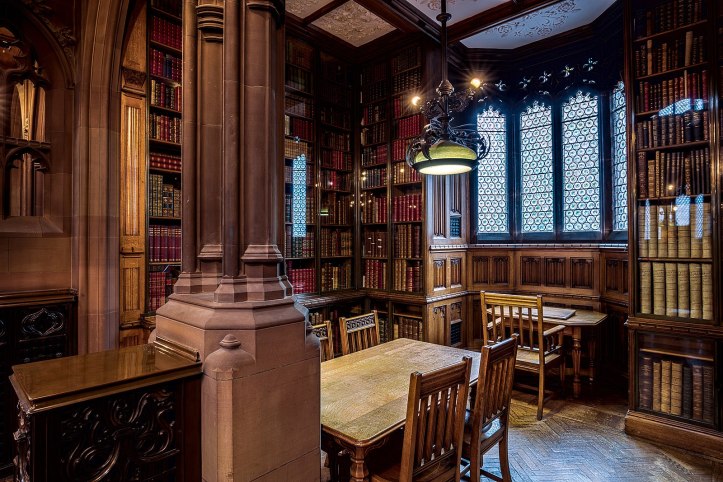 The John Rylands Library, Manchester. Study Area. Michael D. Beckwith, Wikimedia Commons.
It is not only old books that people like to smell and touch, for new books do have a distinctive odour that can be pleasing to many people. They also feel pristine and smooth, their often glossy pages redolent of things inviting, uncharted, untouched.
New pages smell much fresher, of course; they have the scent of clean newness, of fresh ink, paper and adhesive, that can somehow make us feel enlivened and eager to read them. The new bookshop smells very different to the second-hand one, but both have their attractions in terms of bibliosmia!

“Wear the old coat and buy the new book.”
Austin Phelps
- Books As A Journey Into The Self: A link with Jung

Four Rooms, Interior from the Artist’s Home, Strandgade 25 – Vilhelm (Hammershøi. 1914. Wikioo
“Some books seem like a key to unfamiliar rooms in one’s own castle.”
Franz Kafka
Books can take us to new places. They can show us where to go in the world around us, but, perhaps more importantly, they can take us to new places in our inner world. As Kafka says, they can offer us ‘a key.’
What are these inner and ‘unfamiliar rooms’ in our own ‘castle?’
Jung’s theories are highly applicable here and through his writings, the house has long been known to reflect its owners. In psychoanalytical terms, Jungian theory sees the house as reflective of the whole of the self.
When Jung built his own house, which does resemble a small castle, he was aware of how it represented aspects of his inner world. He knew that the unconscious mind expresses itself outwardly through symbols and that each tower and addition he made to his home was meaningful in terms of his own psyche.

Jung’s House. Bollingen Tower. Wikimedia Commons.
Jung added various towers over the years. In 1955, after his wife’s death he made the final, symbolic extension to his house:
“…I added an upper storey to this section, which represents myself, or my ego-personality. Earlier, I would not have been able to do this; I would have regarded it as presumptuous self-emphasis. Now it signified an extension of consciousness achieved in old age.”
Jung.
Jung also wrote about his powerful dream of descending through the storeys of his house, which he interpreted as reflective of moving through different layers of his unconscious mind.
Books can offer us the ‘key’ to such ‘rooms’ by guiding us with their words into new areas of understanding; they can add immeasurably to our knowledge of ourselves, the world and other people. They can also show us that we are part of a whole universe, where people feel similarly to ourselves. We can identify with them, and feel less alone.
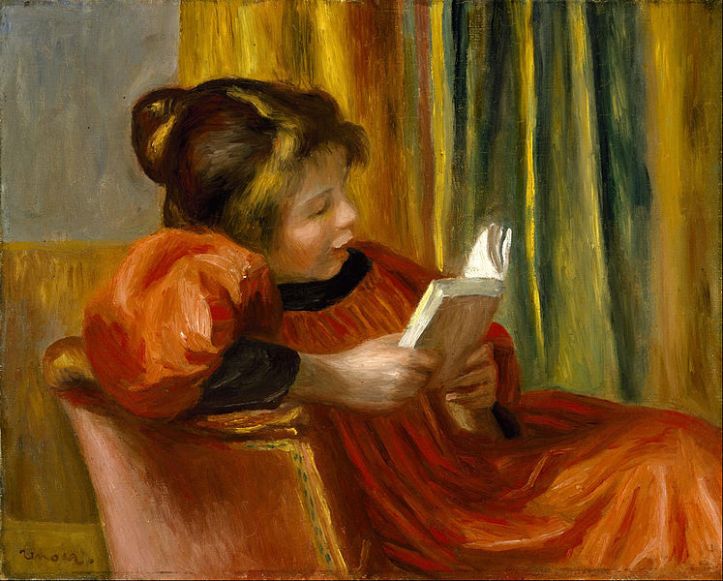 Pierre-Auguste Renoir – Girl Reading.1890. Wikimedia Commons.
“Great books help you understand, and they help you feel understood.”
John Green

Woman Reading. Mark Rothko. c. 1933. Wikimedia Commons
“Reading is the sole means by which we slip, involuntarily, often helplessly, into another’s skin, another’s voice, another’s soul.”
Joyce Carol Oates
© Linda Berman
Part 2 of this post will be published next week.
Nice work on this week’s narrative and fine art selections on the theme of books. Citing Jung on the psyche symbolism he ascribed to the house he built and its additions really piqued my curiosity. Do you know if this is from his Red (or Black) book or his “Memories, Dreams….” autobiography? Looking forward to Part II.
Suggestion for future sermon: Metaphor. For me, metaphor tumbles even deeper into the well of consciousness than books. As I see it, metaphor is the water at the bottom of the psychic well and books are the bucket one cranks up to the surface for to drink. Indeed, many of the writers you’ve quoted this week are quenched by metaphor. E.g. Annie Dillard’s “She read books as one would breathe air, to fill up and live.” Water? Air? Pick one. They are elements both of human communication’s sustenance and substance (whoops! another metaphor!).
And I think with this theme of metaphor you’d have a field day posting the art works. (Sheesh, more metaphors!)
But let’s finish the book, part two, first! hehe
Bob, thank you for your comments; as ever, they are perceptive and intriguing. The Jung quote about his house at Bollingen is from “Memories, Dreams and Reflections.”
Metaphor is a subject I have on my list for a future blog. Not sure when I’ll get round to writing it, but certainly will do at some point! Thanks for suggesting it, ideas always welcome!