

Tranquillo Cremona – Paggio Curioso. Wikimedia Commons. 1878.
“Never forget that anticipation is an important part of life. You’re cheating yourself if you refuse to enjoy what’s coming.”
Nicholas Sparks
In this post I will focus, not on the anticipation of something nasty happening, but on the sweet excitement of anticipating something good. Of course, life doesn’t always meet our needs, and expectations of an exciting future experience may, at times, not be met.
However, sometimes, looking forward does not bring us disappointment; it results in joy and fulfilment.
Today you, the reader, can, with some certainty, look forward to a happy post, one that throws the spotlight on the wonderful joy of anticipation. It is refreshing, and important, to sometimes focus on life’s goodness, its keeping of its promises, on its bounties, its brightness and its delights.
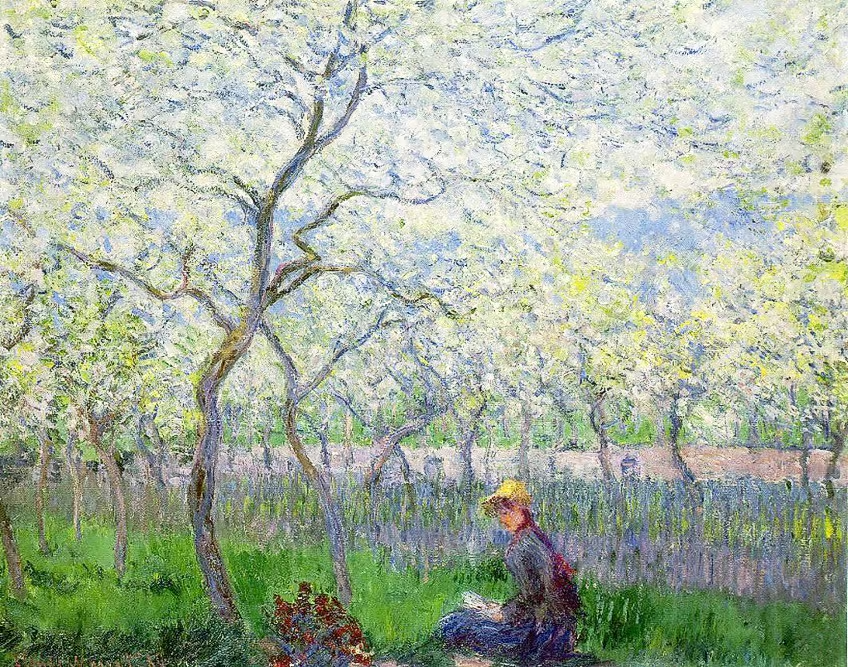 An Orchard in Spring (1886) Claude Monet. Wikimedia Commons
“I am looking forward to,
Springing into April”Charmaine J. Forde
April has now well and truly sprung, and we welcome with some joy the fragrant blossoms of this new season. We can now look forward to the bounties of May, to renewal and new growth, to the sweet, scented fullness of lilac, tulip and peony, beautiful in all their vibrant, burgeoning glory…
 Yun Shouping, Peonies. 17th century. Wikimedia Commons
“The earth laughs in flowers.”
Ralph Waldo Emerson
In many situations, the very act of anticipation and looking forward can magnify our sense of excitement and joy. Pondering what might come next, waiting in the stretch of time between the present and a future experience can create a delicious feeling of expectancy.
We may spend our days imagining how events will unfold, experiencing a hopeful looking forward, a cheerful sense of curiosity and wonderment.
These feelings of anticipation can blossom into real excitement. Can you picture yourself experiencing that sense inside ? The quickening heartbeat, the increase in energy, the feeling of wellbeing that suffuses the whole body and mind, all these are part of feeling excited and looking forward to something with hope and joy.
 Pierre Puvis de Chavannes, Hope, 1872.
“The future belongs to those who anticipate it.”
Baptiste Tricoire
Whilst feelings of anticipation and excitement are actually experienced in the now, in the present, they represent our imagination of future happenings. We cannot truly foresee what they may lead to… we only know that they feel good to us in this moment.
- Really living: having something to look forward to…

Georg Schrimpf. On the Balcony. 1927. Wikimedia Commons
“Life needs mystery or else everything else flattens into a routine… We need the sweet pain of anticipation to tell us we are really alive.”
Lucy Maud Montgomery
These words express the importance of having something to look forward to in our lives; without ‘mystery’ and yearning for something, our daily life will become dull. Despite the inevitably repeated experiences of having our hopes dashed, we still long for events in our life to look forward to. We need to have a sense of excitement about some aspects of our future, whatever these may be.
“We love to expect, and when expectation is either disappointed or gratified, we want to be again expecting.”
Samuel Johnson
What we expect and anticipate does not have to be enormous or life-changing. Looking forward is important to us in terms of small details, too, and we can anticipate little things with a degree of joy and expectation.
“Often, small things give me hope when big things feel so oppressively bleak.”
Julien Baker
The smallest amount of anticipation can soothe and comfort us on a wearisome day, giving some hope, structure and shape to our lives. It reminds us that we have a kind of purpose, that there is light and relief when boredom and routine appear to overwhelm us.

Edgar Degas – Washer Women Ironing. c 1906. Wikimedia Commons
“When you get into a tight place and everything goes against you until it seems that you cannot hold on for a minute longer, never give up then, for that is just the place and time when the tide will turn”.
Harriet Beecher Stowe
In difficult times, people can still ponder what there may be left to look forward to, as a way of focussing their energies on moving forward in their lives.
“Every broken heart has one time or another asked, “What is important to me now?”
Shannon L. Alder
Even the most painful sorrow can serve as a kind of catalyst, when the time feels right, to help us begin to review our life and anticipate potential new directions and choices.
Finding something to look forward to in the midst of chaos or loss can provide an important kind of emotional lifeline, no matter how small it might be.
“[…] until we were living hour to hour, minute to minute, and even then, I still believed in my father, who insisted there had to be something—anything—to look forward to.”
Jenny Zhang, Sour Heart
- Anticipation involves imagination…
“Imagination is more important than knowledge. For knowledge is limited, whereas imagination embraces the entire world, stimulating progress, giving birth to evolution.”
Einstein.
We sometimes do need to allow ourselves to get lost in our imagination when we anticipate the future; even though we know that life never really turns out as we expect, we still love to imagine how it might unfold for us. We need the internal freedom to ‘play’ with reality, to invent scenarios, to anticipate possibilities and opportunities with creativity and inventiveness.
Without imagination, we can only see what is happening now. Whilst there are always aspects of our present day lives that are happy and comforting, some parts of our ‘now’ are inevitably going to be difficult. At such times, we might just need to be able to take ourselves out of the present for short periods, and let our imagination take over, to picture the future in our mind’s eye.
Imagination can take us out of the present, away from the past, and into an imagined future. It can give us wings, to take us into any time and any place we want. Of course, these imaginings will lack the groundedness of reality, but, for a time, we can enjoy the freedom of our world of fantasy.
Indulging in this can help us to find motivation and give us the momentum to move on with hope, with a creative approach to life, open to imagining an array of future possibilities. Having a thread of anticipatory excitement also gives us a sense of purpose, so that we can look forward to our personal and creative development.
Our imagination enables us to have the freedom to wander outside the usual boundaries and strictures of life, to break the rules of time and place, to defy gravity, to float, to fly, to soar.
 Thomas Couture – Daydreams. 1859. Wikimedia Commons
“If you fall in love with the imagination, you understand that it is a free spirit. It will go anywhere, and it can do anything.”
Alice Walker
Involving ourselves in imaginative activity can help take us out of everyday worries; we can lose ourselves thinking of beautiful places we have been or exciting trips we might take in the future.
Our inner landscape has no limits, and, whilst it should not be seen as an alternative to reality, it can enhance and improve our situation, giving us an anticipatory sense of freedom.
In fact, using our imagination can improve our world and make it a better place. For example, many people use stories and poetry to help them get through what might sometimes feel like a daily grind and provide the necessary impetus to looking forward with hope.
“Words are the wings both intellect and imagination fly on. Music, dance, visual arts, crafts of all kinds, all are central to human development and well-being, and no art or skill is ever useless learning; but to train the mind to take off from immediate reality and return to it with new understanding and new strength, there is nothing like poem and story.”
Ursula Le Guin.
 Emil Brack – Planning the Grand Tour. Late 19th century. Wikimedia Commons
“Anticipation is sometimes more exciting than actual events.”
Ana Monnar
This quotation is referring to the thrill of planning, of the journey, of being on the way to something, of anticipation. We can derive great excitement from this, free from the encumbrance of reality, without the interference of unexpected hindrances or downsides.
- Anticipation and relationships
 Zandomeneghi. Waiting or Girl by the Window. Before 1918. Wikimedia Commons.
“If you come at four in the afternoon, I’ll begin to be happy by three”.
Antoine de Saint-Exupéry
Waiting for someone expectantly, someone whom we like, or perhaps love, can be exciting and joyful. Time certainly passes differently when we experience such anticipatory feelings, and, as the writer says in the words above, we being to feel good before we meet the person we long for.
The anticipation is an important aspect of the joy that we feel when we actually do meet them in real time. Something is due to occur, and that is exciting; it lengthens the period of joy that the event itself creates.
 Awaiting the suitor (unknown date), by Gustave Léonard de Jonghe. Wikimedia Commons
“The possibilities of another person. Is there any anticipation on this earth quite like that one? Is there anything lonelier than being without it?”
Mitch Albom, The Stranger in the Lifeboat
Picture a chance meeting that immediately feels full of potential, where two people feel an instant connection, perhaps physically, or emotionally, or intellectually, or all three. This may feel a little scary, or exciting, but it certainly feels alive and stimulating to our curiosity and our desire to know more.
There is, inevitably, a sense of uncertainty that accompanies the anticipation…could this relationship become something fulfilling, rewarding, perhaps gloriously explosive, or will it lead nowhere, fizzing away into nothingness, extinguishing itself like a damp squib? At this moment in time, we cannot know, we can only have hope, trusting the process.
- Pausing for thought: have we lost something precious in this age of instant gratification?

“Nobody knows what anticipation is anymore. Everything is so immediate.”
Joan Jett
Are we gradually losing the ability to wait, to anticipate, to look forward? Twenty-first century life has brought us the ability to have many things NOW! Our world has become a quick click and push-button place, a realm of immediacy, of same-day delivery, fast food, binge-watching, streaming, snooze-buttons, chatgpt,(instant info), one-click buys… all these provide quick rewards or instant ‘relief.’
What on earth has happened to waiting, to anticipation, to working through feeling bored or impatient by being creative, inventive or self-sufficient?
Our world of instant gratification could mean that life becomes flattened, less exciting and without the depth of feeling created through waiting and anticipation. It is important to bear this in mind, and to relish the times when we can look forward with great joy, maintaining the ability to wait and savour such special experiences in our lives.
“Anticipation is the greater part of pleasure.”
Angela Carter

Federico Andreotti – The Love Letter. 1880. Wikimedia Commons
“Wait for it, wait for it! Anticipation is half the fun.”
Phil Collins
© Linda Berman