
 Albert Guillaume. Les Retardataires. (The Latecomers) 1914. Wikimedia Commons
“Which form of proverb do you prefer: Better late than never, or Better never than late?”
Lewis Carroll”
On occasion, we are all unavoidably late. Traffic jams, road accidents, last minute hitches, any of these can happen to us all.
But what about those people for whom lateness is frequent, persistent and predictable? What might their lateness mean? Does it always represent rudeness, being uncaring, or self-centred? Or is there something else we may not have spotted?
We could say that late people have poor time management, or that they enjoy the thrill of arriving at the last minute, but what is really happening underneath these superficial and observable symptoms of being late?
Read on to find out more…
- Those who are kept waiting…
 Federico Zandomeneghi, Waiting, Italy. Before 1918.Wikimedia Commons.
“I have noticed that the people who are late are often so much jollier than the people who have to wait for them.”
E. V. Lucas
Without leaving any messages to say they will be late, some people arrive far later than arranged for all kinds of dates, appointments, meetings, social events. But what about those who are left waiting for them? Others’ lateness can create havoc for the people anticipating their arrival, and they are frequently left with feelings of anger, frustration, worry, fear and anxiety.
- Projection of feelings
What is happening is that such disturbing feelings are being projected into the ‘waiters,’ those who hang around with all the raw emotions that the late people are, unconsciously, repressing. (This is emphasised by the psychiatrist’s words, in the next section, below.)

Contratiempo, 2010, oil on canvas, 190 x 160 cm. Painting by Sebastián Picker. Exhibited at Galería Juan Soriano. Guadalajara, Mexico, 2010.Wikimedia Commons
“People who are chronically tardy never understand the many ways in which they screw up the schedules of people who are punctual and ‘normal’…”
Lauren Kate, Fallen
For those who have their own tight schedules and who prefer to be on time, having to wait for late arrivals can be tortuous and very stressful. How do they handle this awkward situation, with all its uncomfortable ripple effects?
 Alexej Jawlensky – Portrait of a Girl. 1909. Wikimedia Commons
Internal questions abound for those who are left waiting…
Do they wait, or do they leave? Are others looking at them, aware that they have been ‘stood up?’ Do they phone/contact/text the latecomers? Do they start the meeting or not, do they serve the meal or let it stew? When the late arrivals appear, do they mention the lateness or greet them with a shaky and insincere smile? Do they allow themselves to be charmed into overlooking the ‘offence’? Can it ever really be ‘fashionable’ to be late?
 Emil Czech Still Life with Antique Clock.1917.Wikimedia Commons
“I find lateness exceptionally rude; it’s so disrespectful, implying unambiguously that you consider yourself and your own time to be so much more valuable than the other person’s.”
Gail Honeyman (Eleanor Oliphant Is Completely Fine)
Does lateness mean that the person who is kept waiting is not valued, that they are not worth being on time for?
The following artworks and quotations express several of the frustrations and fears experienced by ‘those who wait.’ I have studied the mood of the paintings and put some imagined thoughts and feelings to them…
 Vilhelm Hammershøi, The Tall Windows, ca. 1913, Denmark. Wikimedia Commons.
“Better never than late.”
George Bernard Shaw
This painting, beautiful in its greyness and atmosphere of emptiness and melancholy, expresses a kind of hopelessness, perhaps related to the feelings of waiting for someone who may never appear. The woman, whose face we cannot see, is looking into nothingness, a misty vagueness, an uncertain, almost blank space that perfectly sums up how it might feel to wait and wait and wait, in a room with high ceilings and bare walls. These are feelings of not knowing, of wondering on and on, of uncertainty verging on the chaotic…
 William Ladd Taylor, Awaiting his return.1899.
This woman has waited for hours. Will he ever come? She has been waiting so long and is beginning to lose hope, for there is still no sign of him. She wonders if he has had some kind of accident, and whether she will ever see him again. Has he maybe forgotten? Her feelings are becoming unbearable, as she worries about the man she loves.
 Toulouse-Lautrec – Waiting (1887) Wikimedia Commons
“The intelligent person pays attention not just to their own schedule, but to the value of someone else’s life.”
Inspired by H.L. Mencken.
Do they know, or care, that the person waiting has a life too? Or is that just not important? In the painting above, the woman looks to be lost in some sad thoughts, as she sits and waits…
- How do ‘late people’ see this issue? And what is really going on underneath the lateness?

Caughnawaga Indians at Camp, Cornelius Krieghoff. Source/Photographer Joyner Auctions, Canada. Wikimedia Commons
“Those baseline differences in outlook can make the virtues of both earliness and lateness impossible to explain to people in the opposite camp.”
Amanda Mull, There are two Types of Airline People, theatlantic.com, 2019.
As a chronically early/on time person, (which may also be a problem!) I find it difficult to grasp the ways of thinking of people who are persistently late. This part of the post represents my supreme efforts to understand and to try to have some empathy for the feelings of the late ones.
Whilst it is easy to cast aspersions on ‘late’ people, blaming them for being self-centred and rude, there is more to lateness than we might first assume.
The writer of the above quotation, Amanda Mull, spoke to people who were always late arriving at airports. Some said that they loved the ‘thrill’ of arriving late to catch a plane, or that they wanted to ‘prove the punctual people wrong.’ Some people said that they simply loathed the idea of having to wait.
However, it is interesting to discover that, underneath the apparently different behaviours, early and late people at airports may have the same reasons for their actions. Mull spoke to a psychiatrist, Jonny Gerkin, from the University of North Carolina, who felt that…
“…both airport arrival styles—arriving excessively early or late—are likely just different ways of approaching the same emotional problem: the extreme anxiety of air travel. One person is hyper-efficient and overprepared, and another is someone who doesn’t manage their anxiety that way.”
The Atlantic. Instagram.1/12/26
This psychiatrist compared the effects of being late catching a plane as having similarities to self-harm, in that it moves the person into feelings of excitement, and away from anxiety and distress. This is a whole new ways of looking at this issue, and it helps us understand that all may not be as it seems with those who leave things until the last minute.
- Some further possible underlying reasons for persistent lateness
Rebellion
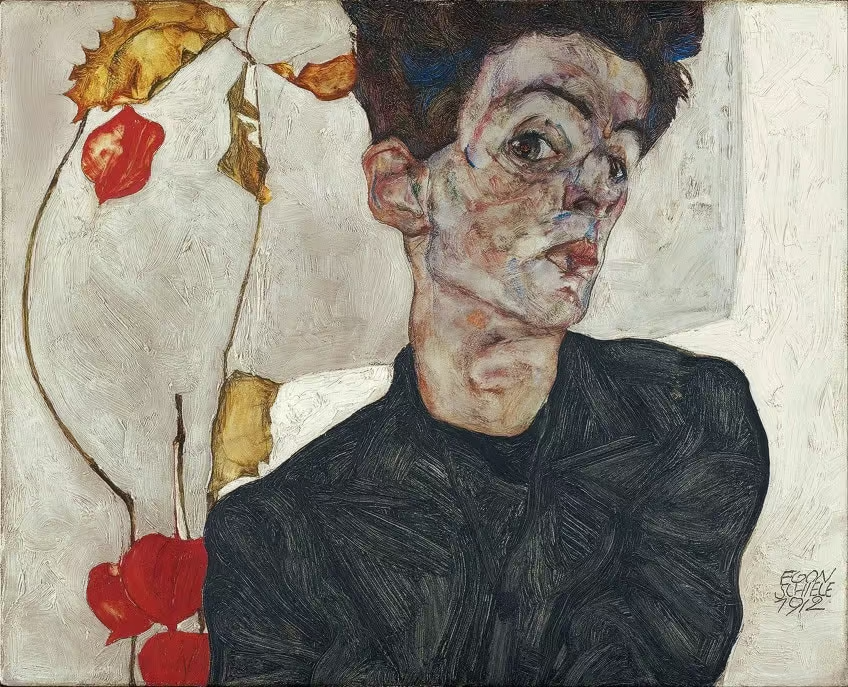 Self-Portrait with Chinese Lantern Plant (1912) by Egon Schiele; Wikimedia Commons
“The superior thing … was to be late. Lateness showed that serene contempt for the illusion we call time which is so necessary to ensure the respect of others and oneself. Only the servile are punctual.”
Rose Macaulay
For some people, having punctuality drilled into them from a young age can feel enormously pressurising. Whilst they may grow up being obediently and obsessively early, some may also spend their lives in a state of defiant, rebellious lateness and disdain for the ‘inferior’ on-timers.
“Punctuality is the virtue of the bored.”
Evelyn Waugh
If there is some difficulty in expressing feelings openly, being late can be a way of dealing with anger. Passive-aggressive it may be, but it certainly is a way of powerfully ‘getting one’s own back’ on those who may have angered the late arrival, in the past or present.
- Control issues
 Anna Berg. Kommer du ej Snart (Aren’t you Coming Soon?) 1929.Wikimedia Commons
“Maybe it’s because he never had any control over what was happening to him as a boy. Being late was somehow a way of taking charge.”
Jan Karon
“Always late: thus I make you the prisoner of my freedom.”
Mason Cooley
In a highly manipulative way, being late can make a person feel more in charge, as they are aware that others have to wait for them. People with issues of control can use their own lateness as a kind of passive weapon, preventing others from keeping to their own timetables, and using their own ‘freedom’ to be late as a way of restricting those who are awaiting them.
- Attention seeking/ attention needing
“Arriving late is a way of saying that you are more important than everyone else.”
Anonymous
“The trouble with being punctual is that nobody’s there to appreciate it.”
Franklin P. Jones
By being late, the focus of attention is, inevitably, on the latecomer; the power lies with them in relation to disrupting others’ schedules and forcing them to wait around. Then they can have the opportunity to make a dramatic entrance, having built up a sense of expectant tension in those who await them.
This may be a negative kind of attention, but it often serves the manipulative purpose of distracting the people who wait and getting the tardy person noticed. In a strange way, with all eyes on them as they arrive chronically late, they become special. Perhaps they felt overlooked in childhood?
- Being early

“Magnus deeply disliked people who were early to business meetings. It was just as bad as being late, since it put everyone out, and even worse, people who were early always acted terribly superior about their bad timekeeping skills. They acted as though it were morally more righteous to get up early than to stay up late, even if you got the same amount of work done in the exact same amount of time. Magnus found it to be one of the great injustices of life.”
Cassandra Clare, What to Buy the Shadowhunter Who Has Everything
Being early can cause difficulties too. It may be awkward for the host at a gathering where food is served- nothing may be ready. In an empty room, those who are early can create feelings of awkwardness for hardly-prepared hosts with these solitary guests.
As the above quotation points out, being early in a work situation can also be a problem for colleagues. They might resent the ‘righteousness’ of the early bird, which they regard as an unmerited and undeserving quality, as they all tend to achieve the same amount of work, regardless of their time schedule.

Image: Pexels.com. Sharath G.
Perhaps, whatever we do, there will always be issues and, in reality, people will continue to relate to time in many different ways. Maybe it is hard to get it just right…
“If you’re early, you’re anxious; if you’re on time, you’re obsessional; if you’re late, you’re angry”
(Source unknown)
In our lives, what we might aim for is a way of being that leaves us feeling the most comfortable, the most at ease with ourselves and others. Repeatedly being early may give us too much time, meaning that we have to hang around, whereas being late can be stressful and anxiety-producing. Perhaps finding a middle course is difficult to achieve for many, but the importance of feeling relaxed about the way we handle time, whilst respecting other people’s schedules, cannot be over-emphasised.
 La Pendule Noire, Paul Cézanne.1869-71. Wikimedia Commons
“Sooner or later, I’ll be punctual.”
Ashleigh Brilliant
© Linda Berman
Very interesting take on punctuality, best to be around on time !
Thanks Leslie. Yes I do agree!
Nice piece on waiting, Linda. As usual, your skill as an art curator is above and beyond. The one thing I wondered while reading was to hypothesize role reversals. That is, how would a chronically late person feel about being chronically held up waiting for another chronically late person? In short, a taste of one’s own medicine. I confess I’m a chronically early person, so my bias shows accordingly. Contrast what looks like an unsettling anxiety or resentment of the always late person having to endure the lateness of another just like him/herself with the situation of two early people, which to me, is an opportunity to relax, chat, catch up while you both wait, (as one is used to doing) a couple of comrades of punctuality.
Thank you Bob. Good to hear from you and I like your question about keeping a late person waiting! Not sure of the answer but would be interested to know. I agree that being early can be a good thing. So glad you like my art selections. 🤗