
1. Commitment is not clear-cut
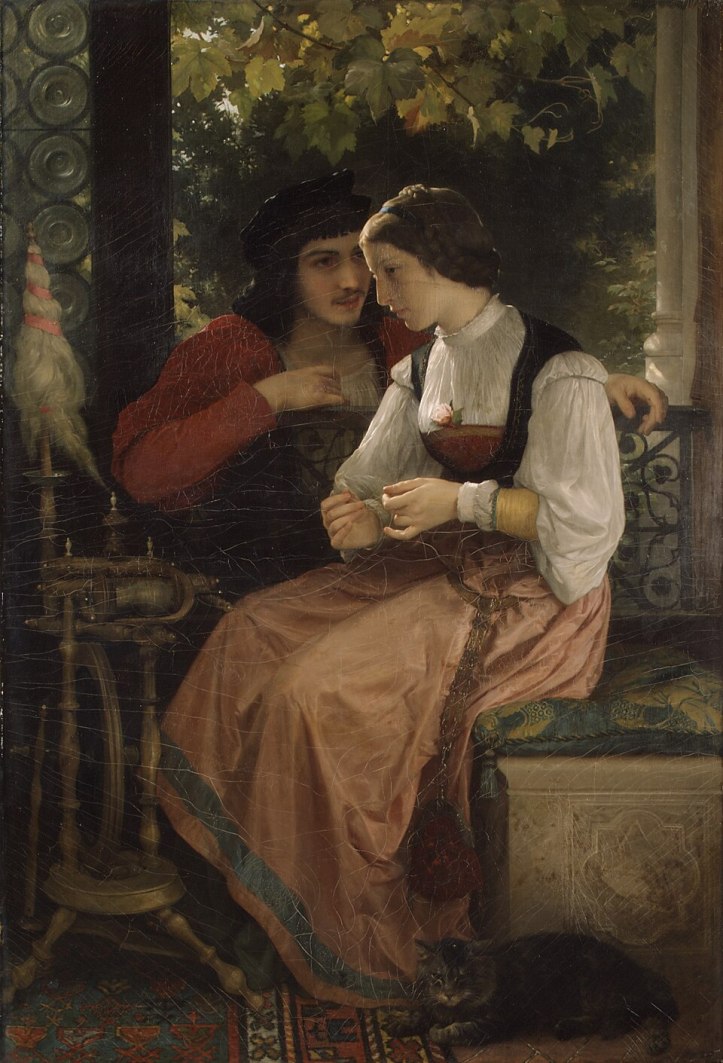 William-Adolphe Bouguereau. The Proposal (1872)
“The relationship between commitment and doubt is by no means an antagonistic one. Commitment is healthiest when it is not without doubt but in spite of doubt.”
Rollo May
If we expect commitment to be clear-cut and simple, then we are not recognising something important… the fact that commitment, inevitably, also means we will, or should, experience doubt. As the quotation tells us, having doubts will imply that our commitment is healthy. What is the meaning of this statement?
Nothing in life is certain, and however thoughtfully chosen are our commitments, decisions, and allegiances, they will sometimes appear questionable and uncertain. Doubt and uncertainty are closely related. Allowing these thoughts and feelings to surface in our minds can mean that we will be able to reflect on different sides of any issue and develop flexibility and originality in our thinking. Making space and time for contemplation, for considering others’ viewpoints, for questioning, or even just waiting for an answer to come, gives us the chance to weigh up situations, rather than jumping into certainty. This is a much healthier way of thinking than appearing all-knowing or excessively sure of oneself.
“Doubt is one of the names of intelligence.”
Jorge Luis Borges
 Emil Orlik – Capriccio with Gilded Fan [1907] Gandalf’s Gallery, Flickr.
“Doubt is often the beginning of wisdom.”
M. Scott Peck
Can doubt help us develop wisdom in our ways of thinking? Are there dangers in not allowing ourselves to doubt? The philosopher and writer Bertrand Russell certainly thought so and said this in no uncertain terms:
“The fundamental cause of the trouble is that in the modern world the stupid are cocksure while the intelligent are full of doubt.”
Bertrand Russell.
If we are shut inside an entrenched, doubt-free, ‘cocksure’ mindset, we are constrained by our own restricted, dichotomous worldview.
Having true commitment does not mean that we will maintain a constant level of feeling in this area. We will find that some days we do not have the same energy for our tasks as we do on others, and, as I have mentioned, we may experience real doubts and uncertainties about the focus we have chosen. We may sometimes feel hampered by an apparent lack of progress, or a feeling of having less commitment than usual.
 Honoré Daumier. c 1870 Retour du Marché. Wikimedia Commons
“It does not matter how slowly you go as long as you do not stop.”
Confucius
We all progress at a different pace and in different ways. Confucius, however, underlines the importance of keeping on keeping on, even when we feel sluggish, doubtful or lacking in energy.
“Commitment is an act, not a word.”
Jean-Paul Sartre
How to define commitment? The words of Sartre imply that it is about doing, about acting, and it does not merely consist of high-sounding intentions and promises. It is easy to state one’s desire to be ambitiously committed, but it is through action that we reveal our real commitment, which is about a clear decision and a genuine pledge to loyally dedicate oneself to something important.
2. Commitment means choice, focus…and courage
 Amedeo Modigliani – Elena Povolozky [1917] Gandalf’s Gallery, Flickr.
“Freedom is not the absence of commitments, but the ability to choose – and commit myself to – what is best for me.”
Paulo Coelho, The Zahir
Sometimes it might appear that commitment is trapping or restricting; however, once we have decided ‘what is best for us’ we can feel at liberty to be creative, knowing that our direction has been chosen, and that we can focus on this choice with a freer mind.
Making a mindful and thoughtful choice about where and how we want to commit ourselves will take time and consideration, in order to be discerning and wise; ultimately this will give us power and the ability to act.
Having too many choices, and constantly perusing and thinking about these choices, can ultimately be stultifying and restrictive in itself. Keeping all our options open may initially be a good thing, but, if decisions are not made, we may feel overwhelmed. Constantly weighing the alternatives can feel superficial and exhausting; once decisions are made, then commitment and more in-depth work can really begin.
Continual difficulty in making a decision can indicate fear, which will cause us to dither and hesitate. If we do not make our own choices and commit to them at some point in life, we may end up feeling lost and ‘at sea.’
“I’m afraid of committing myself,” she thought to herself. She wanted to follow all possible paths and so ended up following none.”
Paulo Coelho, Brida
Choosing and committing ourselves to taking new paths in life involves coping with uncertainty and moving on into the unknown, but without taking such risks at some points in our life, we would remain static. The choice really is ours, and this often feels like a profound responsibility.
“The road ahead is not some predetermined path that I am forced to tread, but it is a rich byway that I can help create.”
Craig D. Lounsbrough
Finding our own path is about knowing who we are, what we want in life and what is the direction of our interest, our passions and skills. In what ways can we can contribute most to the world around us? We will all, inevitably, stumble, but these ‘falls’ may be the times in our life when we learn the most, even though they may feel like dark periods.
“There are no wrong turnings. Only paths we had not known we were meant to walk.”
Guy Gavriel Kay
Choosing a path in life takes courage; it is, inevitably, a risk. However, we will never know which direction in life is the ‘right’ one for us, unless we try it, and make the brave decision to move into new commitments.
Fearing making the ‘wrong’ decision can be paralysing and stressful; being in a prolonged state of indecision can make our lives miserable. We worry that we will miss promising opportunities. If we are expecting to commit ourselves only to the ‘perfect’ decision, we will be waiting forever.
Feeling indecisive is unpleasant and unsettling; as we vacillate between options, it can, indeed, be scary to contemplate the consequences of any decision. Do you stay or leave? Do you buy this house or the other one? Do you apply for this local job or the one in the next town with more money? Do you get married or live together? Do you say something or keep quiet? Do you make no decision at all?
“When you have to make a choice and don’t make it, that is in itself a choice.”
William James
Decisions are rarely black and white, life is just not that simple; our emotions and our rational thinking skills are both involved; we need to be able use a combination of our imagination and our analytical abilities.
Of course, making choices will mean saying ‘no’ to other options; we will need the self-discipline to remain true to our choices and resist the lure of alternatives. Staying with a focus demands that we are dedicated and passionate enough about the choice we have made.
Passion for one’s work, relationship, or other focus is a real bonus, helping us to maintain commitment and purpose, even when things are very tough. Finding real meaning in one’s chosen commitment and developing firm objectives will inspire us to keep on being creative and achieving more, whatever our choice involves.
If we are true and faithful to ourselves, to our ideals, beliefs and aims in life, then we will most likely feel inspired to persevere with whatever we have chosen to dedicate ourselves to.
“Long before morning I knew that what I was seeking to discover was a thing I’d always known. That all courage was a form of constancy. That it is always himself that the coward abandoned first. After this all other betrayals come easily.”
Cormac McCarthy
With continued hard work and some past results and successes, we will also likely develop the self-esteem and confidence to know that we can succeed eventually and that what we are doing is valuable and appreciated by others.
We can then learn to offer ourselves the requisite care and comfort to carry on during difficult times.
“Courage doesn’t always roar. Sometimes courage is the quiet voice at the end of the day saying ‘I will try again tomorrow.'”
Mary Anne Radmacher
Courage is having the mental and physical strength and tenacity to carry something through, despite opposition and even when you know the odds are against you. It can involve being fearful of pain, uncertainty, scandal or danger, yet still being brave and persevering.
In spite of the risk of personal loss, having the necessary courage and the belief that what you are doing is right for you and for others is essential if we wish to remain committed.
3. Commitment involves both the head and the heart
 The Sower at Sunset — Vincent van Gogh. Wikimedia Commons
“I don’t own my emotions unless I can think about them. I am not afraid of feeling but I am afraid of feeling unthinkingly. I don’t want to drown. My head is my heart’s lifebelt.”
Jeanette Winterson
It is important, when making any commitment, to use all parts of ourselves, and certainly to engage both our thinking and feeling powers. Winterson’s words highlight the fact that we need these two important aspects of ourselves, and this is especially true when we make big, committed decisions, whether these relate to work, a skill, or another person.
“The heart has its reasons which reason knows nothing of.”
Blaise Pascal
To commit oneself to something or someone, we need to feel the ‘right’ feelings, to sense that we are going in the best direction for ourselves. This is a very basic secret about commitment: that we need to have the requisite resilience and passion to maintain a sense of purpose, to see us through and help us to endure the difficult, doubting times that, inevitably we will come across as we follow our committed path.
In addition, we will be aided by the logical parts of ourself, making judgements and thinking through the situation, and our choices, in a rational and sensible way, as far as is humanly possible. Our thinking self adds the necessary stability and structure to any decision based on the heart.
 Pierre Bonnard (1867-1947), Misia Godebska Writing (c 1910).
“Without commitment, you cannot have depth in anything, whether it’s a relationship, a business or a hobby.”
Neil Strauss
© Linda Berman