
- What is magical thinking?
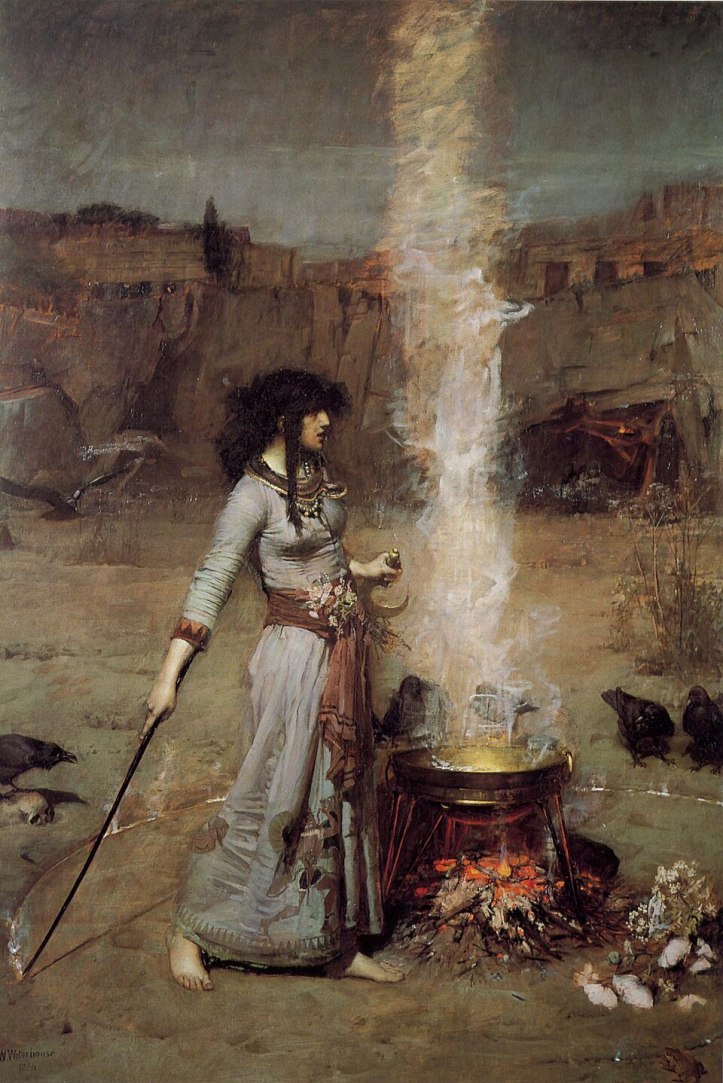 John William Waterhouse: The Magic Circle. 1896. Wikimedia Commons
“We tell ourselves stories in order to live.”
Joan Didion
- What is magical thinking?
‘Magical thinking’ is a psychological mechanism, which may be defined as believing that our wishes, rituals, actions or thoughts can change reality. This kind of thinking involves the notion that, merely through wanting something to happen or to be true, we could magically bring about what we desire, without this being linked to the usual principle of cause and effect.
We human beings are natural pattern-seekers, making links between apparently unconnected events. Many of us will remember the childhood game of not stepping on lines in the pavement to avoid something bad happening.
Our minds often try to form connections where, in reality, there are none; how many of us feel that certain objects or clothes might bring us good or bad luck, that a piece of jewellery has deep sentimental meaning, or that knocking on wood might ward off bad things?
- Some reasons behind this psychological defence
Why do we sometimes engage in magical thinking? Often, this occurs as a coping mechanism in relation to feeling powerless, perhaps in response to great loss, stress or traumatic events. Persuading ourselves that we do possess the ability to alter what is happening, when in fact we are helpless to change things, can be a defensive way of managing thoughts and feelings that overwhelm us with a sense of hopeless impossibility.

The Magic Crystal. Frank Bernard Dicksee (1853–1928) Lady Lever Art Gallery.
“I was thinking as small children think, as if my thoughts or wishes had the power to reverse the narrative, change the outcome.”
Joan Didion. A Year of Magical Thinking
Magical thinking can be a kind of denial of the fact of, for example, someone’s death, and, as Didion says, there is sometimes a wish in the grieving person to alter what has happened in some sort of magical way. Can they somehow make the lost one return, willing them to be alive again, even just for a moment? If they really try to address the dead loved one, might they perhaps talk back?
Could the deceased somehow be conjured up again, or can some kind of contact, even symbolic, be discovered? Can that white feather that has just magically drifted down from the heavens really be emanating from the wings of the angel they have since become?
These, and other forms of magical thinking can be a comforting and necessary part of the grieving process. Wanting to control the painful reality of such loss is a normal and frequent reaction to a highly unacceptable truth. Such magical thinking helps to calm and slow the realisation of the loss of a loved one, giving the bereaved person some time and space to come to terms with the painful reality of their loss.

Author Petr Vodička. VanDyke. Feather. 2008. Wikimedia Commons
- Magical thinking as a coping mechanism
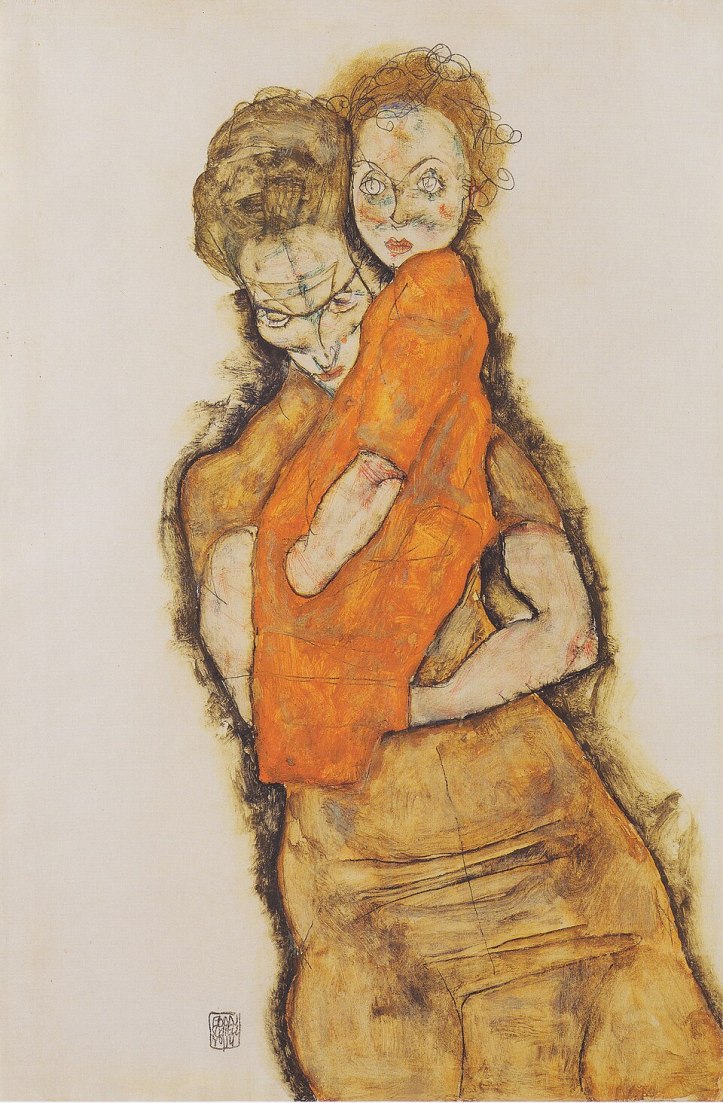 Egon Schiele – Mutter und Kind – 1914. Wikimedia Commons
“Escape from reality. In some instances, dissociation induces people to imagine that they have some kind of mastery over intractable environmental difficulties. Dissociation is often implicated in magical thinking or self-induced trance states. This aspect of dissociation is frequently found in abuse survivors. It is not uncommon for abused children to engage in magical thinking to retain an illusion of control over the situation …”
Marlene Steinberg
This is an important quotation, in that it encapsulates the desperate need for some kind of escape from the hellish pain of abuse; by engaging in magical thinking, the survivor creates a way of gaining a sense of control, even though the situation is actually out of their control. Their only way of bringing about some feeling of control is within their own heads.
Many abuse victims dissociate from what is happening when they are abused; this ‘zoning out,’ this escaping from reality, can be a necessary coping mechanism when things are extremely and unbearably traumatic.
However, if dissociation and magical thinking persist into life in general, they can be destructive, in that they can lead to chronic people-pleasing, (magically thinking that pleasing others will make things right) OCD, and a general escape from the daily reality that life can be hard and painful at times. Defences that protected the survivor from extreme trauma can become part of a routine of existing in a life that gives them only false hope, as they will be depending on worn-out ways of trying to achieve comfort and safety through magical, and outdated, methods.
These may have been necessary during traumatic times, but, as an adult, with an opportunity to have one’s own choices and agency, they are obsolete and destructive and can be debilitating in the long run.
“I think my quarry is illusion. I war against magic. I believe that, though illusion often cheers and comforts, it ultimately and invariably weakens and constricts the spirit.”
Irvin D. Yalom, Love’s Executioner and Other Tales of Psychotherapy
Such patterns of behaviour can remain long after the trauma has subsided. Having therapeutic help can be essential in order to bring about change and more healthful ways of thinking. This can also help rid oneself of the tendency to need the ‘safety’ of magical thinking when it is, in reality, distorting truth and reality; the ‘control’ that much magical thinking brings is illusory and will only interfere with attempts to construct a growthful life.
“Constrictive symptoms also interfere with anticipation and planning for the future. Grinker and Spiegel observed that soldiers in wartime responded to the losses and injuries within their group with diminished confidence in their own ability to make plans and take initiative, with increased superstitious and magical thinking, and with greater reliance on lucky charms and omens.[134] Terr, in a study of kidnapped schoolchildren, described how afterward the children came to believe that there had been omens warning them of the traumatic event. Years after the kidnapping, these children continued to look for omens to protect them and guide their behaviour.”
Extract from Judith Herman. Trauma and Recovery. The Aftermath of Violence-From Domestic Abuse to Political Terror
- Superstition and ritual

Ernest L. Blumenschein: Superstition. 1921. Wikimedia Commons
“You will search the world over and not find a nonsuperstitious community. As long as there is ignorance, there will be adherence to superstition. Dispelling ignorance is the only solution. That is why I teach.”
Irvin D. Yalom, The Spinoza Problem
Many superstitions and rituals can be part of daily life and may bring real comfort and a feeling of safety. As long as they do not take over and become too big in our lives, they can be ways to help dispel minor anxieties and give feelings of safety and confidence. For example, crossing the fingers or wearing a ‘lucky’ charm can increase self-assurance and help someone feel calmer in some stressful situations. Whilst such beliefs may be irrational, and whilst we often know this whilst we are carrying them out, we do still practise them, ‘just in case’ there is a chance they might work!
However, if these rituals or superstitions become compulsive, then they can rule and take over our lives in ways that are not helpful. The psychotherapist Irvin Yalom has long worked on challenging what he sees as the ignorance of superstition, as his words above describe. Such superstitions often have fear at their root, and rely on erroneous beliefs in the links between bad luck and, for example, breaking a mirror or walking under a ladder.
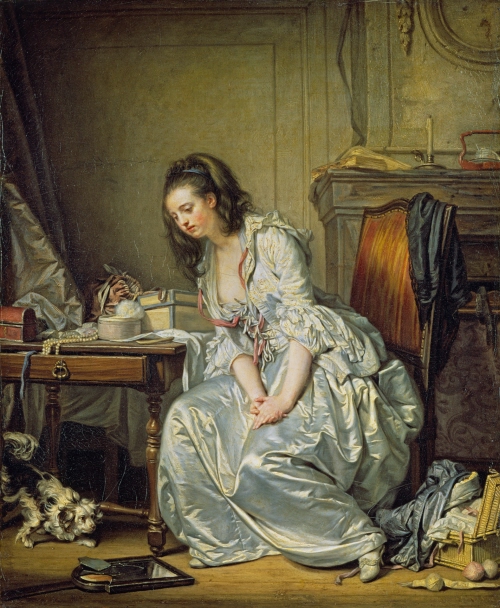
c. 1763 The Broken Mirror by Jean-Baptiste Greuze. Wikimedia Commons
- Magical thinking and creativity
It is important to remember that magical thinking can, at times, also be helpful and can aid creativity. It uses the imagination, and doing this can be enormously important, to both children and adults. If we are able to use a kind of magical thinking to cross rigid boundaries, challenging set ways of thinking and clichéd behaviour, moving outside the usual parameters of thinking, we can sometimes be increasingly innovative and can free ourselves from the inhibitions and restrictions that may hinder creativity and discovery.
We all need the freedom to allow ourselves to play with ideas, liberating ourselves from the usual constraints, venturing into the realms of the impossible or the absurd. Such playing will, inevitably, involve magical thinking, where we will find we are engaging in a kind of fantasy world that can only help us to become more creative and original.
This kind of thinking began when we were very young, when the world was an exciting place, full of imagination and magic. When we were small, our imagination knew no bounds, and life was exciting. If we can allow ourselves to recapture and hold on to some of that childhood wonder, it can lead to all kinds of productive activity.
How liberating it can be to allow ourselves to be imaginative, exercising this part of our psyche, which we may not easily do in our daily lives! Something will be released inside us, a lack of self-consciousness and a more fluid, magical ability to be inventive, a skill that can be highly relevant to work and creativity in our daily adult life.
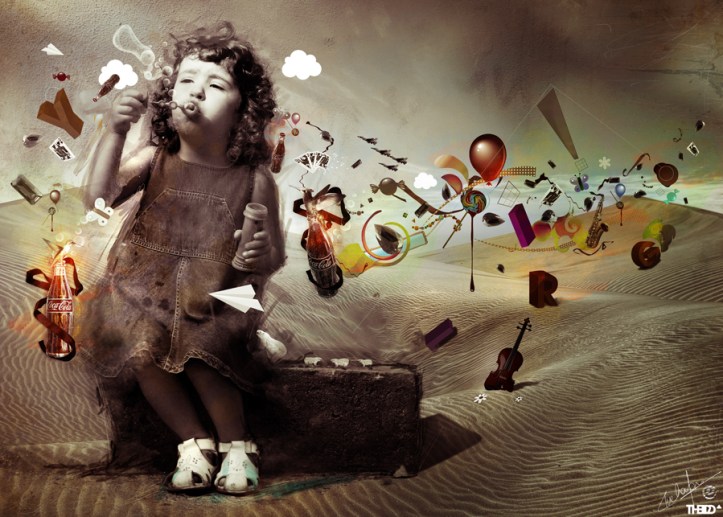 IMAGINATION by archanN. Life in the minds of children. Author: Mehdinhom. 2012. Wikimedia Commons
“There are some people in this world who have magic in them, whose very presence makes you happier. Some of those people, it turns out, are children.”
Adam Gidwitz
Einstein valued his imagination enormously and as he worked, he played with ideas in his head that he called ‘thought experiments.’
“Play is the highest form of research.”
Albert Einstein
Whilst Einstein’s through experiments were unlike magical thinking in that they were firmly based on science and logical validation, they did overlap in terms of a shared use of extensive visualisation. They involve taking huge steps into the realms of the imaginative. In addition, both these ways of thinking focussed on moving outside the boundaries of convention and the accepted norms of their time.
“The most beautiful experience we can have is the mysterious. It is the fundamental emotion that stands at the cradle of true art and true science. Whoever does not know it and can no longer wonder, no longer marvel, is as good as dead, and his eyes are dimmed.”
Albert Einstein
The words of Einstein remind us how crucial is mystery in our lives, so that we may be awe-inspired and filled with wonder at the magic and marvels of our universe.
“We humans can be well trained to pay attention through the lens of beauty and imagination. We can learn from Einstein the value that comes from losing ourselves in the joy and magic of the waking moment, alive to the potentials to create and discern the harmonious arrangements all around us. Even if we might be making things up, Einstein showed us that a little bit of magical, inspired thinking might be just what we need to make some kind of clear sense of the world.”
From: My dear Albert Einstein, what’s happening to you? © Sarah Binns. Substack. Altered Natures. Link: https://civicinterplay.substack.com/p/the-many-afterlives-of-albert-einstein.
© Linda Berman
Interesting Linda as always. Would religion be partially magical thinking ?
Leslie
Thanks so much Leslie. I guess that’s a controversial question depending on our ways of thinking! 🤔