
Quote 1
 Karl Hofer – Girl at the Table with Vase [1930] Gandalfs Gallery, Flickr.
“What others say and do is a projection of their own reality, their own dream. When you are immune to the opinions and actions of others, you won’t be the victim of needless suffering.”
Don Miguel Ruiz, The Four Agreements
Many times, when we feel attacked unfairly by others, we may need to remind ourselves that, in actuality, we are not the target. Projection of other people’s realities onto ourselves can feel barbed and painful, and being unjustly accused can be frustrating and hurtful.
Whilst we do need to become able to accept and learn from constructive criticism with positivity and gratitude, we must also remember that unfair attacks can be a sign of others’ inadequacy, which they might try to dodge by projecting onto the people around them.
Finding fault can be a way of deflecting the focus from themselves, enabling them to feel superior to and above others, who are conveniently regarded as being full of imperfections. Having a sense of superiority over others may indicate an inner lack of confidence, despite the high-handed façade. People who criticise and condemn others may also be envious of their achievements.
“The way people treat other people is a direct reflection of how they feel about themselves.”
Paulo Coelho
If people continually treat others badly, then they are likely to feel unhappy and unfulfilled inside themselves. Lack of self-awareness means that these feelings are largely repressed and it then often happens that, in order to rid themselves of bad feelings, these are projected onto another. It is easier to point the finger of blame at someone else for their perceived bad qualities than to own these in the self.
When we hate another person, we may be revealing much about ourselves. It is highly important to explore our prejudices and biases; often we may reject a quality that we perceive in another that we do not admit to in ourselves.
“The best political, social, and spiritual work we can do is to withdraw the projection of our shadow onto others.”
Carl Jung
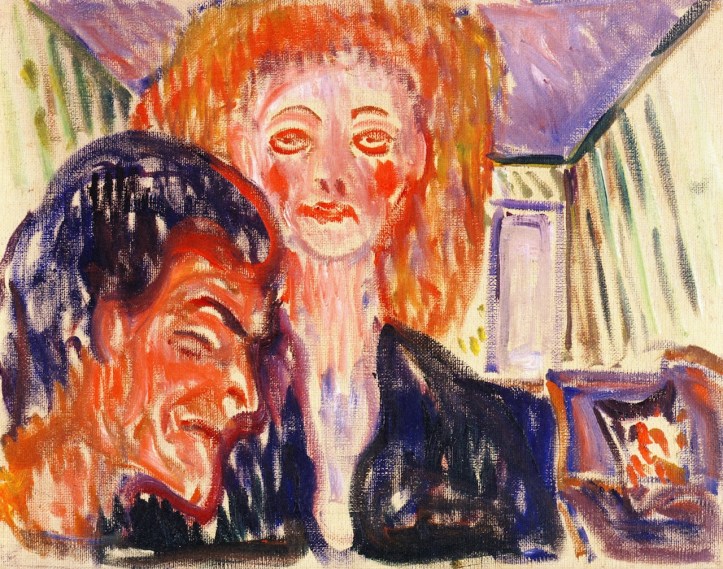 Edvard Munch – Hatred. 1907. Wikimedia Commons
“How easy it is, how dangerously easy it is to hate a man for one’s own inadequacies.”
Grace Metalious
“Often we hate in others the thing which we fear in ourselves; or we hate because the other person raises to our consciousness some fault or inadequacy which we would prefer to have remain unconscious, and therefore without power to disturb our self-complacency.”
Frances G. Wicked
“People who are hurting will hurt others. Their nastiness has nothing to do with you and everything to do with their own internal battles.”
Unknown
Quote 2

Criticism. Julio Ruelas. Engraving. 1907. Wikimedia Commons
“When we speak evil of others, we generally condemn ourselves.”
Publius Syrus
Destructive and negative criticism from another can sting and hurt; it is important not to take it too much to heart, though this can be hard, and it is often easier said than done. Developing the ‘immunity,’ mentioned in Quote 1 is no easy feat, but perhaps we can make an effort to go some way along that road.
It really is true that the critical person actually condemns themselves, but nevertheless, it can be very wounding and undermining to be maliciously criticised. It is important to be able to recognise and identify criticism that is toxic and to separate this from that which may actually be helpful.
In the face of scathing and demeaning remarks, however, remaining as calm and as dignified as possible is recommendable, so as not to escalate the issue or to be goaded into anger. Ignoring the critical comments, as far as is possible, might be the best way of handling the situation.
This will mean pausing to give yourself time to think, to reflect on what has happened and deal with the feelings engendered in you.
 Ernest Joseph Bailly – In Contempt of Hate. 1792. Wikimedia Commons
It may mean leaving the room if necessary, in order to compose yourself. Shooting from the hip would only replicate the critical other’s reaction. Perhaps you can be the bigger person. The hope would be that you could move on, showing some grace, regardless of what has just been said.
If destructive criticism is not something you can walk away from, and if it is happening repeatedly, then it may be time to try to get it stopped, perhaps with the support of others, depending on the circumstances.
Ask yourself: How much do you actually respect that other destructively critical person anyway? Do you really have to please everyone by taking on board even their barbed comments?
“Don’t spend your life believing a story about yourself that you didn’t write that’s been fed to you – that simply you’ve accepted, embedded and added to. Let the story go and there beneath is the real you…and your unique gifts, heart and path that await you.”
Rasheed Ogunlaru
“Do what you feel in your heart to be right – for you’ll be criticized anyway. You’ll be damned if you do, and damned if you don’t.”
Eleanor Roosevelt
Criticism is certainly a part of all our lives. We all need to come to terms with the difficult fact that there always will be those who want to give us negative feedback, or to throw a spanner in the works of our lives.
“Whatever you do, good or bad, people will always have something negative to say.”
W.H. Auden
Random criticising of others does not involve rational or clear thinking. It is impulsive, unthinking behaviour.
“Any fool can criticize, condemn and complain and most fools do.”Benjamin Franklin
Quote 3
 Grant Wood – Woman with Plants [1929] Gandalf’s Gallery. Flickr
“Don’t be distracted by criticism. Remember, the only taste of success some people have is when they take a bite out of you.”
Zig Ziglar
It can be difficult not to take unfair criticism on board. In order to protect ourselves, it is important to have the confidence to realise that the criticism, if not valid, is not our issue, in reality.
“The opinion which other people have of you is their problem, not yours.”
Elisabeth Kubler-Ross
Allowing ourselves to be absorbed into another’s view of us indicates that we might have weak personal boundaries, and that our defensive ‘skin’ is not thick enough, but porous and thin.
Quote 4
 James Carroll Beckworth – Breck [1891] Gandalf’s Gallery, Flickr.
“If you are not afraid of the voices inside you, you will not fear the critics outside you.”
Natalie Goldberg
This quotation is important in that it reminds us to pay attention to the voices inside ourselves that may be giving us outdated, negative messages, and holding us back from feeling confident and hopeful. Where do these gloomy inner voices originate? Often, the roots of these unkind messages to ourself reach deep into the past. Perhaps we were criticised, or compared to our siblings or friends in childhood and found wanting….
Eventually, the critical voices of others in the past can become internalised- they are then a part of us – and we play the same messages over and over to ourselves inside our heads. The internal nagging voices have been absorbed from external criticisms that have been taken into ourselves.
Now this is no longer an external rebuke, it has been assimilated by us and it has metamorphosed into our own voice, fooling us and in disguise, appearing to come from ourselves, telling us that we are no good and that others are better than we are.
It is important to develop awareness of such inner messages, so that we can neutralise and disable them, consigning them to the past. If we have been constantly criticised, abused or hurt in childhood, it can be harder to develop enough personal power and confidence to ward off others’ malice.
If we are able to replace such voices with ones that speak to us honestly of our personal value, we can discover who we really are and develop self-respect. We will then have no need to torment ourselves with put-downs or distressing criticisms, knowing that we are not the target.
 Georg Schrimpf – Girl with Dog [1924] Gandalf’s Gallery. Flickr.
“No one can make you feel inferior without your consent.”
Eleanor Roosevelt
“You can’t let praise or criticisms get to you. It’s a weakness to get caught up in either one.”
John Wooden
“A creative life cannot be sustained by approval any more than it can be destroyed by criticism.”
Will Self
Not allowing oneself to be affected by others’ views of us and their projections takes courage and resilience.
“The final proof of greatness lies in being able to endure criticism without resentment.”
Elbert Hubbard
Quote 5

Painted Target, Litovel Museum. 1875. Czech Republic. Photo taken by Jan Kameníček, Wikimedia Commons
“That which does not kill us makes us stronger.”
Friedrich Nietzsche
As I have said above, it does hurt when someone tries to make us the target of unjust and barbed comments. Painful though this is, learning to build our defences and boundaries can be immensely enriching and character-building.
“The unending paradox is that we do learn through pain.”
Madeleine L’Engle
“Someone I loved once gave me a box full of darkness. It took me years to understand that this too, was a gift.”
Mary Oliver
The poet Mary Oliver discovered that, in time, out of this strange gift- a box of darkness- came some goodness, some light. This can be in the form of new insight, learning, friendship or life experience. Such awareness of the good that may come from bad is part of a process. This is a process of resolution, of healing, of working through our painful darknesses in life and moving into something lighter and brighter.
People who have experienced suffering may develop increased empathy for others, sharing their load and understanding more deeply the vicissitudes of the human condition. Learning to defend oneself against being targeted by others is a highly important life skill, and we will be all the wiser-and very much more peaceful inside- for acquiring it.
“Out of suffering have emerged the strongest souls; the most massive characters are seared with scars.”
Kahlil Gibran
© Linda Berman