
-
Our fear of self-discovery
 Portrait of a Woman (Jeanne) (1913) by Jean Metzinger
“Aren’t most of us afraid to look at ourselves? We might discover unpleasant things, so we would rather not look. We prefer to be ignorant of ‘what is’.”
J. Krishnamurti
Having the feeling that something is on our mind, but being reluctant to face it, can be uncomfortable and disturbing. We may find we are keeping busy, distracting ourselves, and avoiding facing the niggling feeling that something is not right inside and needs our attention. We may say we’re ‘fine,’ pretending to ourselves and others that all is well when, in fact, the opposite is true.
What might facing these difficult thoughts and feelings mean for us? Why are we dodging them? What do we fear finding out about ourselves that feels so threatening?
- Feeling afraid to know our own darkness
 Lady Macbeth Seizing the Daggers. Henry Fuseli (1741–1825)
“We have been to the moon, we have charted the depths of the ocean and the heart of the atom, but we have a fear of looking inward to ourselves because we sense that is where all the contradictions flow together.”
Facing uncertainty and contradiction in life can be a scary prospect. Contained in the huge expanse of the universe, floating in a sea of unpredictability, we are, inevitably, beset with uncertainties and events beyond our control. This can be scary, and can fill us with anxiety and a feeling of being powerless.
 Edvard Munch – Sleepless Night. Self-Portrait in Inner Turmoil (1920)Wikimedia Commons
“The psychic task which a person can and must set for himself is not to feel secure, but to be able to tolerate insecurity.”
Erich Fromm
In addition to having to deal with the uncertainty of life, some people are threatened by the very notion of the unconscious and the darkness that may be concealed in the depths of their own psyche. The (unconscious) threat is that they might have to face ‘unknown’ aspects of the self that they do not like, the dark side, their ‘shadow’ side, and the many contradictions within themselves.
That is why contemplating becoming aware of hidden parts of ourselves can feel intimidating. The degree to which this happens varies according to each person’s openness to the inner workings of their psyche.
“There are things which a man is afraid to tell even to himself, and every decent man has a number of such things stored away in his mind.”
Fyodor Dostoevsky
 Rudolf Schlichter – Lady With Red Scarf (Speedy With The Moon) [1933]. Gandalf’s Gallery Flickr
“Poetry may make us from time to time a little more aware of the deeper, unnamed feelings which form the substratum of our being, to which we rarely penetrate; for our lives are mostly a constant evasion of ourselves.”
T. S. Eliot
This quotation alerts us to the way in which we might avoid our deeper feelings, until we are faced with them through a medium such as poetry. Eliot reminds us, however, that reading poetry can be a way of gaining more awareness into who we are, drawing our attention to deeper parts of ourselves, to our motivations and our unresolved issues, to a reality that we evade and avoid.
Some beautiful lines from the poet Wordsworth serve to illustrate Eliot’s point:
The World Is Too Much With Us
“The world is too much with us; late and soon,
Getting and spending, we lay waste our powers
Little we see in Nature that is ours;
We have given our hearts away, a sordid boon!”
William Wordsworth, 1807
Wordsworth is facing us with the fact that we human beings become preoccupied with materialism, wasting the earth’s natural riches, and selling ourselves short.
In similar vein, in Eliot’s own poem The Love Song of Alfred J. Prufrock, he confronts the reader with the trivia of his life:
“I have measured out my life with coffee spoons.”
He also talks of his personal feelings of inadequacy and the way in which the fear of being rejected for revealing the reality of himself means that he constantly wears a social mask:
“There will be time to prepare a face to meet the faces that you meet.”
Art, literature, drama and poetry can all be ways in which we might be helped to discover the reality of self and other; these way of communicating the truth can function as powerful triggers for us, which may stimulate thinking, reflection and memory.

Edvard Munch – Despair (1894) Wikimedia Commons
“Good art wounds as well as delights. It must, because our defenses against the truth are wound so tightly around us. But as art chips away at our defenses, it also opens us to healing potentialities that transcend intellectual games and ego-preserving strategies.”
Rollo May
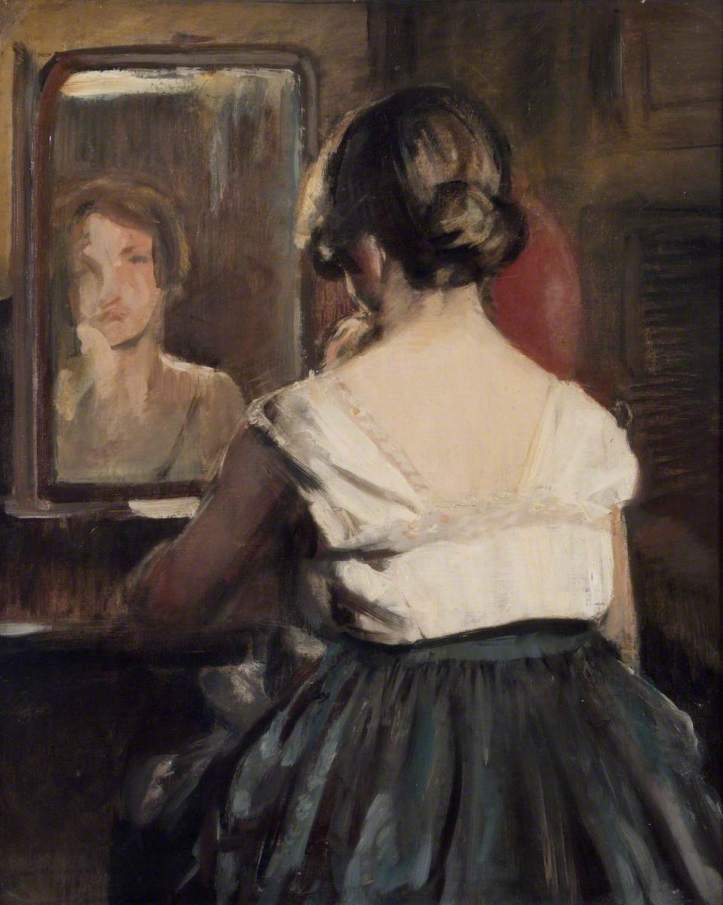 Girl at the Mirror. 1928. David Muirhead.
“It is astonishing the lengths to which a person, or a people, will go in order to avoid a truthful mirror.”
James Baldwin
Some people decide embark on psychotherapy in order to gain more self-awareness; this may involve facing internal, repressed ‘monsters,’ developing insight and understanding, becoming more of a whole, individuated person, having the freedom to be oneself, and the bringing about of real and lasting change…
- Facing the inner darkness
Becoming a better, more fully-rounded person is not about repressing the ‘bad’ aspects of the self. It is related to being more able to acknowledge the less palatable sides of the personality. In this way, others’ darker sides will also be more acceptable.
Posing as perfect angels is unreal and unsatisfactory and will likely lead to unconsciously acting out repressed dark impulses.
Aggression, murderous feelings, manipulative behaviour, are in all of us, and we need to be aware of these aspects of ourselves, so that they can be examined, processed and controlled, rather than given free rein, potentially causing damage to self and others.
We all have them, those aspects of ourselves that we do not like. However, the ‘monstrous’, raging, nasty parts of all of us will become worse if left unacknowledged and unchecked.
 Jean Metzinger – Woman with a Fan [1913] Gandalf’s Gallery. Flickr
“People will do anything, no matter how absurd, to avoid facing their own souls.”
Carl Jung
Unless we ‘make friends’ with our demons and gain knowledge of and mastery over them, they can become out of control. How might we do this? How can we achieve awareness of ourselves, of who we really are?
“You cannot fix what you will not face.”
James A. Baldwin
As mentioned, we might go into therapy, or maybe we will learn in other ways about who we are and what makes us tick. We achieve personal growth through self-reflection, self-questioning and curiosity about our inner world, not through being in denial and wearing masks.
Psychotherapy, group therapy, real conversation with others, meditation, research and reading widely can all help in terms of developing clear and constructive ways of thinking and being.
Finding such new ways involves a willingness to take risks, valuing different viewpoints and not working on this in isolation. An open attitude, a lack of defensiveness and a desire to listen to the views of others will all help towards change and personal growth.
“Face the facts of being what you are, for that is what changes what you are.”
Søren Kierkegaard
“To dare to live alone is the rarest courage; since there are many who had rather meet their bitterest enemy in the field, than their own hearts in their closet.”
Charles Caleb Colton
 Edvard Munch – Summer Evening [1925-27]
“And you? When will you begin that long journey into yourself ?”
Rumi
In order to face who we are and what is happening for us in the deeper reaches of our selves, we need to embark on a symbolic journey of discovery. The above direct and challenging quotation faces us with an important question, for Rumi is referring to the most important journey we can each take… into our own inner world.
“Knowing yourself is the beginning of all wisdom.”
Aristotle
It may be tempting to imagine that wisdom lies outside the self, in great, academic tomes, in encyclopediae, on a library’s shelves, there to be found if only we know where to look. Aristotle, however, makes an important statement, reminding us that wisdom starts, not in the world outside us, but within the self.
” The only journey is the one within.”
Rainer Maria Rilke
How to start this journey? Which direction should we take?
Each journey is different, as we are all unique individuals. The journey can be arduous and painful, for facing these less palatable parts of ourselves can be difficult.
“Transformation is a process, and as life happens there are tons of ups and downs. It’s a journey of discovery – there are moments on mountaintops and moments in deep valleys of despair.”
Rick Warren
The quotation above is referring, of course, to a journey into the self. This is a journey of discovery, one in which we will hope to get to know and ‘transform’ ourselves; it is a moving inwards towards our real selves.
As Warren points out, above, there are times when this journey is full of pain and suffering. To face newly-discovered aspects of oneself is no mean feat and requires considerable ego-strength and courage.
“No one who, like me, conjures up the most evil of those half-tamed demons that inhabit the human breast, and seeks to wrestle with them, can expect to come through the struggle unscathed.”
Sigmund Freud
However, difficult though this struggle may be, it does have its rewards… those of self-acceptance and self-knowledge.
“The unending paradox is that we do learn through pain.”
Madeleine L’Engle

‘The Pains of Hell’ (ca. 1780) by unidentified artist – Museo Nacional de Artes – Mexico
“Do not desperately seek refuge in heaven and delve in blissful ignorance; discover the fires and infernos of hell that have sprung inside of you.”
Forrest Curran
- Fear of rejection from others if we reveal our real selves
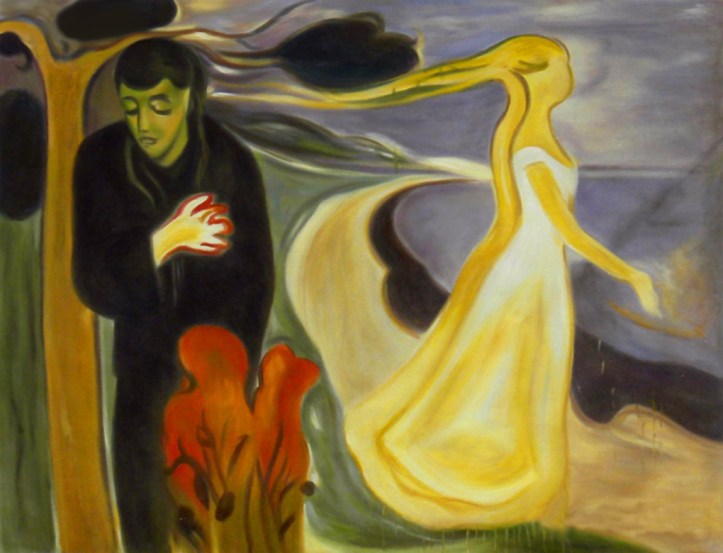 Edvard Munch – Separation (3) 1896. Wikimedia Commons.
“If I reveal myself without worrying about how others will respond, then some will care, though others may not. But who can love me, if no one knows me? I must risk it, or live alone.”
Sheldon B. Kopp
This quotation contains a deep and lasting truth: that we have to take the risk of revealing ourselves because that is the only way in which we can really know we are loved for who we genuinely are…
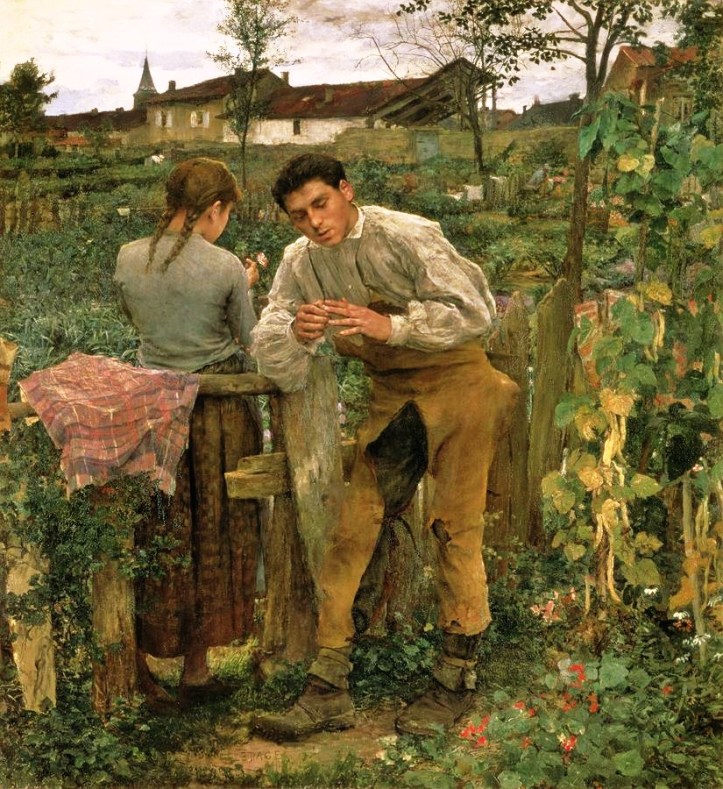 Bastien Lepage L’Amour au Village The Village Lovers. 1882. Wikimedia Commons
“The greatest happiness of life is the conviction that we are loved; loved for ourselves, or rather, loved in spite of ourselves”
Victor Hugo
As children we need to feel loved and accepted by our parent figures; in an adult relationship, both partners’ wishes to be accepted ‘warts and all’ continue; these do not disappear in adulthood. There is still the need to reveal deep and, perhaps ‘unacceptable’ feelings to the other and still be loved.
These feelings may be more complicated than in childhood, less clear and more entangled; nevertheless, adults generally want the other to accept the whole of them… that is, the insecure, angry, shouty, unreasonable parts, which we all have, as well as the loving and giving aspects of their personality. Being ‘loved in spite of ourselves’ is a crucial part of the process of self-acceptance; reflected in the eyes of another, there needs to be some degree of acceptance of who we are as complete, fallible people.
Then, and only then, can we discover the light and the potential within ourselves; perhaps we have also been wary of expressing this light, though fear of our own power…
“It is our light, not our darkness that most frightens us.”
Marianne Williamson
Once we have become aware of the light that exists inside us, perhaps we can use this to help others develop themselves, to bring out their best features. With an awareness that other people’s manner of relating to us may be a product of their own ways of thinking, rather that a direct reaction to us personally, perhaps we can have the confidence to relate to their positive aspects, rather than focussing on their less acceptable parts. This will take courage, but it is worthy of our consideration and reflection…
“People will react to you as a result of their own mindset, rather than as a reflection of your worth. Most people use others as mirrors for their own darkness. If you have been hurt by such people, perhaps you can use these experiences to become a different kind of person—one who reflects the light within others instead of using them as mirrors. Maybe your experiences of pain can lead you to being a great leader, someone who lights up the world. Your most painful struggle is ripe with opportunity.”
Vironika Tugaleva
© Linda Berman